
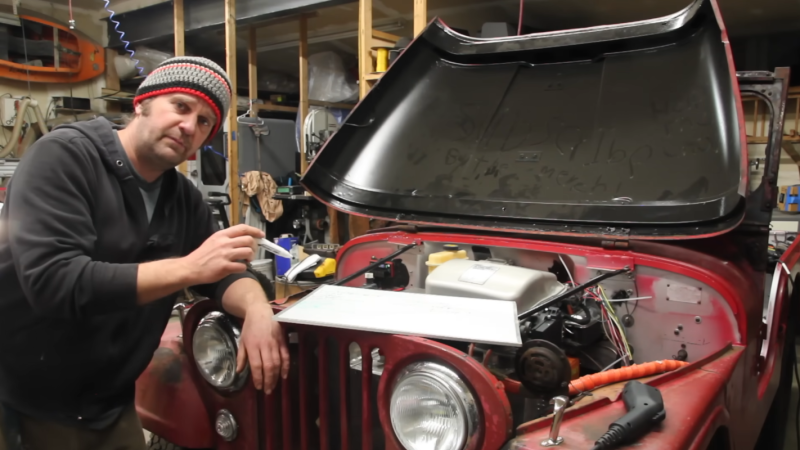
On the list of cars widely regarded as the most reliable vehicles ever built, up there with the Toyota Land Cruiser, the Honda Civic, and the Mercedes W123 diesels, is the unassuming Toyota Prius. Although it adds a bit of complexity with its hybrid drivetrain, its design eliminates a number of common wear items and also tunes it for extreme efficiency, lengthening its life and causing minimal mechanical stress. The Prius has a number of other tricks up its sleeve as well, which is why parts of its hybrid systems are often used in EV conversions like [Jeremy]’s electric CJ-5 Jeep.
Inside the Prius inverter is a buck/boost converter used for stepping up the battery voltage to power the inverter and supply power to the electric motor. [Jeremy]’s battery is much higher voltage than the stock Prius battery pack, though, which means he can bypass the converter and supply energy from his battery directly to the inverter. Since the buck/boost converter isn’t being used, he can put it to work doing other things. In this case, he’s using it as a charger. Sending the AC from a standard EV charging cord through a rectifier and then to this converter allows the Prius hardware to charge the Jeep’s battery, without adding much in the way of extra expensive electronics.
There are some other modifications to the Prius equipment in this Jeep, though, namely that [Jeremy] is using an open-source controller as the brain of this conversion. Although this video only goes into detail on some of the quirks of the Prius hardware, he has a number of other videos documenting his journey to convert this antique Jeep over to a useful electric farm vehicle which are worth checking out as well. There are plenty of other useful things that equipment from hybrid and electric vehicles can do beyond EV conversions as well, like being used for DIY powerwalls.












My dad has a jeep just like this and is rebuilding it. He needs to see this!
Jeep CJs and Wranglers themselves (up until the TJ model line ended in 2006) are also known as being one of the most reliable vehicles ever built.
Converting these to electric is a downgrade, in my opinion, but it’s becoming a popular option as they have a huge under hood area and hardly any accessories that need 12v power.
Why a downgrade?
Electric motors are about the best thing you could want in an off-roader – instant huge torque from zero RPM with very fine control, massive engine braking, the ability to switch direction without shifting gear, super smooth, one moving part, less plumbing, less heat, etc. etc…
Yes batteries are (currently) bulky and heavy but that’s changing rapidly.
Huge YMMV here, but mine: a 1949, an 1951, and a 1971 CJ5, were all maintenance horrors. They were constantly breaking. My 1971, in the mid-80’s, broke more often as a 15 year old car, than my current 1975 little british sportscar breaks as a 50 year old car. The jeeps were fantastic offroad cars and got me into places I would never otherwise have gone in a car, but they also all three broke down and stranded me dozens of times more than any other car I’ve ever owned.
starter motor return spring kept breaking, front ujoints kept failing, clutch linkage pivot cracked, rear driveshaft uj failed, brakes were so bad, emergency brake basically useless, worm/sector steering box repeatedly failed, all the rubber/steel bushings in the rear suspension perished way too early imho, the carter carb float kept jamming against the float bowl and starving the engine, the stupid carb mounting studs snapped off at less than the spec torque, the heat/cold push/pull cable housing mount cracked so it was stuck on full hot, the stupid c-channel frame rusted out, everything rusted out, there were so many holes in the seatpans, I could go on for way too long. tbh I am taken aback by how mad I am remembering cars I haven’t owned in 30 years.
Aside from the challenge, lessons-to-be-learned, and personal satisfaction from the successful completion of a project like this, what us the use-case for an electric jeep?
Drive it up and down the street .. quietly…
Turn it on, drive away without warm up on a frigid day and no stumbles and no constant wrenching/tweaking
Also smog exempt
irritate drill-baby-drill people.
An electric motor setup can be extremely capable for serious off-roading or rock crawling. Excellent low-end torque, precise speed control, and adjustable but solid “engine braking” / built-in vehicle hold.
Depends on implementation, and having enough battery capacity to get out there and back, of course.
The article says it’s for use as a farm vehicle, pretty ideal use case I’d say, it’s never going to be far away from it’s charge point, no need to take it off site to get it refueled, no need to drive particularly fast. 🤷♀️
Having said that, even if it were just a street vehicle it would still be useful, most people don’t actually drive that far in a typical day.
How about an electric postal jeep, right hand drive with sliding doors and the package tray instead of a seat.
I drove a few that had come to the surplus market that the music store used for tuners and service.
The battery could lower the center of gravity of those wobbly jeeps.
Those Prius inverters are legendary on the open inverter forums. Massively overbuilt for the original job and superbly well engineered in terms of fail safes and protections. I’ve seen them wired backwards, shorted out, pushing 5x the rated power, even literally on fire and still spitting out perfect sines.
If you’re into that sort of thing and have a lot of time to kill, you might want to check out Damien Maguire on youtube.