Spy Tech: Conflicts Bring A New Number Station

If you know much about radios and espionage, you’ve probably encountered number stations. These are mysterious stations that read out groups of numbers or otherwise encoded messages to… well… someone. Most of the time, we don’t know who is receiving the messages. You’d be excused for thinking that this is an old technology. After all, satellite phones, the Internet, and a plethora of options now exist to allow the home base to send spies secret instructions. However, the current-day global conflict has seen at least one new number station appear, apparently associated with the United States and, presumably, targeting some recipients in Iran, according to priyom.org.

As you might expect, these stations don’t identify themselves, but the Enigma Control List names this one as V32. It broadcasts two two-hour blocks a day at 0200 UTC and a repeat at 1800 UTC. Each message starts with the Farsi word for “attention” followed by what is assumed to be some header information as two 5-digit groups. Then there is a set of 181 five-digit groups. Each message is padded out to take 20 minutes, and there are six messages in each transmission.

Continue reading “Spy Tech: Conflicts Bring A New Number Station”
An overlay is shown on a topographical map. High points are highlighted in blue. The letters "A" and "B" are shown in red text at two points.

Using A Scientific Satellite For Passive Radar

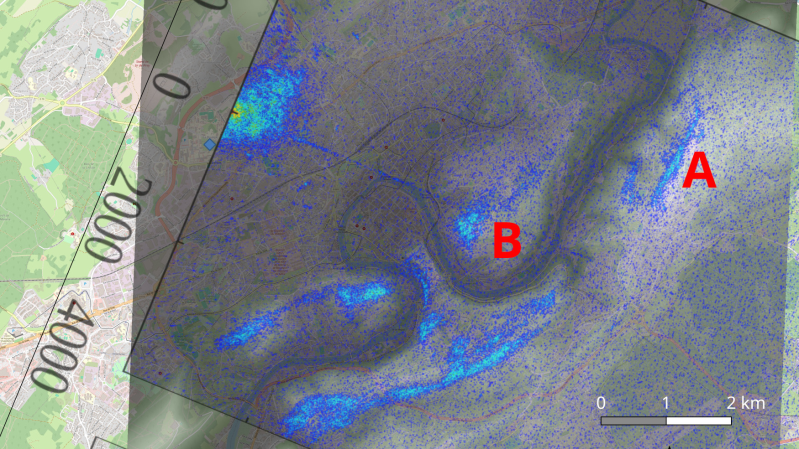
The basic principle of radar systems is simple enough: send a radio signal out, and measure the time it takes for a reflection to return. Given the abundant sources of RF signals – television signals, radio stations, cellular carriers, even Wi-Fi – that surround most of us, it’s not even necessary to transmit your own signal. This is the premise of passive radar, which uses passive RF illumination to form an image. The RF signal doesn’t even need to come from a terrestrial source, as [Jean Michel Friedt] demonstrated with a passive radar illuminated by the NISAR radar-imaging satellite (pre-print paper).

NISAR is a synthetic-aperture radar satellite jointly built by NASA and ISRO, and it completes a pass over the world every twelve days. It uses an L-band chirp radar signal, which can be picked up with GNSS antennas. One antenna points up towards the satellite, and has a ground plane blocking the signal from directly reaching the second antenna, which picks up reflections from the landscape under observation. Since the satellite would illuminate the scene for less than a minute, [Jean-Michel] had to predict the moment of peak intensity, and achieved an accuracy of about three seconds.

The signals themselves were recorded with an SDR and a Raspberry Pi. High-end, high-resolution SDRs such as the Ettus B210 gave the best results, but an inexpensive homebuilt MAX2771-based SDR also produced recognizable images. This setup won’t be providing any particularly detailed images, but it did accurately show the contours of the local geography – quite a good result for such a simple setup.

If you’re more interested in tracking aircraft than surveying landscapes, check out this ADS-B-synchronized passive radar system. Although passive radar doesn’t require a transmitter license, that doesn’t mean it’s free from legal issues, as the KrakenSDR team can testify.

The Hazards Of Charging USB-C Equipped Cells In-Situ

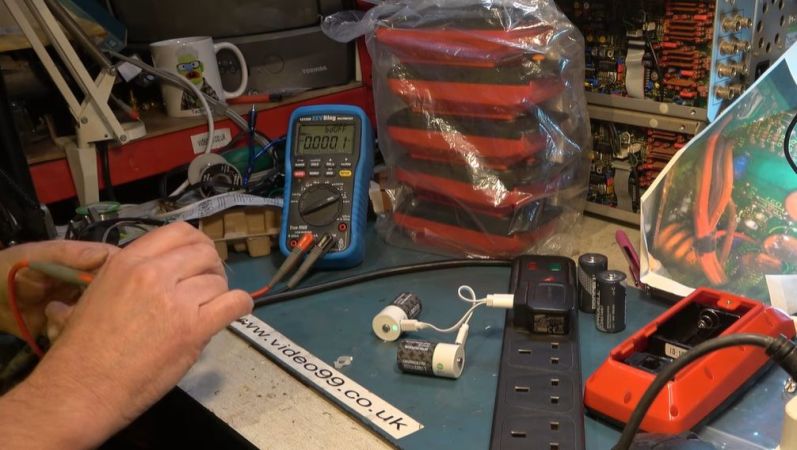
Can you charge those Li-ion based cells with USB-C charging ports without taking them out of the device? While this would seem to be answered with an unequivocal ‘yes’, recently [Colin] found out that this could easily have destroyed the device they were to be installed in.

After being tasked with finding a better way to keep the electronics of some exercise bikes powered than simply swapping the C cells all the time, [Colin] was led to consider using these Li-ion cells in such a manner. Fortunately, rather than just sticking the whole thing together and calling it a day, he decided to take some measurements to satisfy some burning safety questions.

As it turns out, at least the cells that he tested – with a twin USB-C connector on a single USB-A – have all the negative terminals and USB-C grounds connected. Since the cells are installed in a typical series configuration in the device, this would have made for an interesting outcome. Although you can of course use separate USB-C leads and chargers per cell, it’s still somewhat disconcerting to run it without any kind of electrical isolation.

In this regard the suggestion by some commentators to use NiMHs and trickle-charge these in-situ similar to those garden PV lights might be one of the least crazy solutions.

Continue reading “The Hazards Of Charging USB-C Equipped Cells In-Situ”