
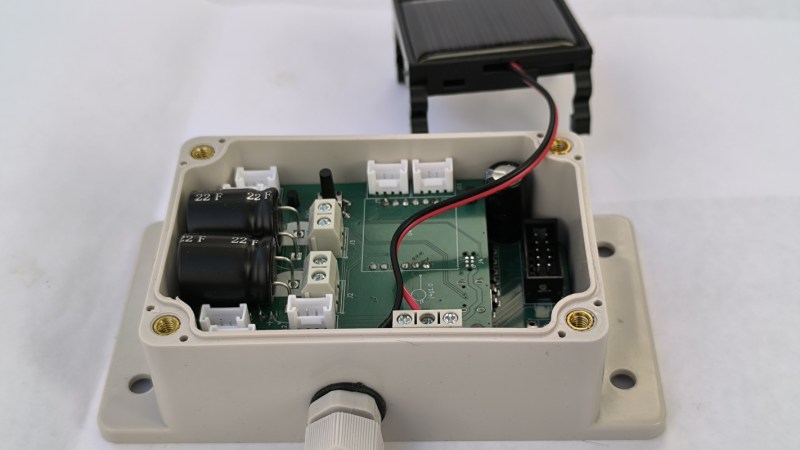
With all the battery technologies and modern low-current sleep modes in most microcontrollers, running a sensor and microcontroller combo off-grid and far away from any infrastructure is usually not too difficult a task. Often these sorts of systems can go years without maintenance or interaction. But for something that still has to be off-grid but needs to do some amount of work every now and then like actuating a solenoid or quickly turning a servo, these battery-based systems can quickly run out of juice. To solve that problem, [Nelectra] has come up with this high-power capacitor-based IoT system.
Although supercapacitors don’t tend to have the energy density of batteries, they’re perfectly capable of powering short tasks in off-grid situations like this. They’re also typically able to tolerate lower voltages, extreme temperatures, and shock better than most batteries as well. A small solar cell on the top of this device keeps it topped up, and when running in deep sleep mode can hold a charge for up to six days. In more real-world applications supporting sensors, relays, or other actuators, [Nelectra] has found that it can hold a charge for around three days. When a quick burst of power is needed, it can deliver 1.5 A at 9 V or 500 mA at 24 V.
[Nelectra]’s stated goal for this build is to bridge low-power energy harvesting and practical field actuation, enabling maintenance-free systems such as irrigation control and remote switching without batteries, going beyond simple sensor applications while not relying on always-on power from somewhere else. Something like this would work really well in applications like this automated farm, which has already provided some unique solutions to intermittent power and microcontroller applications that need very high reliability.













Very good project. Nice write up! Interesting how working on power and long-life margins reprioritizes design decisions.
At a glance, supercaps seem like a long life, maintenance free play. But they too age, just differently than batteries. Capacitance loss, ESR increase, and high leakage issues. Supercaps age mostly by voltage stress, and if your harvester keeps them near full, they sit at high voltage 24/7. An LTO cell doesn’t care about high SOC the same way. Perhaps a tweak could be a combination of LTO battery (eliminate power outages) with a SuperCap (operated at a fraction of rated voltage) to supply short, high current bursts. At these low voltages, any diode is considered lossy, so finding alt ways (FETs) to isolate backfeed is another optimization exercise. Good Luck!
Ideal diode chips exist. They’re basically a voltage comparator and a FET in a single IC. They have other uses as well, like connecting multiple battery cells in parallel where the user may insert a cell in reverse or when the cell voltages mismatch, so they don’t back-feed into each other.
The caveat is that the comparator has hysteresis, so if you try to parallel them it can sometimes lock up or oscillate switching between multiple power sources that have almost the same voltage. The reference circuits for paralleling multiple power sources using ideal diode chips usually specify a way to select the “preferred source” that keeps at least one of them on in case of a conflict.
Something i feel gets often overlooked: combining battery tech with a supercapacitor to buffer loading cycles. Especially ones, that are semi-constantly on a loading wire, would prolong the battery’s lifetime significantly. Does this get used on grid-level storage, maybe cars?