
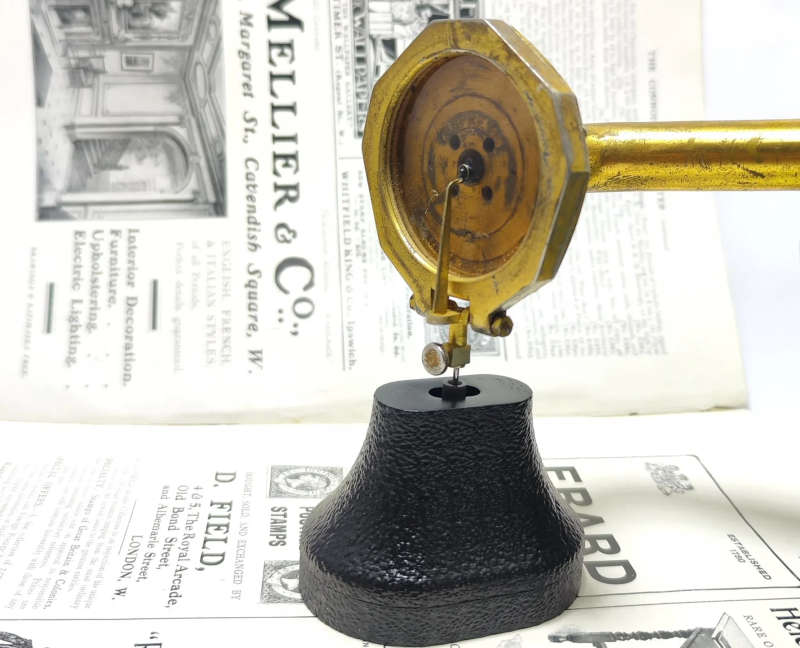
So you happen to have a gramaphone– maybe a big old Victrola/HMV, perhaps a Columbia– regardless of brand, it’s a big, beautiful conversation peice for your living room. It might not be the most practical listening device, since isnomuch as there is a vinyl renessance, it’s restricted to vinyl, not the old shellac 78s the these all-mechanical beasts were born for. [JGJMatt] decided to bring his gramophone into the 21st century, turning it into a bluetooth speaker without altering any of its original internals.
What’s really interesting is that this hack was once a commercial product– sort of. Back in the 1920s when everyone was listening to Jazz, the problem of ‘ what do I do with this massive gramophone cabinet when I’m not cutting a rug?’ was equally valid, and a solution was found: the Dulce-Tone Radio Speaker. A very weak speaker sits under the needle, turning the gramaphone mechanism into an amplifier for the radio. The very same concept, [JGJMatt] would work equally well in the 2020s with a bluetooth signal as in the 1920s with an AM one. There’s no demo video for this project, but you can hear how its 1920s inspiration sounded in the video below.
The driver for this device is made using a neodymium magnet and the voice coil from a 3W speaker. A 3D-printed needle-holder captures the gramophone’s needle– a much thicker and sturdier thing than the tiny diamond-tip you’d find on a modern turntable, we should note– and holds the magnet to it. The voice coil gets driven via a MH-M38 bluetooth module, and everything is held in a nice 3D-printed case along with the battery.
The hack is, of course, totally reversible: at any moment, you can remove the needle from this device and drop it on a 78 for some Jazz-era fun, or swap back for 21st century brainrot. If you happen to have some of those old shellac records and a modern turntable, note it takes more than the right RPM to get good sound.












Excellent idea, I might have to try this on my cupboard-sized 1920s wind-up gramophone.
It always amused me that the door in front of the horn was the volume control!
Our upright version has a felt ball on a cable for volume. These things need to make a comeback.
A friend of mine has one like that. I was so surprised that it didn’t sound tinny like the linked video. Instead it was quite warm and full, and fairly loud for an average sized living room.
Now I need to convince them to let me try this project as it would allow it to be used without wearing out the mechanism or needles. I was told those needles would only last 3 to 4 mins (the length of a single side of a 78 record).
That’s correct, ideally you should change the needle after every play. You could decide to use the needle for a longer period, but since the needle wears heavily, it gets really sharp and eventually starts damaging the record. Since nobody wants that… change after every play.
Regarding volume, there are various shapes and sizes of needles that allow for playback at a lower volume. Ranging from needles shapes like a lightning bolt to cactus needles that can be resharpened (and therefor used multiple times). But since these aren’t “standard” they are not well known to the general public.
As I understand it, some (all?) of the shellac 78s had abrasives added to the run-in grooves on the record to shape the needle before playing.
All these players had two little cups on the plinth, one for the fresh needles and one for the used needles. You really should change the needle with each play. There are plenty of online sources for needles, and they are dirt cheap.
Somebody gave us one a few years ago. The most surprising this was how loud it could be – exceptionally loud I’d say. Like “hearing damage if you put your head next to it” levels of loud.
“Ah, put a sock in it!” That was the original form of volume control, put a rolled-up sock in the horn.
Brilliant! Thanks for posting.
Bravo! I have nothing to add.
dot forget, with these type of players, you swap the needle after every side of a disk you play, or you will damage the groove of the disk with the worn down needle. Look at the tip with a magnifying glass. if you see a flattened side, the needle has been used and should be discarded. (i neve found a way to make them new again)
of course with this bluetooth device you can use one needle as long as you wish.
I was quite pleased to discover that there were quite a few examples of gramophone needle sharpeners out there, predictably with little chucks, rotating mechanisms and grinding wheels at fixed angles. I never realized how often you were ‘supposed’ to change them, but given the relatively enormous size of the little bowls for the needles on the players, it makes sense.
they press down quite strongly on the groove. dont put the arm head with a needle in on your finger, it will puncture your skin
New strategy: sprinkle 1-2 typos in the article to make it as if it was human made.
The typos have been there all along. Is Occam’s Razor really that hard to wield?
Ahhh yes. Ockham, a medieval, politicol-dissident catholic friar; a pre-renaissance philosopher of romance theology. The father of over-simplification. A person of example, oft used by modern comtemporaries to rationalize and embrace shallow thought.
This is also where shallow thinkers believe that they may quote Einstein’s “… as simple as possible, but not simpler”, as him espousing Ockham’s minimalism. The glaring error is that Albert Einstein never said any such thing. There is no reliable attribution, as it was a something taken out of context in a paper by Alice Calaprice’s “The Ultimate Quotable Einstein”; for which there is, again, no reliable, documented attribution. This domain of shallow and superstitious thinkers has less of a place in this century.
The universe is complex. Life is complex and messy. Hand-wavy attempts to foist simplistic explanations and dismiss legitimite scientific doubt are getting tiresome, and becoming a trademark for the loss of respectibitlty and readability for formerly reliable forums.
God you people are neurotic
This would make a good effect pedal to put in-line with vocals or an instrument