Camera Slider: Build Instead Of Buy Goes Awry

[TheHyperFix] had a problem. He’d spied a brilliant camera slider, but didn’t want to lay out big money to acquire it. The natural solution? Build one! Only, life is seldom so straightforward.

The plan was straightforward – take an old broken 3D printer, and repurpose its parts to make a camera slider instead. The build started with a aluminium extrusion, some V-slot wheels, and a 3D printed platform to hold the camera. Moving the platform was done via a belt drive, using the stepper motors and some software to tell the original printer controller what to do.

Unfortunately, the early experiments failed when the controller blew up under load. An Arduino was subbed in with a CNC shield, which got things back on track, and [TheHyperFix] had a somewhat functional slider with relatively jerky movement. A tough iterative design process ensued to work out problems with bearings and the Arduino’s pulse limit, among others.

As it stands, the slider is semi-functional, but it’s not quite well behaved enough to use for professional shooting. Still, for a first attempt at electronics prototyping, we think [TheHyperFix] did a pretty solid job. It might not be all there yet, but it’s well on the way, and a great deal was learned in the process.

If you’re trying to build a camera slider in a hurry, you might like to try recreating one of the builds we’ve featured before. Video after the break.

Continue reading “Camera Slider: Build Instead Of Buy Goes Awry”

The Math You Need To Start Understanding LLMs

Once you peel back the hype and mysticism, large language models (LLMs) are a fascinating application of statistical models, effectively what you get when you dial a basic auto-complete model up to eleven. In order to analyze a mind-boggling amount of text and produce meaningful auto-completion results quite a bit of math is involved, with a recent three-part article series by [Giles] going through the basics of inference, being the prediction step using a trained model.

The text is encoded in the LLM’s vector space as token IDs, each token being a text fragment that has some probability of following another ID, such as when cats may be found on desks, as in the above photo by [Giles]. With inference multiple of such IDs are retrieved in a vector from which in successive steps a sentence can be pieced together. These so-called logits are detailed in the first article in the series, with the second article focusing on vocabulary space and embedding, as well as the matrix operations used for inference.

Finally, the third article puts all of this together and looks at transformers, which is a crucial part of GPT (generative pretrained transformer) LLM architecture. Of note is the attention mechanism, which takes GPTs beyond merely being glorified auto-complete systems by adding pattern matching. Here we can see how the statistical model of the LLM is used to generate a rather plausible output, which is where the human has to ask themselves in how far they feel that it is correct.

Of course, there goes a lot more into making LLMs and GPTs performant, such as key-value caches that massively speed up inference.

Teardown Of A Shahed-136 Gimbaled Camera

The remains of a gimbal camera after its drone was shot down. (Credit: Le labo de Michel, YouTube)

The Iranian Shahed-136’s basic design has seen many changes and additions since Russia began using them, with some featuring interesting payloads such as cameras in a gimbal, making these drones useful for tasks like surveillance. Recently [Michel] got his hands one one such camera that was recovered from a shot-down drone in Ukraine, providing the opportunity for an in-depth look at what hardware is in these cameras.

The teardown thus covers the gimbal mechanism itself as well as the electronics and camera. First up is an Artix-7 FPGA-based board, followed by the range finder assembly. Unsurprisingly the camera feed handling is performed by an Hi3519 SoC, as this appears to be the off-the-shelf option you find all over on AliExpress and similar sites. There’s also an Artix-7 FPGA-based board here, which presumably performs some machine vision tasks or similar.

Continuing the ‘bought off AliExpress’ vibe, the power supply board (pictured above) is quite literally just that. A relay board follows the same pattern, with apparently the entire contents of the camera consisting of off-the-shelf development boards and modules that are readily found for sale online.

For the camera there is a thermal camera presumably for night operations, as most of these drone swarms are launched towards Ukraine at night. Looking at the gimbal assembly it similarly feels like it was sourced off AliExpress, featuring mostly Western components, sometimes with the typical lasered-off component markings and such.

This makes one wonder how much has changed here since nearly two years ago we saw an air data computer from a similar drone that could have been sourced off AliExpress, while the Russian missile teardowns show significantly more custom hardware, presumably because those are harder to source off AliExpress.

Continue reading “Teardown Of A Shahed-136 Gimbaled Camera”

Sunlight Powered, Sunlight Readable: Solar Case For Nook Simple Touch

When life gives you lemons, you make lemonade. What if life gives you a pile of old e-book readers? Well, when [spiritplumber] got box of old Nook Simple Touch devices, he decided to design solar-powered cases to help boost the old batteries. It makes perfect sense to us: sunlight readable screen, sunlight chargeable battery.

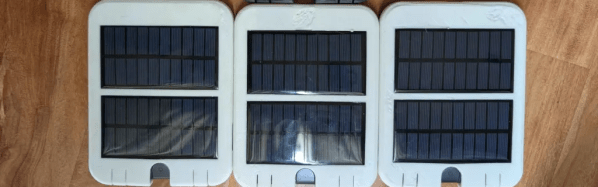
It looks like he’s got a pair of panels built into the 3D printed case. He recommends using any TP4056-based charger, and tying into the battery test points, not the 5 V supply. It won’t hurt anything if you do, apparently, but the device will think it’s plugged in an refuse to turn off the WiFi. That’s no big deal when you’ve got a continental power grid on the other end of the cable, but charging from a small panel on the back of the case doesn’t always give you enough juice to waste on unneeded radio activity. Especially indoors — these panels are apparently big enough to trickle-charge the device under artificial light, which is a nice, if doubtless slow feature.

The design is open source, and includes SketchUp design files as well as the exported .STL, so if you’ve got a hankering to edit this to fit a different e-book reader, you can. He also provides a handy-dandy guide to root this model of Nook, and if you’re on Hackaday we probably don’t need to explain why you might want to.

We’ve seen the Nook Simple Touch go some interesting places — like into the clouds as a glider computer — but solar power is a new hack for this device, at least on this site. We don’t know if [spiritplumber] has a green thumb, but he’s evidently got some environmental bones in his body: his last featured project was about improving quadcopter efficiency with a wing and a prayer.

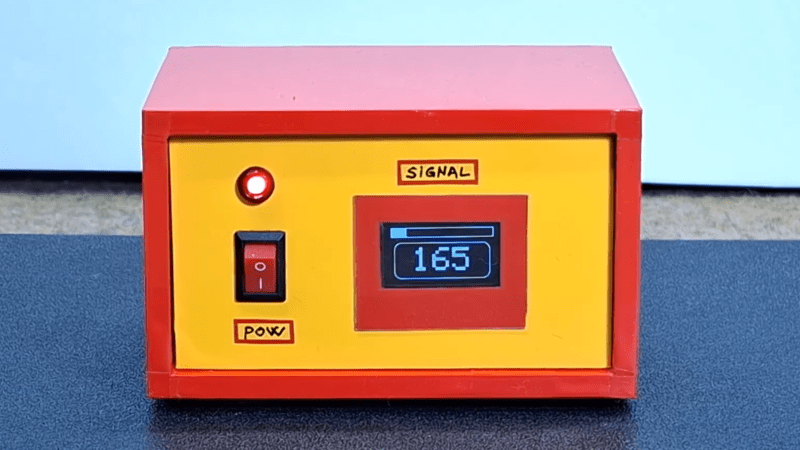
A red box with a yellow front panel is shown. The front panel contains a power switch, an indicator light, and a small OLED display.

A Shortwave Sensor To Monitor The Ionosphere

The ionosphere is of great importance to shortwave radio transmissions, since it allows radio waves to be refracted and reflected over the horizon, and it’s therefore unfortunate that the height and thickness of the ionosphere depends on the time of day or night, weather, season, and the solar cycle. To get a better idea of current transmission conditions, [mircemk] built this shortwave propagation monitor.

The monitor provides a basic measure of ionosphere conditions by measuring the strength of received shortwave signals: if the conditions for transmission are good, it should receive a relatively high level of existing signals, and a weak signal if conditions are bad. It has an external antenna connected to a signal strength indicator circuit based on the CA3089, which amplifies signals in the 1-40 MHz range and outputs a smoothed voltage indicating the RF energy in this range. The output signal can be read by any voltmeter, in this case an Arduino Nano with an OLED display. Assuming the same antenna is always used, the signal should noticeably fluctuate between night and day as the solar wind affects the ionosphere.

Of course, the distance at which you’ll be receiving a signal means nothing unless you have a receiver, which can range from the antique to the modern.

Strange Ways To Make Cold

Making stuff cool and keeping it that way has been a pretty essential part of human civilization for thousands of years, with only in the past few hundred years man-made methods having become available that remove the reliance on the whims of nature and lugging around massive blocks of ice. The most important cooling method is undoubtedly that of vapor-compression refrigeration, but this is hardly the only method to transfer thermal energy from one location to another.

For example, we recently covered an elastocaloric cooling project by a group of scientists that uses strips of NiTi metal. By flexing these they induce a cooling effect which when put in a number of stages serves to transfer a significant amount of thermal energy between both sides, much like a vapor-compression system but without the gases and compressor. Meanwhile the Seebeck effect is relatively well-known from Peltier thermocouple devices, and features heavily in portable refrigerators and kin where these solid-state devices can also transfer thermal energy.

Of course, along with how they function the major question with all of these cooling technologies is how efficient they are, as this determines when you’d want to even consider them for a specific application.

Continue reading “Strange Ways To Make Cold”

ESP32 Hosts SolarPunk Message Board

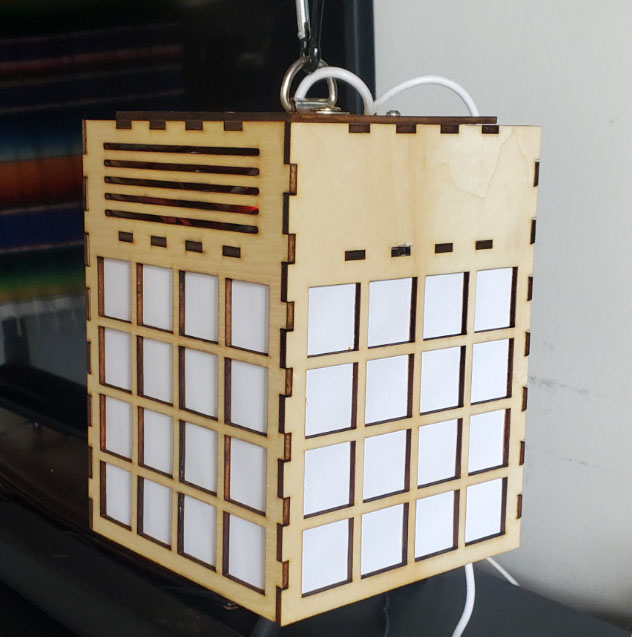
Solarpunk is sometimes thought of as the “good ending” to cyberpunk– there’s technology, but it’s community-focused instead of in the hands of evil conglomerates, and– if the name doesn’t give it away– renewably powered. [Victor Frost] found that image of the future inspiring enough to create this ESP32-hosted community hub. Yes, it looks like a lantern, but it’s actually a very-local webserver.

It looks like a lantern, but it’s got a server inside. Plus two 18650 cells to charge from a solar panel that’s presumably off-camera.

Local webserver sounds like an oxymoron, but this device does serve a page over HTTP… just, not on the world-wide web. Instead the only way to access it is via its own Wireless Network– he’s using the ‘captive portal’ that forces you to log into public wifi to direct people to a community message board.

It’s unmoderated, and unfiltered– users can post what they like, but given that they have to be within a few meters of the device, it’s not exactly anonymous. It’s a lot like the community center corkboard brought into the 21st centruy, which is very in keeping with the solarpunk ethos.

For ease of updates, he’s subdivided the ESP32’s flash into three partitions: one for the data, and two for the software, using LittleFS. This allows live updates and keeping a known-good backup for the quickest possible turnaround and/or rollback. One interesting thing is that his who UI– the actual web site, HTML, CSS, and JS– is all crammed into a single string in PROGMEM rather than files on the little file system. It’s an interesting choice, and makes for quick updates, firmware and UI in one go. Not everyone will like it, but it works for [Victor]. The code is, of course, on GitHub under the GPL— there’s a lot of overlap between the open source and solarpunk ethos, after all.

It’s a bit of a pity that he missed our Green Powered Challenge, as this project would have fit right in to the PV category, considering it runs on a 6W panel. For all the cyberpunk and solar power you see on this website, you’d think the “solarpunk” tag would be more popular, but no– all we have is this stained-glass robot.

Thanks to [Victor] for the tip! If you missed our contest, too, no worries– we take projects of all colours, green or otherwise, all the time. Just drop us a tip.