
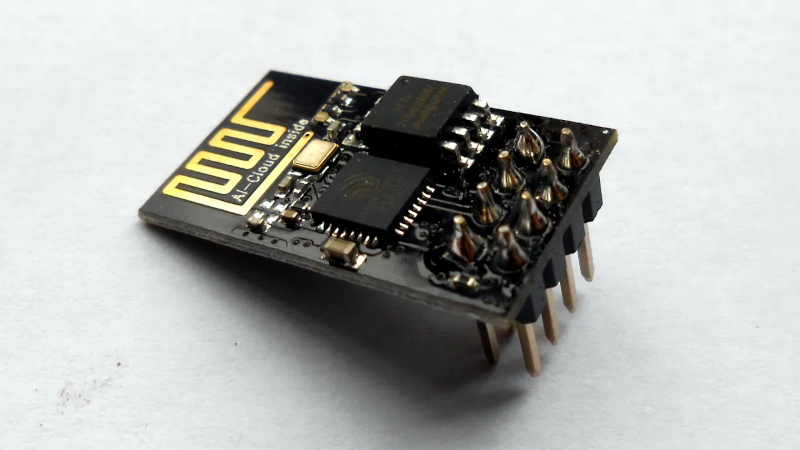
A couple weeks back we brought you news of KernelUNO, a command line shell and very simple operating system for the Arduino Uno. It’s a neat idea, so it’s hardly surprising to see someone port it to another microcontroller and add more features.
Here’s [hery-torrado], with KernelESP for the ESP8266, which takes the original idea and adds a web console, scheduled jobs, sensor rules, scripting, NTP, and a JSON API. The networking using the ESP’s built-in WiFi takes the original and makes it significantly more useful.
It’s worth suggesting that the ability to call URLs with GET data to pass things to APIs would be useful on a networked processor too, but this is already so well featured it seems rude to ask for more. Yet again though, this project has given a new life to an old chip, and we think it has a way further to go. Perhaps a port to the ESP32 would allow it to reach its full potential, or maybe for a ridiculously cheap and powerful platform, the CH32 series of chips. We look forward to see what more will come from KernelUNO.












as long as you’re not working with media files and images, the ESP8266 is an amazingly capable machine. i’m still adding features to my project (which is similar, but is specifically for remote automation and includes a mass of code to be run on a conventional web server, interacting with the ESP8266 remotely):
https://github.com/judasgutenberg/Esp8266_RemoteControl/
I love it!
Sir, this is a Wendy’s.
I can haz cheezburger?
Rusty Whitney wants a cheeseburger.
” web console, scheduled jobs, sensor rules, scripting, NTP, and a JSON API”
All of which has been available in ESPEasy for about ten years.
https://github.com/letscontrolit/ESPEasy
https://www.letscontrolit.com/wiki/index.php/ESPEasy
Honest noob question: what makes this more of an OS than ESPEasy? Or could ESPEasy also be considered an OS?
The journey is the reward.
This is a hacking-site. Not many things make sense here. It is for the giggles.
Literally just read that this is a Wendy’s, now it’s a hacking-site? Please advise.
Wendy’s ? I thought it was owned by Supplyframe…
Dude, spot on!
An OS is a platform that provides all the glue to allow applications to talk to other applications, and hardware to reach said applications. ESPeasy is a framework. It behaves like an OS, but it’s application specific to IoT, so it’s less of a full system and more of a framework. The Earth is like an OS, and your house is a framework. They both do similar things, but one carries everything else while the other carries what it was only designed to carry.
I took a look at ESPeasy but to be honest ESPHome with Home Assistant is far more powerful.
is it time to make a lmaitfy.com?
@McNugget most houses also carry a mortgage which the earth was never designed for. The earth, however, is suffering with lack of upkeep. An HOA would solve that. 😁
What? The earth isn’t designed for anything, a mortgage isn’t a physical item with mass, and HOAs are always a net negative for the community.
There is next to nothing that I wouldn’t put up with to avoid living somewhere with an HOA or next to people who feel the need for them.
But then who makes sure your neighbor’s patio doesn’t have any broken bricks? Or that their drapes don’t clash with the color of it their trim? I mean, that’s one crooked fence picket away from absolute anarchy!
OK a serious question that will not sound serious. If i live in CA or one of the other states mandating age verification will i have to now verify my age if i want to load this on an esp32? A big bag of worms that they did not think about is being opened.
Yes.
And I declare this comment an Operating System.
Probably. In CA I believe the device has to be able to access the open Internet i.e. have a web browser, for the registration law to apply.
That is actually a good question and I did some research. If your device can be accessed by others, you may be in the cross-hairs. While the powers typically go after the “big dish”, its not zero.
Trying to find a use case for it, aside the hacking factor which makes it super cool, and I think this could become a nice platform to test serial/i2c/spi/? devices on the fly: connect it to the port, using a level translator if necessary, turn on, then test the device using the web page or exported shell.
Is it just me, or does the solder job on those header pins look pretty sus?
How? A bit too much solder here an there but?