
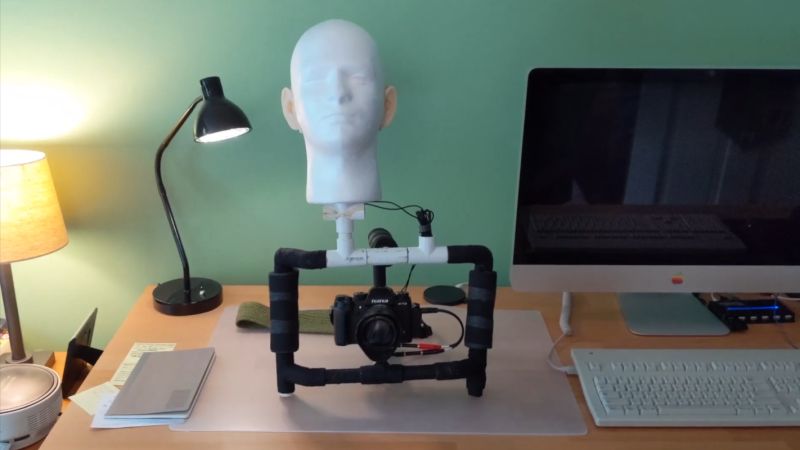
For as many speakers as someone can cram into a surround sound system, humans still (generally) only have two ears to listen to those sounds with. This means that, for recording purposes, it’s possible to create incredibly vivid three-dimensional sounds with just two microphones, provided that there’s an actual physical replica of a human ear attached to each microphone. This helps ensure that all the qualities of the sounds are preserved in a way a real human would experience them, and as [David Green] demonstrates, these systems don’t need to be very expensive.
This build doesn’t just use models of human ears for recording sounds through. The silicone ears are mounted on a styrofoam mannequin head as well, which provides some sound isolation between the two microphones, much like a real human head. The ears are mounted in appropriate locations with the microphones installed inside, and the entire microphone apparatus is positioned on a PVC rig with a camera so that binaural audio will be recorded for anything [David] points it at.
Although he had some issues interfacing two microphones using 19th-century technology instead of soldering everything together, the build still eventually came together, and only for around $70 USD. However, this build is a bit dated now, so prices may have changed by now. It’s still a great way to produce realistic stereo sound without breaking the bank, but it’s not the only way of getting this job done.












I already have a head, and some electret mikes are small enough to stuff in my ears – carefully. Insulate those wires well; shock from the phantom power should be avoided.
now, that’s a good hack!
That can work very well too.
I tried that some decades ago. After wiring everything up I made a short test recording. During that my wife walked in to the room and said something. However it was late and the next day was work day, so I just stopped the recording and left it there. Next day when I came back from work I listened it. It was spooky. I sat in the same place where the recording was made, but I was alone in the flat. Still, it sounded very much like someone was there.
The test recording was actually made on C-cassette, but I transfered it to digital, and it’s still on this music website I was using then: https://mikseri.net/artists/kilpajanis/binauraalinen-testinauhoite/189801/
I’m not sure how well it translates to “other heads” but for me it still sounds quite realistic, especially given that the recording equipment including the tape recorder cost me about 30€.
If anyone wants to try this, make sure the electret microphone capsules are omnidirectional. Those generally have very flat frequency response for the price. You’ll also want the directionality to come from your ears and head and not from the mics themselves.
i have some Soundman mikes that use that system. they look like old in ears with a foam cover but sound surprisingly good and come with their own small preamp.
That small thing with battery is not a preamp, it is called preamp adapter and does only support plugin power (PiP) for the capsules of the soundman in ear mics. It is not needed, when you have a audio recorder that supports PiP. Compared to some modern capsules from PUI or Primo, they are very noisy.
No need to place them into your ears. Just use your ears to clip them just above. It is your head doing the major part getting the space capturing. So most important is to keep your head moving slightly while recording. It helps the listener to locate the different sounding objects.
You can check here:
https://www.klankschap.nl/polderwalking
It used to be pretty common to shove electret microphones into walkman-style foam headphones. You could reuse the wiring; the headset is now a stereo electret microphone, and is electrically compatible with what most stereo recorders expected.
At the frequencies involved, there was very little unintended shadowing, especially with the cheapest-construction headsets. It was a solution that works better with cheaper gear.
The audio results were mostly indistinguishable from dummy-head recordings, and worked very well for things like pov-style walks around a neighborhood, creating a fully realistic sound field, without making everyone you met comment about your weird dummy head.
If filming, it was better to either use a dummy head or for the cameraman to always keep his head rigidly pointed in the same direction as his camera (or else a few members of the audience would get a bit dizzy).
The 1900s were not the 19th century, Bryan.
It’s that same confusion in programming where the first element of an array is array 0.
Something is profoundly unsatisfying with the first century also starting at 0.
This is the second or 3rd time this year alone this winding has done that
Course I’m not really a fan of “the 1900’s” either when it comes to electronics either…
In the 1920’s people were jamming light bulbs up their ass to warm their prostate, and in 1978 we had the first launch of GPS satellites
wat
Meanwhile here in the 2020’s we have people promoting the idea of tanning your perineum as a means of of increasing testosterone production. You’re not making quite the argument you think you’re making.
Sure i am people of the 20’s are stupid
More correctly, the human race is prone to a certain unavoidable amount of stupidity. And if some specific stupidity is eliminated, other stupidity will pop up to ensure that the total stupidity remains constant.
It’s just that old-and-busted stupidity feels somehow stupider than the new hotness stupidity.
You could add, that soldering is much older technology than 3.5 mm jacks and plugs. :D
The way I see it is using connectors to connect different parts of a system together is a smart move. Hardwiring everything together is like hardcoding IP addresses and ports in software instead making them configurable.
With closeups of a person speaking the sound will be off with this rig, farther away OK. My 2 year old Motorola phone is equipped with 2 mics at the top and bottom with the wider screen, it comes close to binaural in distance. For a phone it’s awesome, no distortion with live bands. I’m thinking of making such a rig with 2 handles and making “ears” of silicone to mate with the not even spacing of the 2 tiny mic holes.
I recorded first with a pink wig stand where I put 2 tiny condenser mics in with part of rubber safety goggle flaps for the outside. Then someone gave me an AKG kunstkoff with so-so dynamic mics on tubes stuffed up the neck with 2 inches of bent canal connecting things acoustically. Out went that stuff and 2 electret mics just fit in the holes at the surface. The idea of ear canals being twice in the path is wrong, we don’t have “phones” that fit all the way in at the eardrum. So we interface at the surface of the ear to not repeat parts of the path.
I read that the outside folds don’t matter as much as the delay around the head in location, so I’d think that minimalist printed ugly setup with just the “ears” and nothing in between would not be the best. But then again spaced omni mics do sound quite good. Clement Ader first did this in 1881, so very nineteenth century.
Two electret mics in cheap walkman-style headphone bodies works pretty well. Yank out the speakers, wire up the mic capsules instead. As long as there isn’t too much plastic in the way, it sounds pretty good. If you need more stealth, just put them inside, where the speakers were; you’ll get a slight reduction in fidelity and 3d reproduction, but it’s nice when you don’t want to end up recording everyone talking about your tech setup instead of whatever you set out to record.
If you need higher quality, make the mic capsules more cleanly exposed to the outside sound; your own head does a very good job of creating the correct shadowing and delay.
It’s also a low-cost solution that is easy to experiment with, before you focus on optimizing for whatever your specific tradeoffs are.
I got to try out a few 3D-sound setups at conferences 25 or 30 years ago. What I’m remembering from that time is that external ear shape does matter a lot – not so much for side-to-side localization, but for up-down and back-front. Those ear transfer functions filter frequencies differently from different directions, and that’s what tells us to look up or down or behind us.
That’s also why pure sine waves are harder to localize – without a broad spectrum of frequencies, we don’t get the localization cues we’ve learned to interpret.
While we may only have two ears it’s unfortunately still the case where we are likely to get better results with more than two mics and speakers.
A lot of what we hear comes through our skull so in the absense of a really good algorithm, simulating that with the fake head is the best we usually get.
Did this myself last year, and unless I got it all wrong, I could discern very little change in the sound colour. (Never tested this indoors, only outdoors.) I’m not sure my styrofoam head was dense enough. The effect was noticeable, it works, sure, but was not worth it for all the looks and questions I got. The head, is actually also a bit big to just drop into a bag full of cables.
The ear and ear canal generates a kind of frequency boost arround 4kHz, where most small electred capsules have some higher sensitivity as they have not a total flat frequency plot. I have reduces this effect with a uneaven formed ear channel (not round, no parallel walls) and lots of cloth. This also reduces the high sensitivity to wind noise. I use the same ears as in the video but with two the ears mounted to round foam discs instead of a full dummy head. This is not so bulky and looks descent when using a ear warmer head band over it for extra wind protection.
You can shove the mics in cheap headsets and use your own head as the shadow/delay line. If done well, the results are equivalent to very expensive dummy-head setups, and attract a lot less attention.
But if you’re pairing it with a camera, you have to train yourself to religiously keep the camera pointed exactly where your face is pointing, or some of the audience will get dizzy from conflicting cues.
No, if yyou go binaural, you also want the face. A lack thereof inbetween the “ears” changes the sound profile.
Hmmm.. where have I seen this before…
This issue of this magazine (although not necessarily this project) was what started my interest in hobbyist electronics in the first place. I read and re-read that thing until it was almost falling apart.
Page 145 per the magazine, Page 143 per the pdf…
https://www.worldradiohistory.com/Archive-Poptronics/Experimenters-Handbook/Electronic-Hobbyist-Handbook-1989.pdf
I made a binaural mic that fit’s two electret capsules in my ears. I made several recording with it- some in Japan and some in my yard in a forest in Missouri. You can hear them here:
https://drmrehorst.blogspot.com/2018/10/binaural-recordings.html