
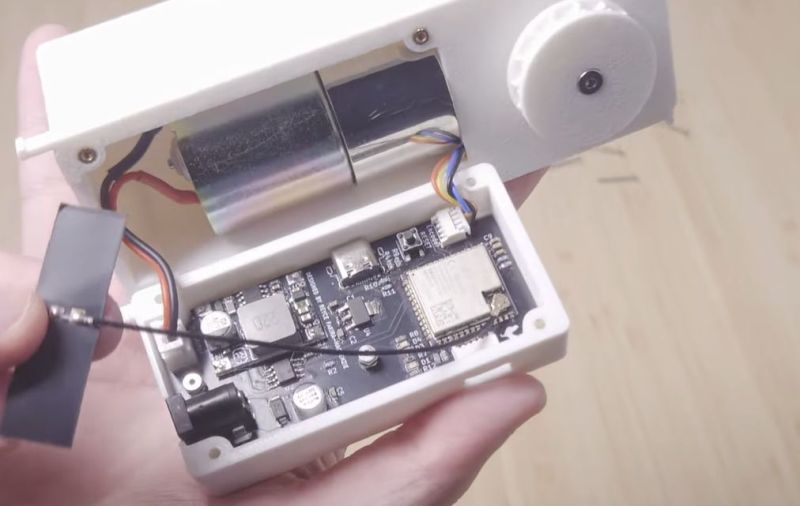
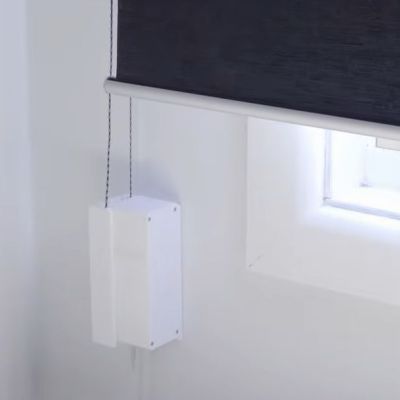
Most people love window shades, but many dislike the tedium of having to open and close them over the course of each day. While there are automation options here, if you’re in a rental place like [Rooster Robotics], then you’d prefer something less intrusive, as well as less cloud-bound. This is basically why he opted to build his own solution from scratch to open and close roller shades via Home Assistant.
The comments to the video helpfully point out that technically his point about there not being commercial options with a forced remote account ‘feature’ is false, as the Aqara Roller Shade Driver E1 for example is just a regular Zigbee device which can be used with a wide range of home automation ecosystems. That said, it’s always nice to have your own device that you fully control.
Of course, these devices are deceptively simple, as you still have to somehow know how far open the curtain is, which is also useful if you just want to open the curtain a certain amount. The other issue is the need to have the motor parallel with the wall unless you enjoy having a big wart sticking out from the wall.
Solving the first issue was attempted with a Hall effect sensor, and the second with angled gearing. With some refinements this led to a functioning design, allowing the development of a custom PCB with an ESP32-S3 module for WiFi control. In the final design the Hall effect sensor and magnets were replaced with an AS5600 magnetic rotatory position sensor that requires just one magnet and offers a much higher resolution.
Currently the design files are not available, but [Rooster Robotics] has indicated that they are looking at open sourcing the files in the future.












Aqara make one as noted, also there’s off-brand zigbee options.
There’s also zigbee tilt-rod controllers for the blinds with rods to tilt the slats.
Additionally on Amazon you can buy zigbee motors that fit inside the roller, so no dangling chain. Reviews aren’t great unfortunately.
Disappointingly Ikea have stopped selling their motorised blinds (in the U.K. at least) which is a shame as they appear to have been zigbee, no need for the Ikea app, quiet, and reliable.
But always good to make your own!
Very nicely done!
I’d look into getting/making a linear position sensor like the ones used on lathes and CNC machines to report on the position of the curtains/shades.
Lutron Casetta shades are expensive but they work amazing. Has all this automation built in.
I kept my bedroom dark 24/7 for years since I only use it for sleeping.
One very short day during the last winter I had an epiphany and I asked myself why do I even bother sliding the curtains open and closed every day in other rooms? It’s a collosal waste of time. For instance, a single LED bulb keeps my working room lit about 16 hours a day and its monthly cost in electricity is less than a single bottle of beer.
Because sunlight through a window is still strong enough to kill half the bacteria stuck to the dust floating around your room.
Yellow eye burn.
Today I learned…
That’s the spirit. If you can afford to, why not waste electricity. It’s not like there’s a environmental emergency staring us in the face right?
It may not be much energy on its own but if a billion humans choose to be this lazy, the picture is quite different.
Yeah. It’s far better to put 50 Watts into running a home automation system than 10 Watts into a light bulb.
I think you save more energy from decreased heat loss than you lose from running a light bulb.
I’m working on the other side. Hoping to open source this soon. https://github.com/tamusjroyce/Rotary-Mixer
Two-way feedback for controlling shades or audio mixer. I hope it can be cut into a wall at one point
I use a belt and encoder instead of a linear resister. So instead of $25-45 a slider. It is dollars
It is still a work in progress. Printing it a 4th time to make sure everything lines up. Engaging and disengaging the single stepper is my current challenge
I’m also working on a home assistant ported to gentoo that will optionally run on the shader/mixer fader