The Team Behind The Flipper One Needs Your Help

You’ve probably heard of the Flipper Zero, a pocket-sized device that packs in lots of great hacking potential. The team behind it has now turned their efforts towards developing the Flipper One, and they’re calling out for help from the broader community. 

The Flipper One is not intended to be a replacement or sequel for the Flipper Zero. Instead, it’s designed to exist as a entirely new device in its own segment. The team is hoping to build “the most open and best-documented ARM computer in the world,” as they attempt to create a Linux cyberdeck of grand capability. Where the Flipper Zero has found great use for interrogating and investigating low level communications, like IR and NFC, the Flipper One is intended to go to a higher level, working with protocols like Wi-Fi, 5G, and Ethernet in the networked world.

The new device will be based around a co-processor architecture, where a microcontroller is paired with a capable CPU for great flexibility. It will also feature all the high-speed interfaces you’d expect, like PCI Express, USB 3.0, SATA, and Gigabit Ethernet. It’s a proper, capital-C Computer in that regard. The intention of the team is also to redefine some of the typical Linux experience, by creating GUI wrappers around certain traditional CLI utilities. It should go a long way to giving the software the same cyberdeck feel that the current prototypes embody in their hardware design.

If you want to learn more and get involved, head over to the Flipper One Development Portal and dive in. Alternatively, you might like to get up to speed with some of our prior reporting on the Flipper Zero. Happy hacking!

[Thanks to Andrew for the tip!]

Flipper Zero Blasts Past Funding Goal And Into Our Hearts

There’s never been a better time to be a hardware hacker: the tools are cheap, the information is free, and the possibilities are nearly endless. But that doesn’t mean there isn’t room for improvement. The Flipper Zero was developed to make the world of hardware hacking even more accessible, and as of this writing, has officially ended its Kickstarter campaign after raising a staggering $4.8 million. To say the community is excited about this little gadget is perhaps an understatement.

So what does the Flipper Zero do that’s gotten everyone so worked up? Well, for one, it’s not so much what it can do as how it does them. Taking inspiration from the already popular pwnagotchi project, the Flipper Zero gamifies the normally rather mundane tasks of sniffing for 433 MHz signals and flashing EEPROMs with the addition of an animated dolphin that’s sustained by your hacking. If you want the little fellow to grow and be happy, you need to keep poking and prodding around at any piece of hardware you come across.

If you’re looking for a comprehensive list of features, that’s a little harder to nail down. Partially because the device has picked up a number of new tricks (such as support for Bluetooth and NFC) thanks to the fact it made better than 8,000% of its original funding goal, but also because it can be expanded with additional hardware and software which obviously won’t get developed until the community gets their hands on the core device.

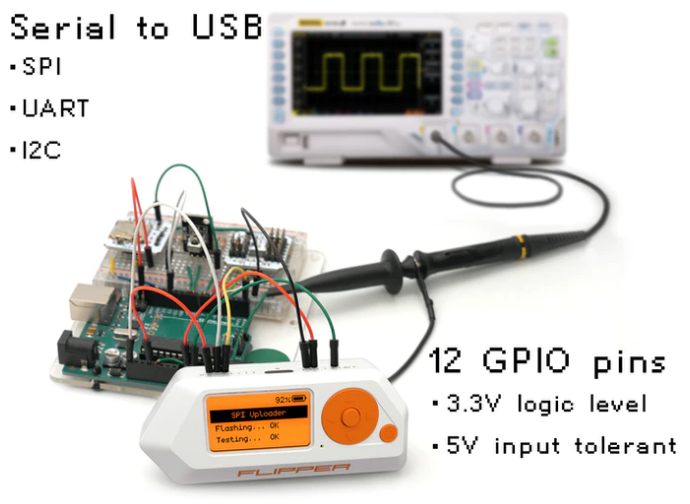
But even the core functionality, demonstrated in the video after the break, is quite compelling. The Flipper Zero’s CC1101 transceiver chip (anyone else thinking of the IM-ME right now?) allows it to record, analyze, and play back RF signals from 300 to 928 MHz, meaning you can instantly take over remote control systems that aren’t using a rolling code for authentication. It can also read and emulate many different RFID cards, record and transmit IR signals, emulate a USB HID device and run programmable payloads, and act as a USB to UART/SPI/I2C adapter. All contained in a sleek and pocket-sized enclosure that looks like a proper cyberpunk hacking gadget.

We’re extremely interested in seeing what the community can do with the Flipper Zero, especially now that the extra windfall has allowed the team to create a formal Developer Program for people who want to help work on the core platform or produce add-on modules. After banking nearly $5 million, this will be the yardstick by which all other crowd sourced hacking gadgets are measured for years to come; let’s hope they make it count.

Continue reading “Flipper Zero Blasts Past Funding Goal And Into Our Hearts”