There are plenty of ways to get sound into your house: good old fashioned headphones, the Dolby surround setup we all lusted after back in the day, or the 21st century’s ubiquitous soundbar, with its ‘spatial audio’ magic. Which will work in your space? If you were an audio engineer, you’d set up listening area and use a microphone to map the space– but that would be thousands of points and sounds like tedium. [PlasmatronX] had a better idea: use Schlieren imaging to see the sound waves as the travel through the space. Schlieren imaging has trouble with audio frequencies, though, and imaging the entire living room was going to be difficult. So he scaled it all down– including the sound waves, by shifting to ultrasonic frequencies.
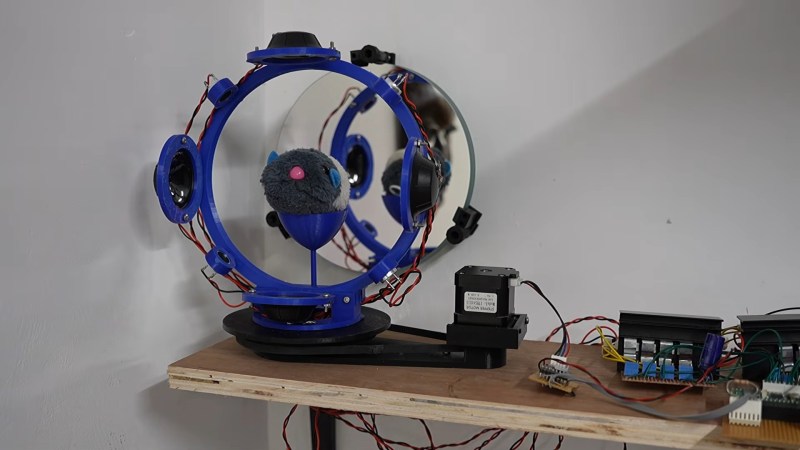
He’s using the usual mirror-and-razor Schlieren setup with an 8″ telescope mirror– and if you don’t know what that is, we did a deep dive on this kind of optical flow visualizer a while back. Inside the circular imaging area where that lets him see density changes, he’s set up what he calls a CAT– Computer Acoustic Tomography– array. It’s a rig on a turntable he can set up ultrasonic transducers on, to match the various speaker setups he wants to test, and turn so he can see from all angles what the scaled-down waves are doing. To capture those waves, which aren’t going to be standing still, he adds a stroboscope. All the ultrasound signals are being generated by a Pi Pico, and are scaled 4:1 in the frequency domain– that is, a high 10kHz whine becomes inaudible 40kHz. Those signals are fed through a DIY 8-channel amp into both ultrasonic transducers and larger ‘cat-repellent speakers’ from AliExpress.
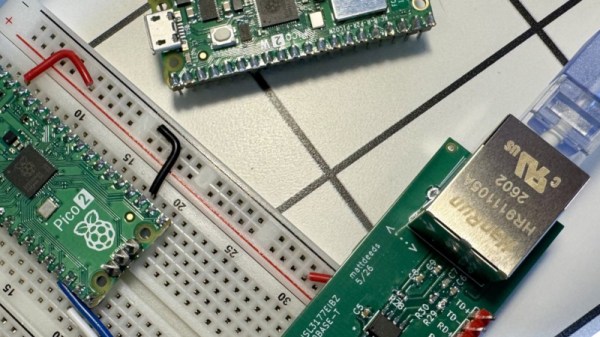
The microcontroller is actually a Pico 2W, which is using its “W” to communicate via Bluetooth with a Pi 4. That SBC is running the camera, the stepper for the turntable, and image processing, along with the timing for the audio signals. After that it’s a matter of setting up a scaled down 7.1 surround setup and itty-bity soundbar, and test it on a (stuffed) guinea pig. Obviously you can see a big difference between the steered beams from the tiny soundbar and the true surround, but how that translates to listening pleasure will be at least somewhat subjective.
What’s less subjective is the obvious effect soft furnishings add to the simulation. Now he doesn’t take the time to find a material that will scale the frequency response of a set of curtains, but we’re not sure how much that matters. At 5kHz or 20kHz, they’re going to deaden sound, and you can see that here, and you can see it’s a much bigger deal for the shaped beams of the soundbar than it is for surround sound. In the end, [PlasmatronX] decides to stick to headphones, but the whole video is very much worth watching, so we’ve embeddded it below. If you want to try it yourself he’s put his code on GitHub.
Thanks to [PlasmatronX] for the tip!
Continue reading “Pico-Driven Ultrasound Enables Scaled Acoustic Model Of Home Stereo”