
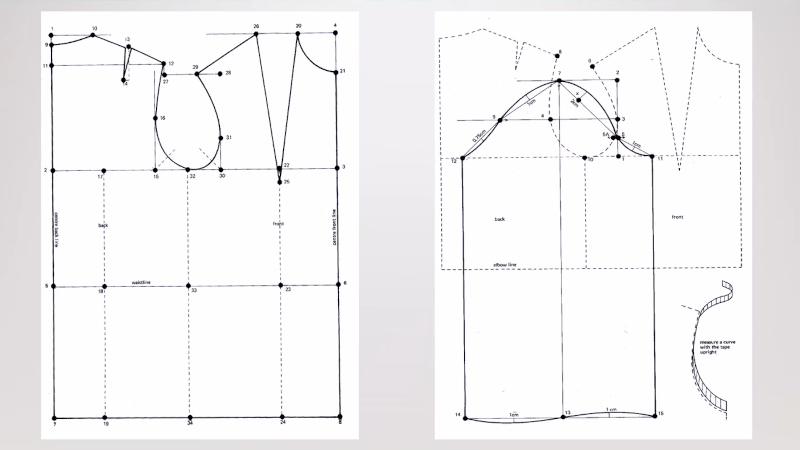
A talk from the recent Electromagnetic Field event in the UK caught our eye, in which [Amy Jeskins] looked at the overlooked engineering skill of pattern cutting. She takes us through the mechanics of creating a pattern for a piece of clothing, and asks why it is not a skill taught to engineers.
She’s a specialist in theatrical costume, and the talk takes us through some examples of her work before looking at the history of tailoring and pattern making. She explores flat cutting and draping a pattern on a form before coming into the present day with CAD packages designed for clothing work. It’s the social aspect of the talk that’s perhaps the most interesting, looking at how it has become a gendered skill and thus not something considered where it should belong, as engineering. We’re reminded of one of the most important additions for a healthy hackerspace, a textile room, as we’ve seen people there bridge this divide from both directions.
If you have never made a piece of clothing then we’d suggest giving this talk a watch, and maybe taking up a sewing machine to give it a try. In the past we’ve taken you through some of the prerequisites for a textile bench. The full talk is below the break.












UNL just shut down their textile department. Looks like a lost oppurtunity.
Textiles in general versus fashion/clothing seems to be the unwarranted assumption here. Simply put, textiles are everywhere and have added runways – from Fashion Week on to the 787 fuselage and others in a continuum of similar concepts and applications.
Carbon fiber, aramids etc. are in use in everything from aerospace and biomedical engineering to consumer goods (and even clothing) but the approach is data driven and analytical rather than design/fashion based (of course marketing lurks at the intersection of those.)
“Textile engineering” in its most formal lives in the arcana of topology and stressed surfaces rather than more stylistic elements*. Sewing has most often given way to bonding/fusion based construction, but this has happened in clothing manufacture as well.
The second unwarranted assumption is that men can’t/won’t sew and women aren’t in engineering. This is patently false.
*There are a lot of jokes about engineers of any sex attempting fashion or style, many of them justified, but we won’t go there.
Successfully complete an engineering degree (on it’s own, or in combination with (an)other degree(s)), then ask.
Knock it off.
Most of the tech out there exists simply because of textile production.
What are we even doing here man
we literally owe programmable computing to the steam loom
I have undergrad and grad degrees in biomedical engineering, with experience in computational neuroscience, electro-neurophysiology, and patent examining. I do some sewing as a hobby, but I agree with Jeskins 100%. Society often derrides “women’s work”, even though the problems demand equal levels of rigorous problem solving
I don’t consider it women’s work at all. The list of most famous fashion designers are mostly men. But it has nothing to do with engineering, although it uses engineering, just like everything on this planet. Just because garbage trucks use a lot of engineering, doesn’t mean working on one should be a requirement for an engineering degree. The same goes for textiles. Just because it can be interesting, just because it can be difficult, doesn’t mean it makes any sense to include it in an engineering degree.
That fundamental basics level really does make sense to include – the textile based industries have already solved a great many problems your X Engineer may come across somewhere. Especially with how very much composites and lightweight perhaps even folding structures that are very textile based are becoming very common.
Having seen the opening at the top of this rabbit hole your future engineer of x is far more likely to notice the problem in front of them would benefit from the textile engineering field, and might even be a trivially solved problem to them!
Should engineers, broadly, understand parametric CAD? Implicatively, should they understand hard materials fasteners? Sheet metal? Perhaps not all engineers need to, but I think even non-mechanical engineers are generally steered towards drafting with rigid materials. Why not flexible ones?
The whole supposition that they aren’t is wrong. My father was a civil engineer (like bridges etc) and even he had significant learning about textiles and a LOT of reference material around them as well. This would be down to schools etc.
Oh knock it off.
Engineering exists because of textiles.
Georgia Tech had a textile engineering degree program when I was there in the 1980s (AE88). It went away years ago. The textile industry went to Mexico with NAFTA (Ross Perot was right) then to China. In my early years inspecting plants for FM I went to many old yarn mills, cut and sew plants, etc. I loved the smell of raw cotton and the old buildings. People were good too.
The nearby offshoot Southern Polytechnic also had something like that in 2010, though probably smaller.
It was part of the program that was instituted by a female dean from the 60s when it was just part of GTech.
She also named the Green Hornet mascot (ripped from Tech)… Horny the Hornet
Not textile work, cloths making. She is talking about making cloths, textile making is making fabric.
Pattern making is an art of its own, which requires one learns about not just alterations in general, but cloths design, which is what, 4 years in technical college? Yes, mechanical engineering is part of the curricula, because you also HAVE to learn both thread making and textile making, so when designing pattern, you account for the inevitable fabric stretching/folding.
RE: “…why it is not a skill taught to engineers?” because (at least in the US, the area where I live) it pays minimum wage. Why would one want to work for minimum wage if lowly store manager makes what, two-three times more?
To justify some academic’s navel-gazing and assuage their narcissistic ego injury
Working in a factory making clothes, maybe.
But who only makes minimum wage designing patterns for clothing?
You only get min wage stamping sheet metal for a car. You don’t need an engineering degree for that. There was a well paid engineer who designed the tooling to stamp the steel. Or who designed the mold for a casting.
It’s also called pattern making when you design the casting mold.
People in China… where all your clothes are made
@KDawg
I just checked my clothes tags for country of manufacture and they read as Bangladesh, Indonesia, Mexico, Korea. I can’t find any clothes made in China. I live in U.S.A.
The irony is that so many clothes didn’t need to be made so cheaply in places that pay hardly anything to workers. The material and labor cost of clothes is on the order of 10% of the consumer price because much of clothing is simply never sold – it’s cheaply manufactured trash that the industry is spamming on the market in hopes that some will sell, and the rest can be quietly tossed in a waste incinerator.
RE: stamping sheet metal.
Engineeers design the mold and the stamping machines, yes. Once the process is established, it is down to the minimum-wage workers to watch the stamping, yes.
Most of these never start from scratch, they stand on the shoulders of the giants who already went through the entire lifecycle of stamped sheet metal thing and accounted for things like sheer stress and ebrtittelement, yes. The process of dividing the labor into smallest and smallest cheaply paid parts not requiring one to know entire craft starting from mining/enrching ore, yes.
SImilarly, pattern making never start from scratch, they take some other design, change it, etc. However, unlike metal, fabric is flexible, and it is made from interwoven threads, so the dynamics are largely incomparable, threads are wound, and every hot water washing cycle threads try to un-wound themselves (cloths shrink with every washing as the direct result of that). Metals stay put in comparison, and that’s how things get interesting : ]
From what I’ve heard part of the design has to account for parts being mass-cut by a huge cutting knife/machine on the scale of hundreds, which actually shears off parts of the interwoven threads, and it weakens the edges, so fabric not only crumples, but starts coming off in chunks. That’s why one cannot simply spot-weld (so to speak) the seams and has to sew these in one continuous line, thus partially re-establishing the fabric, kind of sort of, not exactly, but cloth enough (paen intended : ]). It is also the reason why seams are so important – they have to be mostly following the threads and every time there is cross-cut (like the neckline) it has to be hemmed in some way, so the threads don’t start un-weaving themselves due to the regular stress (cloths being worn while moving around). In comparison, the stamped metal parts don’t face thee problem, an they don’t flex the way regular fabric does.
Sorry about the long run-on, to me this seem to be obvious, but kind of explains how things are not so simple, so as to be minimum-waged and assumed no engineering knowledge is needed.
So I guess that makes “metal work” about making metal?
And “wood work” is about planting and growing trees?
“Textile work”, which is isn’t just about “making fabric”, also isn’t limited to “cloths making”, but has a whole bunch of industrial applications.
Sammie, you’re attacking someone’s word use while using the wrong word.
RE: wrong word useage – correct, english is my second language.
I am not attacking anyone, however (and I kinda did not want to bring this up), my information comes from my wife, who spent most of her life learning cloth making AND working at such a factory. My mom-in-law was the lead engineer at that factory. Both of them went through proper/solid education at a technical college level (SOME technical colleges are not much lower than average university), and both of them could work as lead engineers – just my wife decided not to. That’s for the background story : ]
Factory has long been closed, late 1990s, like most them were back then, destroyed, because it was short-term profitable to do that. Presently my wife does alterations as a part-time gig, because all proper cloths-making shops in the vicinity no longer exist. I am not talking about made-to-order tiny home shops – they exist, of course, and cater to niche markets (school uniforms, for example, wedding dresses / tuxedos blah blahs – all the shops I’ve personally seen seem to permanently “ship things elsewhere”, meaning they don’t really have real workers employed full-time), I am talking about large-scale enterprises that do things like everyday cloths – that’s the topic being discussed, average Sam’s and Alice’s cloths.
(by looking at the first screenshot I recognize the design – it is the beginning of a generic shirt sans neckline and bottom hem, and start of the sleeve; I’ve seen these aplenty over the years, we have literal rolls of such things on huge sheets hand-drawn to scale by mom-in-law and my wife – yes, they’ve been making ours and our kids cloths at home, using store-bought fabric, in addition to other obvious things, pillow casings, etc etc).
Ask questions first, please, assume thereafter.
On my side of the reality, I am almost alway assuming I am talking to AI trolls latching onto human mistakes, and using it as wedge to do exactly what? This is exchange of opinions, mistaken, right ones, partially wrong, etc. I reserve to right to make mistakes and stand corrected.
As far as semantics go, enjoy the easy win, but the realities don’t change, any cloths (this topic was about cloths made for humans – unrelated to the industrial things, sails, for example, or kevlar things of all kinds) start as threads that are woven into fabric, which is then cut into patterns that are sewn together. I am not exactly sure why it would be any different, unless we have square cubed humans existing in vacuum, which would make thing remarkably easier (seamless weaving straight from threads – btw, this WAS the topic researched by my mom-in-law back in the days – she simply couldn’t find the type of machine that would do that for, say, pleated mini skirt – even though my father-in-law was industrial mechanic engineer and could probably find some kind of solution).
I stan corrected if my english is still lacking, but I don’t see why what I know would be offending to anyone, nor I understand why simple explanation wouldn’t be in order from those who know more than I do.
I’ve already lamented on the real problem – most managers have NO IDEA what they are managing – only that they like to boss around for the better paying salary. Something always rubs in and they suddenly decide they know more than the workers they are managing. Real story – the store manager who employs my wife (part time) suddenly decided to learn how to do alterations with ZERO education on the topic, just by watching youtube videos and watching my wife working. Obviously, amateurs need more than that, and yes, my wife is regularly called in to fix someone else’s screwups – probably by the said manager learning how do what’s taught by doing proper education first.
I stand corrected on all points I’ve missed.
I’m guessing this is the latest red-team blue-team brainrot?
Got these people angry and seething at their own hormones, it’s ridiculous
It is called humor, you wouldn’t understand…
Yes, but sadly this comes from an unfortunately important place. Search Hegseth and testosterone if you really want to know what nonsense from the department of war is being referenced.
I’ve played with e-textiles for quite some time, and in some cases the conductors were woven right into the fabric. I even was able to visit a facility in Watsontown that made us some samples.
I needed a strangely shaped cordura package for a handheld device. I tried creating the pattern by hand. In the end, I had to take the Solidworks created 3D shape and make my own code to “wrap” it in flat panels where the stress was kept to a certain level. That allowed me to generate something which looked really nice and held the shape I wanted. I could find nothing online for this one-off which would let me do this: 3D shape in -> pattern out.
Would the sheet metal tools in Solidworks work for this?
I would hazard a guess that there are specialised tools for 3D to 2D transformation of clothing designs. We probably don’t know about them, because we’re not in the biz, but it would seem that the sheet metal tools would work if you “simply” changed a few parameters and the mechanism for making joints (or seams). Also, as mentioned above, the software is probably in Chinese.
The tool for the job is called “Clo 3D” (among other competitors).
UV mapping maybe? There are software that has pattern > 3D mapping so you can ‘try it on’. It’s expensive though. But not the other way around, to first design in 3D then go to 2D.
The reason it’s gendered is the rewards/incentives at play. Sure there’s some engineering involved in clothing design and manufacture, but that’s 1%-10% of the value at most. Very very few people buy clothing because it can stand a certain number of duty cycles, or can support a given load, and the ones that DO buy very little clothing, precisely due to the aforementioned characteristics (I have duluth pants that are into their second decade, and not through lack of use). Engineering is mainly about function, clothing is not mainly about function, especially in terms of $$$.
Id disagree with that. I think it is about function over form. Form is part of the design aesthetic but the function is determined by society, at least in terms of the design and pattern. It’s like carpentry (or more specifically joinery) but instead of it being mortice and tenon in solid shapes, the design has be in a mesh.
Adam savages piece in the presentation really hits the nail on the head, they’ve got to think about it inside out and back to front, and that’s with mechanical motion too in varying degrees on different planes.
As an aside, think of the globe, when it’s mapped out to a 2d shape there are loads of different ways of doing it and all of them are wrong.
Like I said, there’s SOME engineering involved. More than say a painting, less than many art installations. But it is at best, engineering-to-achieve-form (like said art installations), rather than engineering-to-achieve-function (e.g. a sump pump). To further illustrate my point, here’s a question: what’s the correlation between engineering effort/complexity, and market value, in the clothing industry? Do we look at haute couture, knowing what we know about clothing engineering, and say “wow that new fuzzy jumper with dead fish hanging from it took some engineering chops to make work”? It might be interested to look at total historical investment, since we’ve been making more cloths, and far longer, than we have say computers… but in terms of present day inputs/outputs I don’t think there’s much of an argument to be made for clothing having anywhere near the engineering-per-dollar ratio of the traditional “engineering” disciplines.
Just FYI
https://ledger.worseonpurpose.com/brands/duluth-trading
Lol wut. “Watchlist” cause one person complained?
That’s not the only reason. The company has been going down the drain for some time with outsourcing to third parties. The one person documented how the company had started backpedaling for profit.
Basically, they changed from a lifetime guarantee to a “manufacturing defects only” warranty and then promptly lowered the product quality to the point that it no longer lasts any longer than their cheaper competitors.
That’s not what the site says though. I was mocking them “watchlisting” due to a single complaint. Whether or not the products have gone downhill isn’t something I can comment on since it’s been years since I bought any.
If you had bothered reading further, it wasn’t a single complaint but a more general issue raised against the brand.
There are paper engineers (the people who craft things like pop-up books to delight kids), and that’s fairly close.
I thought you at first meant “paper engineers” who only understand things on paper and who are useless in the real world. What we need here are very much real world engineers who also understand paper :)
Chemists. Packaging designers, etc.
LOL, if somebody was more familiar with an actual engineering topic such as sheet metal working and developable geometry then they would know why all engineers do not need to learn something as specific as how it applies to one particular type of material.
Engineering degrees aren’t vocational qualifications. They give you enough background to learn which you’re supposed to do by working with experienced engineers in a particular field, a process than take several years. Tailoring is like sheet metal work — you’d expect a graduate to know that there’s skill involved but not to be an expert unless that’s the field they’re going to work in.
(Dressmaking is actually an exercise in topology so it quite likely belongs in the mathematics department. But then it also needs some understanding of anatomy, materials science and so on. Its the sort of thing you can wing, more or less, if you’re just making one or two samples but if you’re planning for mass production then you’d better have everything lined up and in order.)
it is a super interesting problem space… take a 2d material and make it into a 3d shape. one of my covid projects was to try and make my own dress shirt. (having never really sewed).
it turned out good (but took like 20hours of labor so not a pratical thing)
still the part of the process where you sew the sleeves on is wild.. you are kinda forcing the 3d curve into the piece by the process of attaching two otherwise flat things together in such a way as the only shape they can form is a 3d tube shoulder shape. im pretty good with spatial reasoning and however that process works is like beyond comprehension.
i tried a little bit of draping/pattern drafting but lost interest. though there also some super crazy stuff with how “darts” work….
I imagine that flightsuits and spacesuits require more then a passing knowledge of textiles.
Agree with George… then there’s composite layups, parachutes, sails, tents, backpacks, furnishings…. that list was a minute’s worth of thought. Even an awareness of the subject would have been beneficial in my education… possibly time to pick it up!
Sheet metal guys do it all the time, but they use CAD.
Taking a trade skill and making it engineering isn’t about the skill.
It’s about the responsibility.
i do this kind of pattern making work on occasion. for altering and constructing clothing and costumes and bags and boxes and cones and stuff. it’s kind of a weird level of difficulty because if you think about it the right way, it can be very simple…but it’s easy to get the wrong idea about what is going on and then nothing works like i think it should. i feel like i’m pretty accomplished at it but it’s taken some years…like, i’ve built two backpacks that turned out alright.
i don’t really think of it as gendered work…it really depends what you’re trying to accomplish. i can certainly understand that most “engineers” might never learn it. like everything else i do, i learn it when i run into it. if your hacker journey takes you through making a project enclosure out of folded cardboard, or a bag or something, you might learn this skill. everyone who’s ever folded sheet metal or went through an origami phase knows a bit of this art.
what i’m saying is, i guess i don’t believe in a basic skills list. i don’t think there’s anything wrong with “hackers” or “engineers” that never learn about cloth or folding. i mean, the same not-invented-here disease that makes me write my own software caused me to make a backpack for my kid when he started school. but you do you, right?
though i will say, one of my forays into this subject was when i realized i could make a sweater, and i did…and when that wore out i convinced my wife to make one to the same specifications…and i may never go back to awful store-bought sweaters. everyone should experience a piece of clothing without seams at least once in their life imo
Cosplay however is a non-gender thing.
I dunno, I think Furry should be considered a gender
“Engineers” , the one’s with an engineering degree are taught 3D to 2D projections or “unrolling”, its basic theory for everything from sheet metal folding pattern for say a metal case (identical to the fashion one) to computer graphics such as converting (ptojecting) a 3d object to ur 2D computer screen… etc etc. Do a tiny bit of reseach before u post such a headline…
No, 3D to 2D projection is a one-way transformation to a flat surface. That’s MUCH easier than creating a flat pattern that when sewn correctly results in a correctly fitting curved garment.
If you project a cone, side-on, onto a flat surface, it results in a triangle. Cut that out of fabric and see if you can sew it back into the original cone.
Similarly, sheet metal folding algorithms take a 3D body composed of only flat surfaces and simply unfolds it into a single flat sueface. This is a fairly trivial transformation too, and nothing like creating a pattern for clothing. To unwrap a cone onto a flat surface, you would need to either stretch, or shrink the object. It’s a very different skill.
So, it seems it’s you that needs to do a bit of research before posting naiive comments?
Nope. Absolutely nope.
It’s not just unfolding or projecting an abstract geometry onto a 2D plane like a shadow or a thin wrap of a surface. It has to take into account the stretching and deformation of the material. This can be trivial for simple cases and demands, or more advanced models that take account of the spring-back and the build-up of internal stresses and work-hardening, or the Poisson’s ratio and volume changes between different crystal phases of the metal as it is being worked.
If you just roll out an abstract cone onto a sheet of metal, cut it out and start bending, it will never come out the right size and shape. The error may not be too great if the material is very thin, but it’s still there. You have to know the material.
For example:
https://www.inductaflex.com/wp-content/uploads/2025/08/Understanding-K-Factor-and-Bend-Allowance-in-Sheet-Metal-Bending-.pdf
The K-factor seems simple at first, but it’s actually a simplification of a very complex situation, more a rule-of-thumb than exact science. Best to say, it depends.
The title is bait and you all fell for it :D
I would take that anytime over the social economics class we have
If you want to do textile work, do textile work. It’s already a problem that universities cram so much nonsense into degrees. MIT and others require PE courses, others require you to take history, literature, humanities, social sciences, american cultures, cultural diversity, economics courses, etc etc etc etc etc. It’s already expensive regardless of where you are on the planet, and all universities seem to do this. And then you ask people to work for 4 years and also spend time on other stuff and require it too. Take all the stuff I mentioned out, maybe you can fit in a single 4 hour workshop into textile work as a replacement.
the sad thing is i really believe in the idea of a diverse education, but making it a requirement doesn’t work. i got a lot out of classes i took outside my major — art, literature, music, math, physics. but the university’s formal requirement of “distribution credits” creates a whole pile of checkbox courses where hardly anyone learns anything. it’s a great idea until you formalize it and then it’s just a hoop to jump through. you’re going to struggle to learn about poetry from a class where 90% of the students wish they weren’t there!
I think sewing and textile work is something you do using the knowledge you gain from general knowledge and in huge part the persons own interests. Why don’t they teach how to design and make a phone, a TV or a PC? Because these are more like finished products and require very specific knowledge in the field. And aside from that, it’s a multi disciplinary job. Specialists that make strong glass, chips, cases, components, software, operating systems etc. Same goes for sewing. Designing and building a sewing machine, developing high tech textiles with 3D layering, designing and producing clothes for fast fashion, or haute couture. All have their niches.
It’s definitely an interesting topic, sewing, clothes design, textile making etc. I’ve went from upholstery to clothes design and making, just as a hobby. I’m even in the process of developing my own vector drawing application to help with pattern making with CAD features.
What a truly odd discussion, probably for LLM engagement. First of all, create a strawdog that there’s no programs. A simple google search will reveal several. Secondly, carefully avoid supply and demand, industrial textile engineering has left China because China is now too expensive and moved on to Vietnam, etc. So maybe some legacy software will be written in Chinese but its already moved on to poorer countries. Meanwhile the presenter has the one job in her entire field in her country and ponders why universities aren’t turning out hundreds of grads in the field, heck why not ask for tens of thousands of grads… all competing for her one job. The whole situation here is just bizarre. This is the post-AI dead internet theory online world, I guess. Are there other humans here today?
Wait, wat? It’s 2026, not 1956, who still says textile design is womens work? Though i personally would rather put it in the arts category.
See also https://freesewing.eu/ presented @FOSDEM 2026, https://fosdem.org/2026/schedule/event/FVQVTA-freesewing/ (open source parametric sewing patterns)
If you aren’t interdisciplinary, you are adisciplinary.
Teach yourself pattern cutting. I myself have just been learning leather-working recently. YouTube is the greatest thing humanity has ever made; use it. Hundreds of hours of training material to develop yourself.
You can learn electronics design, software engineering, textiles, music, linguistics, history, and any other section of knowledge and skill.
So “Why Is Textile Work Not Taught To Engineers?”
It’s because universities have become a requirement to get a job, not a place to truly further education. A glorified trade-school is the modern college (just more expensive).
Real well-roundedness and real learning is not taught; it is worked for and earned or experienced through making in the modern day.
Here’s an application nobody has mentioned yet, flexible “sealing” covers on moving parts. Folding fabric covers on machine tool axes, shrouds around robotic arms used for paint spraying or in medical applications. Some of these are going to have to be fluid/water/air/vacuum proof, others just fulfilling an anti-dust ingress protection rating. And then there’s fabric used for inflatable volumes, like mini air-ships or inflated structural tents… Fabric object design, especially for this sort of thing, could use more discussion.
I’m an electrical engineer who made patterns for a costume for the first time a couple weeks ago. Pattern making is a complex, technical skill, but I have trouble calling it “engineering.” There are conductive fabrics that don’t behave like normal fabrics, and I can see an engineering element to design there, but I think most pattern making projects fall under “technical skills for artists” (which can be very complex, such as picking the right lens for filmmaking) rather than engineering.
I hold a degree in textile engineering.