
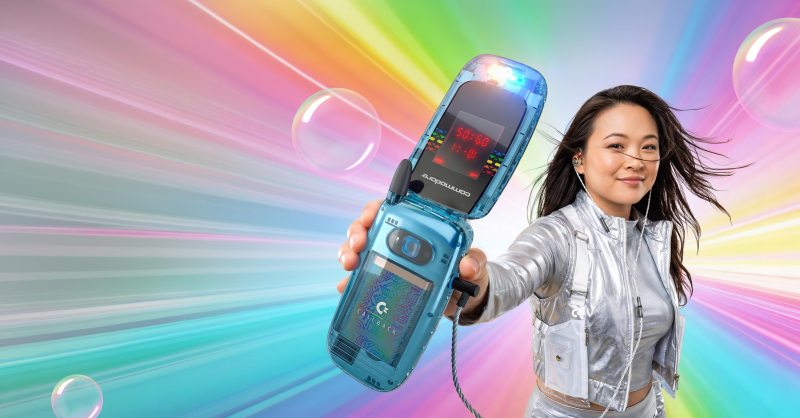
Whatever happens with the new incarnation of the Commodore corporation, we’ll always remember the old one fondly. Well, we’ll remember certain of its products fondly, at any rate, if not the corporate leadership that drove them under. About that, perhaps the less said the better. That’s why we’re looking at the revived Commodore’s latest offering with equal parts interest and trepidation — is there really a market for a Linux-based, Commodore branded flip phone in 2026 and beyond?
The official reveal trailer, which you can watch below, can only be described as weaponized nostalgia for the late 90s, which tracks because the revived C-64 is more-or-less the same thing for the 8-bit era. That said, between replaceable batteries, actually having a decent camera — a 48MP Sony module — quality Cirrus Logic DAC for audio, and running the Linux-based, Android-app-compatible Sailfish OS, the “Callback 8020” ticks all the boxes. Except for price, that is. Many will find the $499 USD launch price a little tough to swallow in this economy, so we hope they aren’t betting the farm on this one being a mass hit.
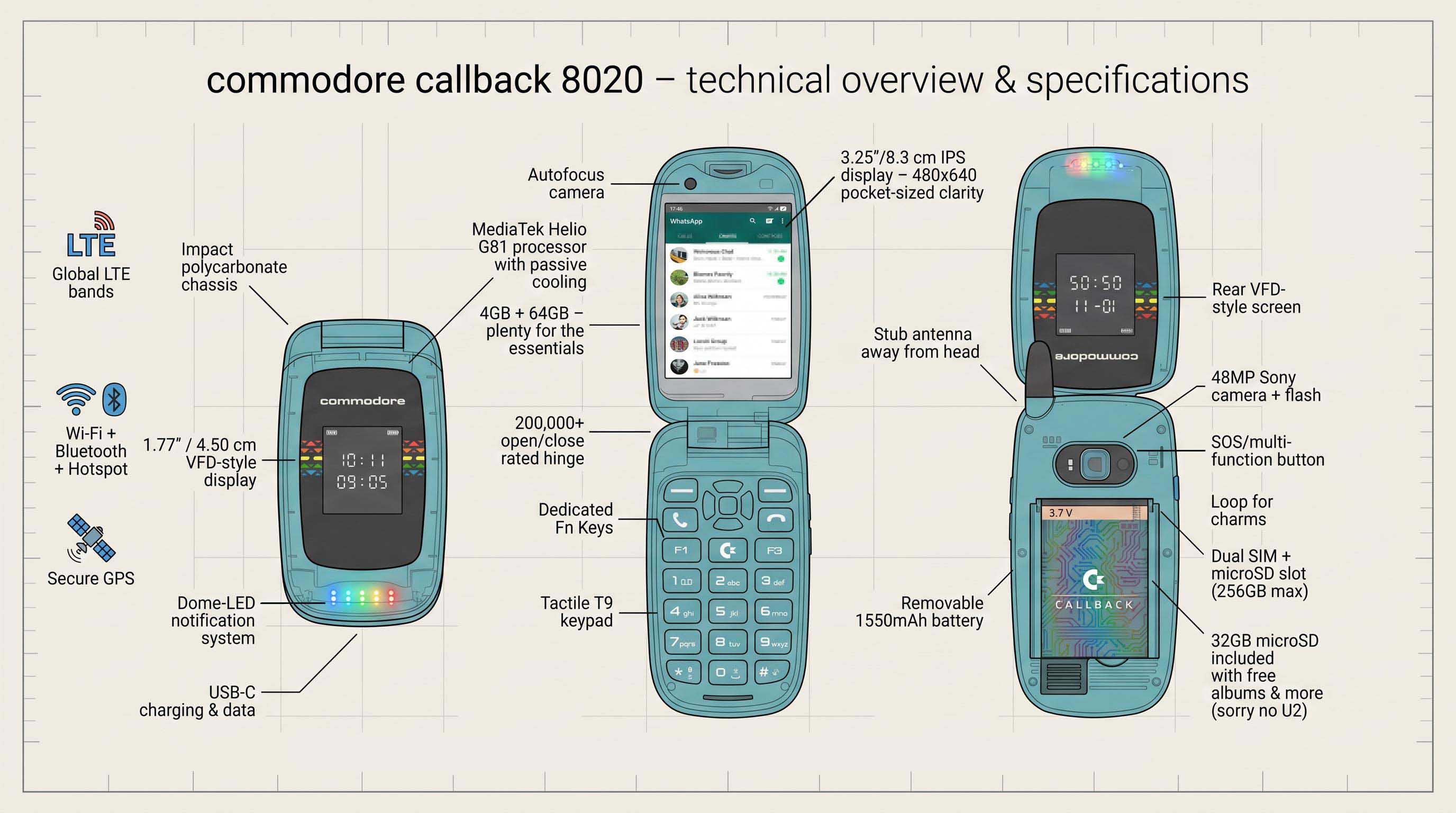
Still, compared to other premium “digital minimalist” products like the LightPhone III, the price looks reasonable — and with web browsing and social media explicitly excluded from the app store, this phone is firmly in that category. At least this one comes with some sweet Commodore branded headphones, which double as an FM antenna just like they did on your Nokia back when.
While it doesn’t come with DOOM from the factory, it does come with Snake and a selection of emulated C64 games . Ringtones are SID samples, but of course there’s no actual SID chip in the phone, any more than there’s a 6502. That said, if someone builds a phone around a 6502, please let us know.
No, it’s not a new Amiga, as so many of us were hoping for, but by putting quality modern components into the flip phone form-factor, at least they’re trying to innovate (or perhaps retrovate) and we have to respect that. Only time will tell if the market does.












I doesn”t have to have Doom but Gian(n)a sisters or Skate-or-d1e, of course
No want Flip Phone
BIG WANT qwerty slider.
Or a “candy bar” form factor! Needs QWERTY either way.
With modern autocorrect seeming to get worse, even from major industry players, I’m highly skeptical of any modern take on T9 from a small newcomer.. also T9 was pretty annoying to start.
I’d love a more real keyboard linux phone too, but still a flip phone is way way better than one of those annoying touch screens to type on when you must, as actual tactile feedback is just unbeatable allowing you to use the darn thing without looking, and means you don’t have to actually proof read every word to be sure the touch keyboard hasn’t made up button presses or auto corrected to entirely the wrong word.
As I’ve been needing a new phone for a long time I might actually be tempted, but going to need to look at what it really is on the Software/hardware technical front first.
I was also not entirely put of by the form factor.
My phone is more than 5 years old now so I was also tempted to get it.
The thing that breaks this concept however is that is completely stop you from installing or sideloading a browser or a mail client. And that is on a system level.
I don’t know who they think this is for but I can imagine it’s a lot of people.
Only 5? My phone’s 2nd? 3rd? replacement battery is probably getting close to that old! Yes that means the device is so old isn’t all that functional anymore as it doesn’t support volte very well if at all… I really should get a new one, and have been saying that for ages, but as long as the SMS ‘hey I’m at x’ type messages can be sent/received and the browser works its been good enough.
If they at least promised a documentation pile and perhaps even some support for alternate OS so interested folks could more easily make use of the hardware the way they want I think I’d sold enough to give it a go. The price isn’t exactly a marvel, but small niche product testing the waters it doesn’t seem that bad, and the design looks nice enough to be very comfortable to use.
Nobody will stock language specific keyboards, creating SKUs for every language.
idk, I’m going to make an apples/oranges comparison here, but have you seen Framework’s laptop keyboards? I’ve got an English/French Canadian, there’s yet another French Canadian, there’s Finnish/Swedish, Belgian, Int’l English, British English… If a company makes it’s multiple keyboards a big selling point, SKUs mean little. Computing in Asia was arguably pushed forwards, more than than kept back, by the innovations required to get logographic languages on PC keyboards. I haven’t studied Asian phone keyboards, but I’m sure they would surprise you.
Ok, yah, Laptops.
I think there is still “PC business”, devices are assembled as they are ordered.
Then you look at Apple and they do laptops the way phones are done.
For something like this they probably wouldn’t have to – just ship you a box of stickers with the alternative layouts on, or a bit more elegantly a printed insert that you can fit behind the clear keyboard buttons easily.
Industry estimates suggest that 75% to 80% of the world’s computer keyboards use the standard English QWERTY layout
Why would they bother creating SKUs and variants for every language?
TONS of devices have been built over the years that were only made in standard english qwerty format. They wouldnt lose much in sales volume sticking to a good old fashion QWERTY slider. All those “special” key people can stick to screen typing on their buttonless phablets.
There are other layouts like QWERTZ because there’s a 100 million strong German speaking customer base to buy them instead of QWERTY keyboards. Same deal with the French AZERTY layout, the Nordic layout… etc.
In the world market, 1% more sales is still millions of devices sold and millions in profit. Someone wants those millions, so that’s why they bother.
This. If there’s a winning format for mobile devices that should also do other things where a keyboard becomes a necessity that’s the ideal one. Here’s an interesting platform I found lurking around some time ago. All Linux capable, the flip one giving strong Psion Series 5 vibes. No idea about how good they are, reliability etc, would love to read comments from users.
https://www.www3.planetcom.co.uk/devices-specification
I second Cosmo Communicator, just the right form factor combining the best from both, flip phone and flat brick phone.
I bought a Communicator, and it was horrible. On a device where the keyboard was supposed to be the major selling point, the keyboard had atrocious rollover problems; on Dvorak, simply trying to write “the” would cause ghost characters. Other layouts were also comically broken, and seemed like they had been done by someone who simply looked at a photo of the layout: the tonos dead key in Greek, for example, was mapped as a second apostrophe key. Note both Dvorak and Greek are directly advertised layouts, and they sold devices with keycaps for them.
Beyond that, the HDMI out dongle was wonky, non-standard and unreliable. Battery life was abysmal. The advertised ‘planned’ Linux support never really materialized in a stable way, and the repositories disappeared at some point, with ‘they’ll be up again in a few weeks’ being suggested (they never came back). Support was almost non-existent, and even basic bugs in advertised features brought up on forums were left unaddressed, particularly after they moved on to selling their next device.
I’m astonished that they’re still selling the Communicator, and with the same advertising. They essentially abandoned the device as far as updates years ago.
Sad update, ineed.
I was noting the design, The Right Step in The Right Direction, finally, AWAY from the flat slate bricks that eem to be the only prominent/dominating kind of budget cell phone.
Sadly, don’t see any makers toppling over each other offering anything other then.
Unihertz has a few more novel form factors at a reasonable price – Blackberry keyboard style rather than slide out bigger keyboards only last I looked, but . They also seem to be a pretty decent company for looking after their clients – got one of the diddy jelly ones that was supposed to be my new phone, really nice to use (for a touchscreen) in even my giant mitts, fit well in a pocket. However sister really loved and stole it, then broke the screen, spare part for that model at the time were trivial to order the repair as smartphones go trivially easy (which is to say I’d think anybody can do it, not that it is really really easy).
Be nice if Unihertz helped the folks that want to make custom ROM for their devices more, but that is a pretty much universal problem so not something I can really hold against them, as they were equally not trying to lockdown and deny you playing with your device.
I would stay away from planetcom. The whole Astro Slide debacle, lots of people out of $700+ and nothing to show for it
exatly … i want my G1, but now-anised … best phone for its time i ever had
Omg I miss my helio ocean, that dual slider was amaaazing
“BIG WANT qwerty slider.”
YES…..PLEASE!
Hmm, bit too much of a stance for me. I don’t want the social media apps, but I really do think a web browser is a useful thing to have in your pocket.
You can always load the APK of your favourite browser. It’s not locked out at the system level; it’s just not in whatever they’re calling their app store.
I don’t know what they mean by it, but the website literally says it’s locked out at the system level.
Their “four phase” patented system should prevent loading browsers. I get a very “we hijack retro sentiment to put the digital surveillance on steroids” vibe from their site.
I’ve heard you can hack their walled garden by typing LOAD “”.
ssh works?
It’s just sad the newest phone with SailfishOS is an expensive Commodore device which highlight is doing less things than the other phones, and with a pitch so filled with obviously generated AI slop that makes my stomach turn.
Give me my new Linux based Nokia E71 please :'(
It will be a bumpy start for sure, but we could use a big corporation that is sincerily on our side. I’d rather buy this than an Iphone, and to me it is way cooler.
I don’t think this Commodore is a big corporation to any extent more than my local plumber is.
Yeah they’re not big. Run by a YouTuber.
How do you do banking on this during vacation? You carry a 2nd phone?
Banking on your phone? Good Lord. You get what you deserve.
Sound like it is time for you to change bank.
Needs a Commodore beige version.
There is a Commodore beige version.
Oops, looks like I missed it, but it’s there on the site. I seem to remember the C64 being a shade darker though.
There were multiple shades of beige to the C64 depending on the version, with the original “bread bin” being the darkest, and C64C / C64G in different shades of lighter.
Just keeping up the bad business decision tradition of Commodore.
“secure gps” What, how, which??
Same reaction
I can only speculate and I assume they’re less that successful. Modern phone AGPS augments accuracy from many sources, telco networks, wifi and bluetooh scanning. Each of these augmentations allows a provider to log location, probably anonymously, to “help make gps” better.
Something like: “These are all the Wifi/BT devices I can currently see, my geolocation is XYZ.”
In turn your phone, when powered on can ask: “These are all the Wifi/BT devices I can currently see, give me a rough geolocation so I can fix satellites quickly.”
So, your OS maker, chipset supplier and cell provider run databases to make things work smoothly.
Did some digging the only publicly authenticated GPS available is
https://www.u-blox.com/en/technologies/osnma-galileo-spoofing
There is something really weird about how corporations and their IP and trademarks can be gobbled up such that we can see things using the name and logos of the old companies long after their death.
This can’t be healthy and probably undermines the purpose of trademarks.
While you are correct in general in this case I’d give them a pass – they are a revival of the old Commodore bringing various community members that have kept the C64 alive together along with owning the IP etc. They are to some extent a nostalgia based company revival, but that won’t be enough to last as a real company will it?
So at the same time as redoing the old for a modern audience, creating new products with some of the same ideals for the tinkerer seems like a good idea – not sure this specific product is going to be a good idea yet. But you can’t sell new C64 forever.
That’s nice for now but it does still seem weird. Think about 100 years from now, IIRC someone could still own the trademarks through whatever convoluted chain of buyouts may occur.
The best case is these names get purchased and used like here to make throwbacks, worst case we have the zombies that make up media. Companies are bought killed, revived, IPs absorbed until nothing of the original remains with no one able to use them for a lifetime or longer.
It isn’t that weird really – where did IBM start and what do they do now, Lamborghini and so many others started as Tractor or Bicycle companies before becoming something else (etc). Evolution of a company is to be expected, the IP and ethos of the company might last decade after decade anyway, or it might not.
For those that didn’t really survive the zombie IP crap is annoying but hardly matters – no one will be able to use them for a lifetime, but who would want to? Whatever reputation they once had has been erased! You want to effectively start a new company with the ethos of the old one you can – only reason to want that IP is if you are also wanting to produce the old products again.
Indeed — how about the sad fate of Radio Shack, gobbled up by that online scamster who famously shot video of himself in a garage that contained a bookshelf full of what appear to be books and a Lambourghini. SMART and RICH! I think he used that brand for some skeezy NFT play. NFTs! How soon we forget!
It was all bought by Peri Fractic and a collection of other Commodore retro enthusiasts. I wish them well with this new endeavor
Sure but in general that doesn’t happen. All the game studios that get bought and then shuttered for example.
Peri Fractic’s real name is Christian Simpson. The decision to market this flop phone seems to have been made by his brother Homer. DOH. What a mistake
I wonder if this OS will be made available for install on other phones ??? I imagine a retro revival if it can
Sailfish OS isn’t a Commodore product; It’s already available on Jolla phones and some Xperia models:
https://docs.sailfishos.org/Support/Supported_Devices/
The OS itself is also Open Source, but the Android compatibility layer and the custom interface designed by Jolla everybody praises are unfortunately closed. They said some months ago they want to Open Source them in the future, but as of today… that’s what you get.
It’s currently only available in Europe. If you’re in the US, you can’t buy a license to install Sailfish on your Xperia.
i tried the fxtec pro1 when it finally launched and was disappointed to find that pretty much every app out there has abandoned landscape mode. ESPECIALLY gsuite apps. it was a major disappointment and made qwerty mode pretty much worse in every way. i feel like we need to solve a lot more than just adding a keyboard.
i wonder what things break in apps that expect to have a touch screen. ie how hard is it to arrow around their ui.
According to the FAQ on the website there is a touchscreen that is disabled by default but can be enabled for each app.
I have actually been interested in something like this for a while, my phone is constantly at risk due to my job, + I would like a flip phone with a great camera that is unbreakable, And I would like it to basically have my main phone forward its calls to it when I’m working, no texts allowed. But the price point is all wrong, my giant pixel 10 XL pro is a great phone but I am going to destroy it eventually and then I’m going to be pissed and be out $1,000. I would definitely be interested in this if they would make a lighter version of this phone for about $200 with the same gray camera and all that, my one catch is is that the phone does need to have access to Google Play / photos so that all the pictures get automatically synced with Google photos.
Have you looked at the CAT phones? They’re quite rugged, although I don’t think their cameras are great.
Otherwise, the https://www.dumbphones.org/ phone finder might help you find something?
You might want to check devices with KaiOS (Androids silly nephew) last time I checked, Nokia had those devices with 5MP camera. Nokia 800 Tough may look good for you but camera and screen suck.
Other option is Samsung XCover (Samsung Solid’s grandson).
Having read further I’m not sure this really does tick all the boxes – it is interesting, hits a few good points I’d want like wifi hotspot features, and the deliberate no browser and most social media type stuff I can understand some people would want. I’d even largely agree its not really the best device type for them, and the whole detox thing might be what you need help with in which case great – but still I’d want a browser. Navigation features does you no good if you can’t look at the store’s website for their opening hours today etc.
So having the OS actively block applications and apparently block side loading them too with some sort of black/white list and with no mention of providing a ‘and for the developer crowd here is everything needed to just run native real Linux, UBTouch, etc so you can really do whatever you want on your device’, that doesn’t sit great with me. No doubt some experienced folk will be able to get at least many of the features running without any documentation, its a relatively common chipset etc, but what is the point of the phone with a good DAC, real buttons etc if you can’t give you OS of choice a way to make them work, which is so commonly the case with such efforts. Actually solving the puzzle to get some other bit of the device working without help might be rewarding to some, but it doesn’t make for a good device.
$499.99 preorder
i used maemo nearly 20 years ago on a nokia n810. it wasn’t really a stable platform…they just used whatever open source stuff was handy, hacked it just enough to work in their setup, and then shipped it. The very next version pretty much reinvented things from scratch…so the upside is Sailfish will have very few of the boneheaded decisions that Maemo did, after these years of churn. But the downside is, there’s nothing there, it’s all just poorly-cobbled-together separate components. i like open source components but on Maemo key components were closed (a thin ‘open’ wrapper around proprietary garbage, like Broadcom Pi boards), and nothing really worked. Any effort i put into developing for Maemo was wasted because none of those APIs were supported into the future.
I want an alternative to Android but i would be surprised if this is remotely viable. I expect they’ll ship it and then close up shop when the early reviews dry up sales.
Unrelated, but related, is there some kind of 5G kit that one can home-DIY-reuse for something like lowly ESP32-P4?
Presently I can only find 3G “kits” that are mostly of no use in the US. 4G maybe, but it, too, could be suddenly shutdown like 3G (cell-phones-wise), so I’d very much rather have it 5G ready and working. Also, I do not want to be stuck with locked-in cell phone deal either, SIM card only, no provider cartel/maafiaa.
Alix has some interesting choices, though, unsure how far these would travel before being whacked with some kind of 100% tariff or turned around and sent back (happened to me already, btw, luckily, refunded in full). Or maybe I have to travel to Canada to get one and bring it back in person, whichever.
robotshop has a 5G Waveshare Quectel RM500U-CNV if youre willing to pay $200 and care to adapt an m2 device to your application. PiShop has an adapter hat that will do the job.
Good stuff, thank you for sharing : -]
I’m not sure about USA, but here in Canada that solution would be data-only.
Voice calls, after the 3G rug pull, go over VoLTE, and that isn’t just a matter of matching frequencies– even “bring your own phone” prepaid carriers here seem to operate on an IEMI whitelist for VoLTE, from what I’ve heard. (If there’s one that’s actually going to accept the phone I bring them onto their network, a fellow Canuck can point me at, please do! I’d love to be wrong.)
That said, a data only plan might still work for a DIY phone with a good VOIP bridge.
Great idea, but the price is completely out of touch in this economy. Hard pass. Get it under $150 and I’m in. Maybe a cheaper camera would be a start. The same target audience for this probably uses a separate digital camera.
If they can keep AI right out of this, have linux, hotspot, ssh/ufw, BT keyboard, vnc, whitelisted calls only, drive my headphones. Then this is more my dream phone. Real low rez camera that does nothing more than a QR code.
There are choices for most people, but in the need accessibility but not-google/not-iphone arena it’s still heavily screen/android weighted or unsuitable oldies phones, which are never linux.
I am weird and very much away from everyone else, but I am more than happy to be a Luddaite thanks.
i’m not sure how much sailfish has evolved or how much commodore intends to lock it down, but generally sailfish is “just linux”. it’s not like android where they replaced all of userland when they skinned it. so there’s some open questions especially around accessing the modem if you want to make your own phone app to implement your whitelist. but i’m relatively optimistic that the rest of your list should be achievable if you are willing to hack it.
think of it more like a next generation pinephone and less like a consumer product, is what i’m saying.
Good idea, but not at this price.
This could have been a downgrade many people would go for, but has actually become a luxury commodity for people that need to show off how much they do not conform to the new reality of the internet.
Like it or not, unplugging like this is a luxury. That’s why all phones with a “digital minimalist” slant cost more than low-end smartphones, and you can’t hardly buy a dumbphone for any cheaper.
The people on the bottom rung don’t have PCs, in general; if you’re living out of your car or sleeping rough, you’re probably doing everything on your phone. Then you really need that connectivity.
Back to the 2000s?
I’m 60 and remember the days wo/cell phones. I’m more of a tech geek than I assume many my age are. I would be satisfied with a reliable, Linux based phone that I can control as well as my Linux computer. Install what I want, remove what I want and allow me to physically turn off things like Bluetooth and WiFi (and maybe GPS). For example my phone currently has 3 browsers on it and the two I don’t use I cant remove. Also make it so it can accept a microSD card and have a removable/replaceable battery. With those features I can choose what social media I want to install and use ( I deleted my Farcebook account YEARS ago). I know of one maybe two phones that are trying to get a foothold in the market but I’m not sure of how reliable they are at this point.