
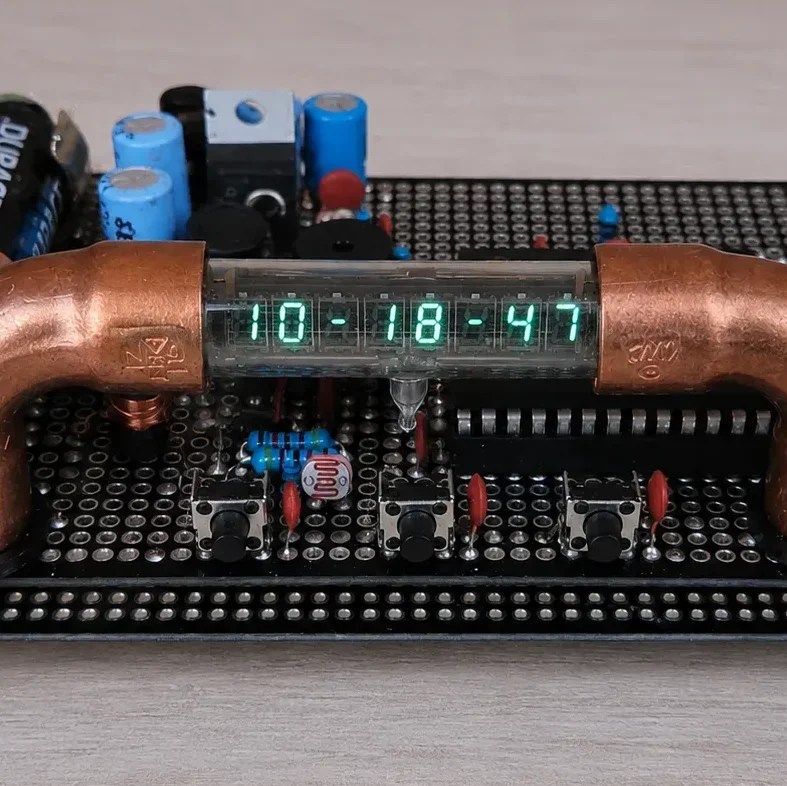
There are lots of different ways to build a clock. [Sciter_] came into the possession of some old calculator parts, and decided to reuse them for just such a project.
The heart of the build is an ATmega328P microcontroller, running off of a 32.768 kHz crystal. This allows the chip’s counters to neatly divide down the frequency to get a steady 1 Hz pulse for accurate timekeeping. Time is displayed on a vacuum fluorescent display (VFD) harvested from an old calculator. These displays need rather high voltages to run, which in this case are produced by a HV5812 driver chip and supporting circuitry. The display itself is neatly cradled in a pair of copper pipe elbows for a stylish look, with some addressable RGB LEDs present to provide some charming underglow.
Power for the device comes from a single AA battery, using a transformer-based low voltage converter. Alternatively, it can run off a USB 5 V power supply, which also charges the NiMH AA cell while available with the aid of an LM2576-ADJ buck converter.
Overall, it’s a neat homebrew clock that taught [Sciter_] plenty during its construction, and not the first time we’ve seen somebody put together a clock with second-hand VFDs. If you’re finding fun ways to reuse old display tech, don’t hesitate to let us know on the tipsline.












It’s actually 5V USB powered with AA battery full backup. A major battery eater because the VFD filaments alone are around 1/2W then add the boost converter… I don’t see an RTC used.
My Icetube Clock slid off my desk onto the floor, the IV-18 tube smashed to pieces.
Moral of the story – it needs a decent case. Don’t make a PCB that can slide around or have a power cable that can get yanked. I bought a replacement VFD and fixed the Adafruit design errors and it works fine.
That is the biggest tradeoff when building a nixie or VFD project. Risk verses appearance. I find it hard to resist putting the glass out on full display.
Nice one, pretty look old VFD digits.
Those LEDs are described in the text as “small elongated COB-style LED bars”, not addressable RGB, and are each driven via a 5k1 resistor. In any event the idea of putting them in the glass tube from a fuse is definitely one to remember.