
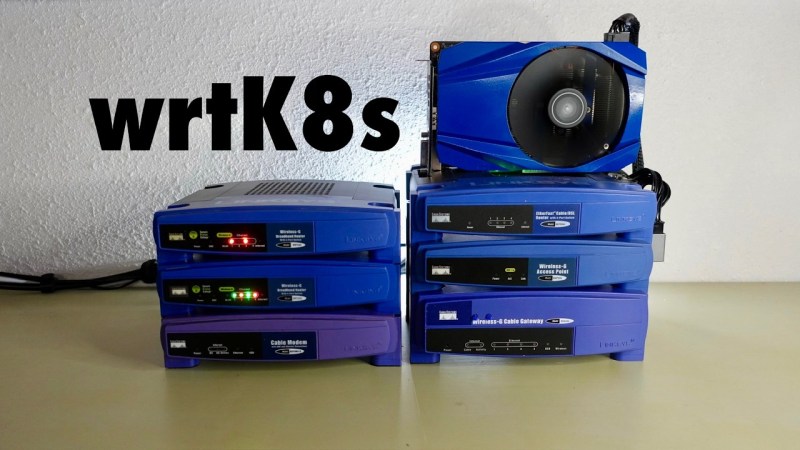
If you’re building a homelab rig, you could just use off-the-shelf hardware in standard cases and slap it all in a rack like the normies do. Or, you could follow the example of [Justin Garrison] and build a more oddball setup.
This particular homelab is, at its heart, built from familiar components. There are two Raspberry Pi 5s, two Raspberry Pi 4s, a GMKtec NucBox M6 Mini with an ASUS GeForce RT 2060 GPU, a LattePanda IOTA, an NVidia DGX Spark, and an HP Z4 G4 mini PC. These machines are all laced together with a TP-Link LS108GB PoE switch. [Justin] has the mini PC running the control plane components, with the rig as a whole running Talos and Kubernetes workloads. What makes this build particularly appealing, though, is the aesthetics of the rig. [Justin] documents how he hacked this hardware to fit into a bunch of old Linksys router cases, which provides a pleasant early 2000s look to the build. This included a bit of hackery to get status LEDs flickering as they should be. [Justin] also took the time to make the power buttons accessible.
If you want to stunt on your friends with a rad homelab, you either have to go for maximum power, or maximum style. This build would be the latter. Video after the break.












I didn’t watch the video but I don’t get it. Is it a bunch of R-Pis and a x86 mini-PC stuffed into some fugly old router cases? Why? Might as well stare at the rubbish bin.
I didn’t read your comment but I don’t get it.
Why so negative? Might as well not comment and just go on with your life.
What else am I supposed to do while sitting on a throne and struggling with pushing out that last bit of poo which annoyingly decided to turtle head itself.
buy a bidet
Doesn’t solve constipation.
I’m 30 seconds into the video and he said “I enjoy building random things out of random cases.”
I can see the appeal. It’s not necessarily “better.” It’s a hobby. For enjoyment.
Seems like a good enough reason to me. Good luck with that turd.
Ok, go stare at the rubbish bin then.
Helps analysis what the “Linksys aesthetic” is. Color. shape, placement, fonts, etc?
It refers to the styling of the original Linksys WRT54G:
https://upload.wikimedia.org/wikipedia/commons/thumb/6/6a/WRT54G_Linksys_Router_with_7_dBi_Antennas_Digon3.jpg/960px-WRT54G_Linksys_Router_with_7_dBi_Antennas_Digon3.jpg
lol the first thing i used to do back in like 2006 with linksys router motherboards repurposed and reflashed to be raspberry-piesque was to remove them from their unnecessarily bulky (and dare i say ugly) cases. the exact opposite of what is being done here. we could’ve had a jack-sprat-and-wife symbiosis had we stumbled upon a motherload of linksys routers are the Tibetan Center thrift store just west of Kingston NY on route 28!
Wrtk8s: kubernetes reimplemented so that it fits on a 4MB flash Openwrt wrt54gl :-)
Openwrt has docker support btw, pretty sure it does not fit on 4MB flash.
One could reimplement it way simpler and just spin containers with chroot (written the year i was born in 1979).
i genuinely don’t understand ‘homelab’ concept, and i think this reflects a maturation of a deepening generational divide. seems to me like an abstraction of the concept of understanding.
i think i put my finger on it. to me, the fundamental idiom for thinking about computing is the capability. input, output, storage, computation. i’m convinced the word ‘homelab’ is symptomatic of the fact that for many people today, the fundamental idiom is ‘the root of a dependency tree’. honoring a dependency tree is not just another feature of installers and linkers and so on, it’s now the fundamental abstraction that people expect from their computer.
I remember when homelabs were like “run secondhand commercial switches and routers at home to learn Cisco IOS or JunOS and get certifications that get your foot in the door”, and it’s still the same general idea, a learning environment for commercial computing. It was “VMware” for a while and now it’s Kubernetes. There’s things that you really need multi-node clusters to learn.
Considering some of the gear on the used and new market, homelabs will certainly up their game to meet some of those ambitions.
Hm, I guess a “homelab” is the computer enthusiasts equivalent to an amateur radio shack (ham shack)?
A sort of man cave, basically? :)
It can be as simple as a NAS, a VPN, and a few internal services that you don’t want to host in the cloud. It’s as simple or complicated as you want to make it.
Huh, a case mod project? I think that’s well done! Congrats! 🙂👍
Reminds me a bit of those Iomega 5,25″ external chassis for PC/Mac!
They’re stackable, too!
(I do hope the internals of the routers can be re-used for other projects, eventually.
Say, as an RJ45 to SLIP media converter. Or something along these lines.
You never know when something obsolete might be usable again.
Old analog modems, for example, are great for simulating an ISP to old game consoles and such. See DreamPi project etc.)
Yep… should have saw this coming.
I just did a major purge from my garage workshop. I took a car-load of stuff to a hamfest and tried to give it away. (turns out it works better if you try to sell it.. people will pay for things they won’t take for free).
Then I took the leftovers no-one wanted to a recycler.
I hate doing this but… I can’t really work on anything until I make some space and re-organize.
Well.. anyway… something I got rid of was the shells of my old Linksys router and amplifier which I kept after their internals stopped working. I liked how they stack and thought they would make great cases for a project like this. But… 20 years and still hadn’t used them… they had to go.
So of course.. here it is on HaD only about a week later to remind me what could have been.
Well.. I’m not sure where those cases ultimately ended up. Maybe someone is doing this very project with them right now. I doubt it but I would like to think so.
I don’t get the people who don’t get it. I mean… of course no style is for everyone. But you really can’t see how some would like these?
Back in the day when Linksys was it’s own company, before Cisco bought it this style was a thing. They had several products one might use together such as routers, wifi amplifiers and ethernet switches. I don’t really remember the whole lineup. Anyway, they all followed this same visual style but also the same sized cases. Each case had 4 feet that extended downward and matching divots on the top so that they would stack and more or less lock into a stable stack.
For someone doing what today might be called ‘homelabbing’ the effect was sort of like having a rack. But smaller. And you didn’t have to buy the rack. It was perfect for the server-desk-corner as opposed to the server-room.
I don’t think this survived for long once Linksys was bought by Cisco.