
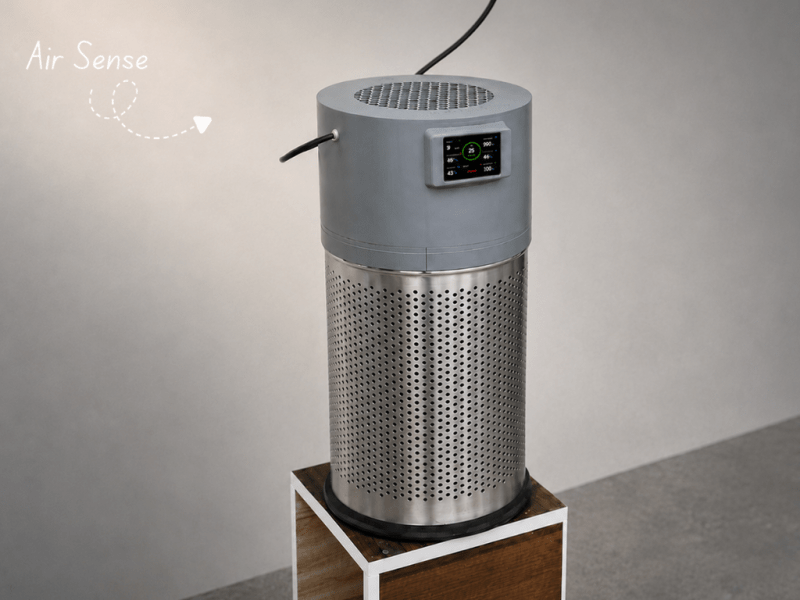
As predominantly indoor creatures, it’s important to maintain a healthy habitat for the hacker. [Kishan Pratap Singh] designed a clever solution in AirSense, an ESP32-powered air filter.
If you’re thinking of cleaning the air in your environment, you might also want to know some properties about the air coming out of the filter. AirSense measures PM2.5 dust concentration, Air Quality Index (AQI), temperature, humidity, and atmospheric pressure. The various sensors are mounted along the exhaust path of the filter, which lets your know what kind of air it’s pumping out.
The system drives a 150 mm exhaust fan mounted in a 3D printed cap that pulls air through a cylindrical Xiaomi HEPA filter inside a perforated metal trash can enclosure. The ESP32 and an LCD readout of the environmental data also live in the cap, giving the device a sleek look. While [Singh] chose to run the filter continuously, we wonder if it might be interesting to set it up to only filter the air if air quality drops below a certain level to conserve power, especially if you’re on a time-of-use power plan. That would require redesigning the sensor assembly (or running the unit in reverse), so maybe it’s over-complicating things?
We’ve seen the Xiaomi Air purifier filter mentioned before, but under the auspices of hacking it’s filter DRM, an open source air filter designed by [Naomi Wu], and even an ESP32 pressed into service to plug an air purifier into Home Assistant.












My air quality sensor goes nuts when I make bread. Its a bit disturbing.
Does it measure VOC’s? It’s probably just detecting fermentation products the yeast is farting out and that get baked out in the oven. Nothing to worry about.
Happy with my “intelligent” AliExpress filter, it also has a pm2.5 sensor, it connects to my home assistant sonic can monitor and control it from a distance and the whole device was cheaper than just a few parts of this DIY project
Its also probally beaming a live feed direct from your house into a chineese AI bot while also scraping every account and password info that it happens to see on the network
Easy enough to prove / disprove, and, when it´s the case, to block.
Considering the demographics here, I imagine such nonsense doesn’t go as far.
Even if that were true (which it sometimes is), it’s often cheaper to buy it for parts and rebuild it to fit your needs than it is to acquire the parts. Economies of scale can also be leveraged for individual use…
Nice… One thing i would do is add a fine mesh screen inside the tube, then in the gap from that to your HEPA… Place in granules of activated charcoal to that gap…. I buy the granules in a container from the tropical fish man, The added charcoal cleans the air, like a NIOSH gas filter cartridge does on a face mask.
The charcoal will work for ~3 months, 90 days… if you add it it will actually POLISH the air and get out even more contaminants. If you program the ESP32 to keep track of the days passage, you can even setup a monitor to track when you need to replace the granules….I do my HEPA annually, and i do the granules every 3 months like clockwork. I am sick and have to polish the nasty out of the air to stay healthy, this is how i do it…. A single container will do you for ~ 3 years of charcoal if you get the large 2 L container.
If you get large granules that will not come out the holes you can skip the mesh part.
This is the best way to remove chemicals from the air…. My fan has been running for over 9 years now and it is still a trooper. Nice look.
Polish air smells too much like kielbasa, in my opinion.
A pm2.5 sensor before and after the filter would be interesting for monitoring filter efficency …
If theres one thing in my life I need to track, quantify and log its a dumb ahit air filter barely powerfull enough to turn over a small coat closet in a day
The fan is rated for 300 cubic meter per hour. In reality, it’s probably half of that because of the filter’s dampening, but 150 cubic meter per hour is a large processed volume. If you live in a 100 sq m condo, with 2.5m ceiling height, this system is processing the whole volume in 1h40. This leads to another “issue” in the design, there’s no way the HEPA filter will keep filtering such a volume for long. It’ll saturate with dust in few hours (maybe days) and then be useless. It needs to be protected from the particules that could cover its hole size first, with a standard filter that will have to be washed often to work. So this gizmo isn’t actually doing what you’d expect it to do, there’s a reason air filters are made with multiple filtering layers.
A HEPA filter will reduce it by way more than half. Especially on a fan not built to deal with obstruction in the first place.
yeah if we’re going to be collecting data about this unit, the data i want is how much air actually moves through the filter. i have been under the impression that this sort of fan isn’t good at back pressure at all, but i’m not an expert. i would personally be drawn to a bathroom fart fan if i was designing something like this, which is a tiny squirrel cage fan in a cheap standardized size
Yeah. A MERV13 with a 20 inch box fan will flow MUCH more than this, let alone a corsi-rosenthal box with four MERV13s (which actually flows more than 4x because the fan doesn’t handle static pressure well)
Yeah, but it’s going to do that no matter what… the telemetry is redundant. If anything you would want to know what the overall air quality is, not just what’s coming out of the filter. That tells you nothing about what you are actually breathing.
Agreed that monitoring the air coming out of the filter is pointless. Unless you maybe suspect you were sold a fake HEPA filter, you should be able to assume the air coming out of the filter is clean. The real, more interesting question is: How dirty was the air before going thru the filter?
The display shows a temperature of 39 degrees Celcius!? Is it the real ambient temperature? or it is heat-up by the nearby ESP32 and the dust sensor?
Fan is not good for static pressure against HEPA.
On amazon they sell water based filter, push the air over water and it captures particles.
But needs frequent change.
Computer fans made for dense heatsinks can be good enough pressure if the filter is large compared to the intended flow rate.
Amazon sells bongs?
My choice of blower came from a Mazda rear air conditioner… If you run it on 5v it is barely audible and can move tons of air…
Doing this project requires a squirrel cage fan for the best results…
Blowers from cars are perfect for this application.
For the price of the air filter used in this project you can buy a used Xiaomi Air Purifier 2 or 3 device, full and working, with ESP32. It makes zero sense to build your own.
That applies to a lot of things that show up on Hackaday. There’s almost always a commercial offering that does the same thing, maybe even better.
This is, however, HACKaday. Not BUYaday.
It’s about folks making things , not folks ordering things from Amazon.