
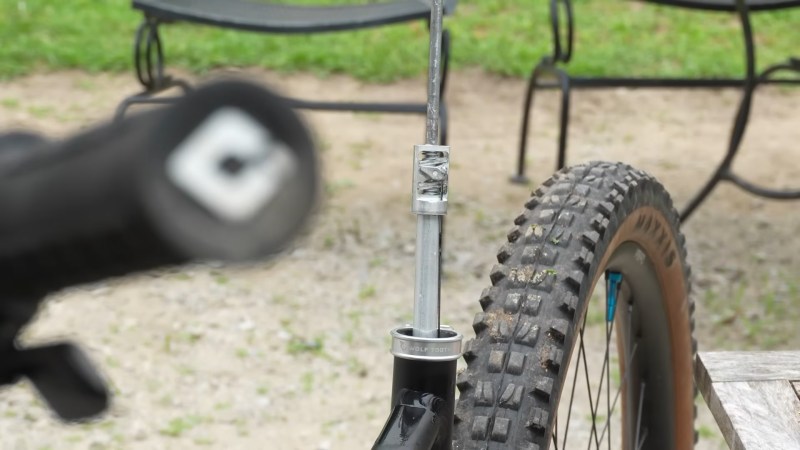
A recent addition to mountain bikes is the dropper seat post. This invention is in the vein of office swivel chairs, allowing the seat height to be adjusted with a simple handlebar mounted lever. They are rather fascinating inventions ranging in complexity from simple mechanical systems, to electronic monstrosities actuated by Bluetooth. Inspired by the panoply of possibilities, [kane components] set forth to create such a home-built dropper post.
Inspired by woodworking bar clamps, [kane’s] design utilizing angled plates binding against a rail inside the dropper post. Two pairs of plates sitting at opposite angles resist opposite forces from either the rider sitting on the post, or the return spring. A simple cable actuated cam moves the plates to a nonbinding position when the lever is actuated, and springs return the plates to a binding rest-state. The return is handled by an air spring pressurized against a piston at the bottom of the shaft.
Though 3D printing could be used for a cursory test the mechanism, properly machined parts are needed to handle the loads running through a typical seat post. But instead of machining everything from scratch, [kane] reused the lower post and bushings from a broken post. To fit everything together, the lower post got thread milled so the entire mechanism can be threaded into the seat post as a replaceable cartridge. The upper telescopic section consists of aluminum tubing and a custom machined seat clam mechanism press-fit together.
As is the case with all engineering projects, a number of issues came forth once the dropper post made it onto a bike. Issues ranged from the cable pull causing the seat post to move slightly, to all manner of mechanical jamming. Filing down the ball end of the cable so it didn’t rub against the outer-housing of the seat post fixed that particular issue. The two-piece upper design also proved problematic with the press-fit having a bad tendency to come apart.
Despite these particular issues, did it end up working? No, not consistently. The binding mechanism does not consistently produce enough force to keep the dropper post from falling under a rider’s weight. Regardless, we really enjoyed following along with [kane] for the journey of creating such a mechanically complicated bicycle component!
To our surprise, this isn’t the first dropper post hack we have come across. So make sure to check out this bodge of a fix for a far more complex (and expensive) dropper next!












Too many fail points, little bobs to dig into soft aluminum. That aluminum shaft to break off would be a pain in the butt. There were lab-classroom stools that pull up then pull harder and it goes down to the bottom, pull up less to lower. Might be a problem when hanging air.
This dropper post invention looks like something that might really help me ride more comfortably. I like to have a low seat when I come to a stop so I can use both legs for stability while waiting at a stop. I like to have a high seat support and immediate axial control via the saddle when I’m running down the road with full leg extension.
Over charge the air spring and you have a bicycle ejection seat/anti-theft device.
One missed opportunity here would be to create a quick-release seat. Imagine leaving your bicycle somewhere in public. If you don’t want it to get nicked you could quickly swap seat to an adult toy. Unless the thief has iron buttocks, he’d suffer push-pull behaviour on every crank.