
If you run a large meteorology bureau, then you probably have access to a wonderful weather radar for scrying the heavens. The rest of us aren’t so lucky. If you find yourself bereft of such hardware, though, you could build your own, taking your lead from [Koakno]’s fine example.
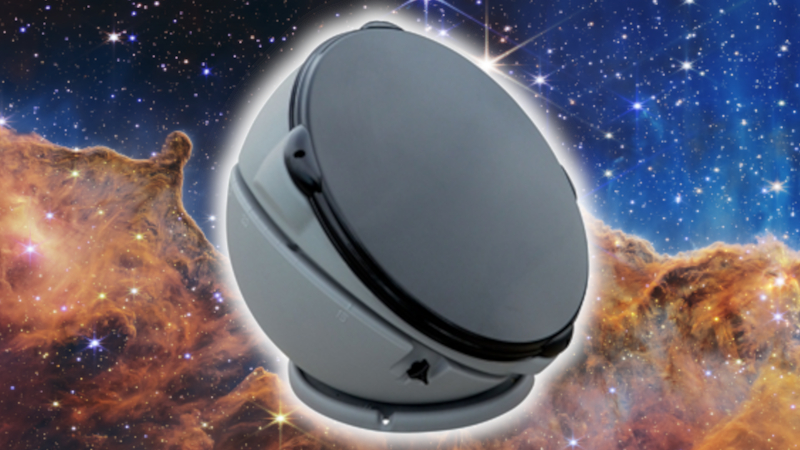
The build uses a satellite dome salvaged from an old RV that [Koakno] scored for just $5. Specifically, a Winegard Carryout Anser GM-5000. The motorized parabolic dish was designed to track TV satellites, but here it’s been repurposed into a scanning radar antenna for X-band signals. It’s paired with a cheap SDR—you can use several on the market—which injects an 850 MHz signal, which is up-converted to 10.4 GHz by the low-noise block (LNB) in the GM-5000 and sprayed out towards the weather.
Echoes come back from rain, hail, and debris, and get down-converted by the LNB back into an 850 MHz signal that the SDR can capture. The echoes are then plotted on a Plan Position Indicator (PPI) display, showing what’s going on in the atmosphere around the dome. [Koakno] reckons detection ranges span out to 40 km for things like heavy rain, while a supercell hail core could be spotted at up to 60 km in the right conditions.
It’s worth noting something important, though. [Koakno] explains that this system is currently in violation of FCC regulations, and shouldn’t be used without the proper licenses to access given spectrum. It’s a useful study of how to build a weather radar, but perhaps not something you can just wire together and fire up without getting in a spot of bother.
If you’re a die-hard tornado chaser or you’ve just always longed to stare meaningfully at a PPI display, this could be the build for you. We’ve featured other DIY radars before, too. We’d also like to see yours, so when it’s done and written up, fire us a note on the tipsline!












Extremely cool build! Its so nice to know that DIY radar is not only possible but can be used to do productive things
Always remember, the first radio and radar transmitter was also in fact, violation of future FCC regulations
So many questions…
Like how does a LNB turn into an upconverter and transmitter? Especially one that does transmit and receive? Especially when the SDR transmitter is connected to the output of the LNB?
FMCW buys some process gain, and X band (10.4 GHz) gives higher return than the usual weather radar S band. BUT how on earth do they expect 1-5 mW of power to get 3-8 km of range when it takes literally almost a BILLION times more power (1 MW) in a conventional weather radar to get out to 200 km.
Smells like a huge project ingredient here is “wishful thinking”. I do note the distinct lack of any images or data.
There is no FMCW or anything, the current, seemingly incomplete state of the SDR code just blasts a full power carrier wave as the pulse and that’s it. The receiver side doesn’t seem to work with live data in the current version.
It would be neat to have these all over like meshtastic radio. Then we could get real time weather info.
Range in RF signals is not linear, but exponential. So a range of 3km with 5mW while a Range of 200km with 10kW is somewhat plausible.
The github readme dies not give any details on what he does to the LNB to make it transmitt, there is only a GUNN diode on the parts list as a 10GHz source. Did not open the zip. Who puts zip files on Github?
I highly doubt it is possible to make one LNB transmit and receive at the same time. I have seen people inverting an LNB for TX, but only by de-soldering and mechanically flipping all tranistors inside, and additional bypassing filters. So in the end it is again one direction only.
If he managed such a feat as a two way LNB mod, then this is unique.
We want details!
Jeri Ellsworth did it: https://www.youtube.com/watch?v=Dhp21FxttWM
Not exponential. Inverse-square. The Friis Equation applies here.
https://en.wikipedia.org/wiki/Friis_transmission_equation
And since it’s a two-way transit, you square that, so it becomes the radar equation:
https://www.rftoolbox.ca/RadarRange.html
But even when you recognize that it’s actually inverse-fourth power (inverse-square in each direction), and even add a fudge factor for path attenuation, it still doesn’t scale enough to get 3-8 km of range on 1-5 mW, unless there’s significant process gain somewhere (like you could get with FMCW).
And that is not the Ellsworth video you want. You probably actually want the one where she actually modified a LNB: https://www.youtube.com/watch?v=vDyo_OQFdAc
And that device has a range of a few centimeters, not kilometers.
But the OP apparently didn’t even modify the LNA: Just plug a transmitter into the LNA output and hope for the best, it seems.
Cargo-cult engineering at its finest.
It MIGHT be possible to use this legally under a HAM license, if it transmitted a callsign instead of a pulse and could be considered a propagation beacon. (or if you were listening for a reply and not just an echo.)
It’s easy enough to encode the callsign at the beginning and end of the transmission. (Which, doesn’t have to be transmitted as the same process. Transmit callsign/transmit signal/transmit callsign when done or X minutes).
Pfff, if you embedd your call sign, it’s an legit operating mode! Just look at things like this: https://rainscatter.com/ (no affiliation!). Rain scatter, cloud scatter, meteor scatter are all known and cool stuff
73
Look up how many times idiot storm chasers have been fined by the FCC for running unlicensed marine radars inland.
Given that I used to be a meteorologist, and that a colleague of mine (a PhD thunderstorm researcher) died in an accidental core-punch of a supercell, “idiot storm chasers” is somewhat redundant.
Samaras?
I think Haig Engineering in Birmingham Alabama had a seismograph of the 1998 Oak Grove F-5
Tuscaloosa 2011 looked like a shoggoth.
Maybe an array of these things could be useful in the study of horizontal vortices.
I wonder if one could do that with a wifi card and a high gain antenna.
Already demonstrated multiple times, at least at short range, with COTS WiFi devices. MIT and UCL are making bank on it. Not quite exactly “pulse radar”, but similar effect. “wifi radar sees through walls”. Stick a 1m dia 30 dB dish on it instead of the dinky whips and you might get 1 km out of it
I am very well aware of that, hence the wondering how far it can get.
For extra sensitivity one could use a COTS WiFi for legal Tx and a sensitive SDR for Rx.
Could you use a SDR (software defined radio) to demodulate the return signal’s frequency and get a doppler weather RADAR … ?
reddit says this is illegal, better stop or ull get banned from /r/pics randomly!!!
Anybody doing this for its own sake likely wouldn’t even notice.
Anyone who would care about getting banned probably won’t be contributing useful new knowledge to the art.
There are exceptions. They’re a lot rarer than I wish they were.