
If you don’t actually need one, you’d be forgiven for thinking a hearing aid just makes everything louder for the wearer. Especially since there are plenty of shady products out there which will do exactly that for just four easy payments of $29.99. But the reality is considerably more complex, as a proper hearing aid needs to be capable of selectively enhancing certain frequencies while squashing down others.
The technical challenges involved in pulling that off in a device small enough to fit inside the human ear and run off of a tiny battery are considerable — and while there’s undoubtedly been some degree of artificial price inflation going on over the years, there’s a reason proper hearing aids have been so much more expensive than their “As Seen on TV” counterparts. These same challenges are also why DIY and open source hardware hearing aids have struggled to gain much traction.
 But over the last few years the situation has changed. In 2022 the United States Food and Drug Administration (FDA) established the framework by which hearing aids could be sold over the counter (OTC). Although they’re generally less capable than their prescription counterparts and not suitable for individuals with profound hearing loss, the wide commercial availability of OTC hearing aids has kicked off a competition between manufacturers to deliver more affordable devices.
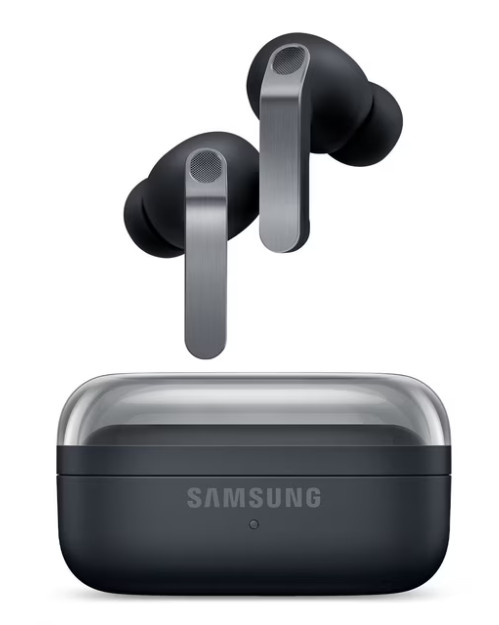
That competition entered a new phase earlier this month when the FDA granted approval for Samsung’s Galaxy Earbuds to fall under the same category. This follows a similar decision made about Apple’s AirPods back in 2024. The two biggest players in the smartphone market being able to offer their earbuds as OTC hearing aids represents a unique value proposition. Not only are they priced for mass market consumption, but many individuals who would be interested in purchasing an OTC hearing aid will already own them and need only to enable the feature with a software update.
Given how different the situation is today than even just five years ago it’s worth asking just what qualifies as a over-the-counter hearing aid, and how the shifting definition of these devices can inform the community’s efforts to develop open hardware solutions.
What is a Hearing Aid, Anyway?
We’ve already covered what a hearing aid isn’t, but before we go too much further it’s a good idea to clarify what exactly a hearing aid does in comparison to a simple audio amplifier, which in the industry are officially known as Personal Sound Amplification Products (PSAPs). This is a topic we’ve touched on previously here at Hackaday, but the short version is that since the 1980s or so, the frequencies that a hearing aid amplifies have been tailored to match the specific auditory deficiencies of the wearer.
Traditionally, getting a hearing aid prescribed would require going to an audiologist and getting an audiogram. This chart plots the results of a hearing test, and shows how well the patient can hear various frequencies. With this data, it’s possible to quantify the severity of a patient’s hearing loss and determine where a hearing aid could improve the situation. This information could then be programmed into a hearing aid to provide a bespoke amplification profile that takes into account the needs of the wearer.
It’s worth noting that this is only in the context of relatively modern digital hearing aids, essentially those created after the introduction of solid state electronics. Prior to that point, hearing aids were closer to what we would now consider PSAPs and amplified incoming audio indiscriminately.
Defining a Middle Ground
With this in mind, the primary difference between a prescription hearing aid and an OTC model is that the audiologist is cut out of the loop. That means there’s no audiogram, and in turn no data to program the hearing aid’s filters with. The specifics of this does vary from model to model, and both Samsung and Apple offer some basic audio testing tools that can help the user fine-tune their experience. But at this point, no OTC hearing aid product is capable of diagnosing the wearer’s hearing to the same level as a comprehensive hearing test performed by an audiologist
That being the case, it might seem like an OTC hearing aid is just a PSAP. But in their ruling, the FDA established the formal requirements for a device that falls somewhere in the middle. The full document, Medical Devices; Ear, Nose, and Throat Devices; Establishing Over-the-Counter Hearing Aids, comes in at around 200 pages if you’re looking for some light reading.
Fortunately, the agency provides a boiled-down list of what features a device must have to meet the definition of an OTC hearing aid. Some of the requirements have to do with the packaging and marketing of the product, which of course are important for a medical device, but it’s the technical parameters that we’re interested in.
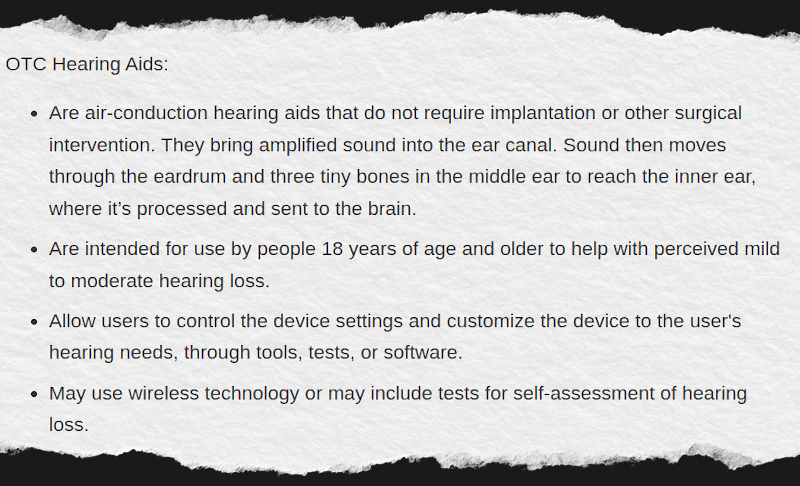
The FDA specifies that all OTC hearing aids must use air-conduction, that is, operate with a speaker inserted into the ear canal. The alternative would be bone conduction, which is generally used in cases with more profound hearing loss. The devices must also allow users to adjust, at least to some degree, the output to match their specific needs.
The intention with this second requirement goes deeper than a simple volume control as you’d have in an PSAP. In lieu of the sort of tailored output a prescription hearing aid would offer, the OTC device can offer a selection of pre-defined audio filter profiles which the user could flip through. At the risk of oversimplifying things, it’s a bit like the audio presets for different genres of music that modern headphones and earbuds usually offer in that the user can cycle through different profiles to find what best matches the current environment.
When combined with the acknowledgement that OTC hearing aids can utilize wireless technology to communicate with another device, it’s not hard to see how the smartphone fits into the equation. While a stand-alone device is capable of meeting the requirements necessary for OTC hearing aid classification, being able to connect to the user’s phone to easily switch between audio profiles on the fly makes for a greatly improved user experience. Additionally, by playing tones through the earbuds, software on the phone can perform a hearing test on the user — the results of which can be used to fine-tune the output beyond what’s possible with simple presets.
Hackers, Take Note
Of course, anyone looking to build an open source hearing aid probably isn’t looking for FDA approval. The goal is likely to make the technology cheaper and more accessible, especially in areas where getting a commercially produced hearing aid may be difficult. As such, the new over-the-counter classification may not seem terribly important for folks like us.
But that doesn’t mean we can’t pick up some tips from what companies like Samsung, Apple, and Jabra are doing. By bringing the user’s smartphone into the mix, they have made hearing aids more accessible and easier to operate. Instead of trying to pack all of the functionality directly into the wearable, using a smartphone to do some of that heavy lifting opens up a lot of new possibilities. There are naturally trade-offs when switching a hardware problem for a software one, especially when dealing with mobile operating systems, but it may be a compromise worth making if it means getting this sort of assistive tech to more people that need it.












‘proper’ hearing aides are wildly overpriced for what they are. I get the overheads associated with certification but NZD 9K for a pair is just taking the piss.
True. They’re basically small DSPs doing programmable frequency equalization (boosting frequencies you don’t hear well). I suspect the outrageous pricing is “let’s see what we can get away with”, because, at least in the US, they try that, then see how much of the inflated price they can get the insurance comanies to pay, and then try to get you to pay the rest.
About 1/3 of people over 65 could qualify for hearing aids. Unfortunately, most of these people are on Medicare and Medicare does not cover hearing aids. They will cover the hearing test but not the visit to the audiologist also. Hearing has also been associated with decrease in dementia so I think it is imperative that Medicare consider covering the cost
MedicareAdvantage plans pay $XX for hearing aids annually. Most people do not need all the bells and whistles unless they are working and involved in large group meetings or attend the symphony or opera where they require amplification of the higher frequencies. Spoken as a retired audiologist.
While U.S. insurance companies generally pay for at least some audiologist visits and tests, I have never heard of them paying for the hearing aids themselves. My theory is that the exorbitant prices are a holdover from the olden days before the Chinese manufacturing revolution. Traditional high prices are being seriously eroded by OTC hearing aids. Though $6,000 hearing aids are still available, few beat the Apple AirPods Pro’s adaptive noise cancellation I rely on to fend off the cacophony in busy pubs and restaurants. Too bad they only come in white, prominently stick out of your ears, and make you look like you are perpetually listening to podcasts.
Due to radiation during the treatment of cancer, I have one ear with no drum nor the three bones that connect to the intact cochlea. My other ear has deficits (poor highs recognition) that it shares with the “dead” one.
I currently use Apple Airpod Pro 3’s, tuned on my wife’s Ipad. I use them with my Android phone in my one good ear for phone calls & music. I tried a bone conducting “amplifier” headphone that only emphasized the deficits shared by both ears. So back to the Airpods with only one ear “listening”.
Traditional hearing aids cost way too much. Airpods are in the $200 to $300. Cheap. I’m looking forward to more bone conducting players getting into the market to drive the prices down.
This is a timely article. I have a hearing test scheduled with an audiologist for next week. I have known for years that I some level of hearing loss that hinders my daily life, but not bad enough I was willing to try to correct it. Now that I sometimes struggle to understand my kids I am more inclined to try to improve my hearing somehow.
Working within the realm of my work insurance makes it extra difficult; it will only pay for a set of hearing aids once, and I’m under 40. The Apple or Samsung options sound intriguing, but we aren’t allowed to wear ear buds at work for safety reasons. It makes it frustrating trying to figure out what the best option is for my situation. Although having had many relatives with hearing issues, I know the options today are so much better than they used to be.
Auditory Reality would be nice. Ability to wear, and let the outside through.
I used AirPods as hearing aids (and some minor protection) in a warehouse setting with transparency mode. Safety guy okayed it, so it might not hurt to ask yours.
I have a friend who buys used Phonac hearing aides and uses open source software for tuning them. He hears much better than he did with the audiologist’s tuning. Pays like $100 on ebay for the hearing aides.
Reference please.
Could the settings be tweaked in such a way that hearing is further damaged?
Yeah! This would be an awesome hack. Any links?
Thanks for correcting my pessimistic misconceptions about U.S. employer-provided health insurance coverage for hearing aids. Sounds like I should plan to take advantage of any once-only subsidy immediately before I retire.
I’ve had a rather serious hearing loss in one ear since childhood. 2 years ago, I was lucky enough to have hit my out-of-pocket maximum on my health insurance, so I used the opportunity to get a hearing aide for my bad ear. I went to a professional audiologist (Doctor of Audiology) and got an aide programmed for my specific loss. This was fine-tuned several times. I could hear quite well from that ear.
The weird thing is that I STILL couldn’t understand speech in that ear. I think my brain gave up on that ear years ago, and is no longer capable of processing speech heard in my bad ear. I therefore gave up on the hearing aide.
But now, as a 69 year old man, I feel my “good” ear isn’t so good anymore. I’m retired and don’t want to spend the $6K for an aide in my good ear. I think I’ll give one of these OTC units a try. For a few hundred dollars, I think it’s worth the trial.
Whether or not bone conduction would help depends on the source of the hearing loss. With otosclelerosis and eard drum deficiencies probably. Otherwise probably not.
Hearing aids perform more functions than indicated in the article.
They also act as limiters to prevent further damage, and companders to maximise the volume before limiting.
They also suppress howlback, with the side effect that sine waves can only be heard for a fraction of a second before being interpreted as howlback and suppressed.
And on top of all that, they are inserted and then tuned to compensate for the vagueries of the wearers ear canal and eardrum
All that requires specialised equipment, takes considerable time and experience – and even then there is a degree of suck-it-and-see. In my experience it takes several visits and a couple of hours. That cannot be cheap.
Having a national health service removes a lot of worries.
HaD has already coverred the ‘best’ open h/w solution. Latest iteration at tympan.org.
Interesting that Mr Nardi chose not to give a URL to it.
https://hackaday.com/2019/03/01/meet-tympan-the-open-hardware-hearing-aid/
Cool link. Surprised that he forgot about that, but man, we write up thousands of hacks.
No conspiracy. Just people. :)
I think Adam Savage called the AirPod Pro a “gateway drug” for people with some hearing loss. He recommended that people gift them to their loved ones with hearing loss, as a way to get them to hear what they’ve been missing so they’ll do something about it.
Brilliant!
When VLC stopped working on my phone I went down a rabbit hole of no help at all but I read of AIMP a player for android, it didn’t work either. Turns out my files are hard to find on the phone. Repeating trying VLC many times finally got it to work and then I tried AIMP with it’s 21 band EQ! Familiar tunes sound right now thanks to that EQ touch-up due to an explosion induced notch. 10 band EQ doesn’t do it. I’d expect this might make a homemade “hearing aid” work better.
Put Rakarack on a portable with stereo mics, compression, parametric EQ, and limiting it’s free.
I’m watching this wearable stuff get even cheaper then I might bite.
I think hearing aid manufacturers are “missing a trick”. I watch my father’s hearing degrade over the years and I’m rapidly heading in that direction. He started with high dollar amplified hearing aids and ended up with even higher dollar tuned, equalized, feedback controlled hearing aids, but what none addressed was that the hearing loss was worse at higher frequencies. They were just equalized amplifiers. He could hear me fine with very little amplification, but never hear my wife even with deafening amplification, and at those levels feedback was a constant problem even with feedback control.
Why not to take higher bands and frequency shift them to lower bands where hearing is still OK. It would not be good for music and higher pitched voices would initially sound strange (and be slightly delayed), but in a room of conversation, it would fix some of the problems and stop the feeling of isolation that hearing impaired people have when they stop being able to hear even highly amplified higher pitches. I think it would be better to hear people speaking unnaturally than to not hear them at all.
I’d love to hear what others think about this.
You make a good point. Seems like a lot of innovation to be had here.
Newer ones do that… Mine (~9 years old) do shift higher frequency down into ranges I can hear. It took awhile to get used to it because almost every woman sounded drastically different, and some men too. But they do EQ, Suppression, Frequency shift etc.
You don’t mention that prescription hearing aids have had smartphone apps for years that can adjust aspects of the aids capabilities just as the new OTC aids and even more so in some cases. The high cost of hearing aids is due to the immense research and development of them that OTC aids have some access to now thanks to the prescription hearing aid industry. Also aids must meet strict regulatory and reliability standards because they’re medical devices designed to be worn for many hours every day. Could you wear an OTC aid for 16 hours straight? The other factor is health conditions such as tinitus OTC aids may not be able to help. One caveat that isn’t made clear is that compared with OTC aids or earbuds, hearing aids sell in much lower volumes, so manufacturers don’t benefit from the same economics. I wear hearing aids and I have tinitus 24/7, and for moderately severe to severe loss conditions a hearing aid are the answer.
I hate to be that person, but some of the prices stated in these comments appear to be extremely regional. My hearing aid (singular, as I wouldn’t benefit from a pair) was €800, bought 6 months ago. I could’ve qualified for it for free had I had a couple more years of work experience. My aid also comes with an app to tweak things here and there, which I actively use as different settings work in different places. Even when I was looking at more expensive options, I would still rather take out a loan for a €1500 medical device, than Klarma a gadget like Airpods (which wouldn’t even comfortably fit in my ear; and for which the hearing loss compensation, on which I depend all 16-20 of my waking hours, is only secondary functionality). As much as I yearn for hacker-friendly and open-source hearing aids, all this article and these comments revealed to me is that healthcare in other places is bananas.
In the US we are taken for over $5000 for a set. No insurance coverage either.
And for me, I no longer have an app because they discontinued it about 1-2 years after I got my hearing aids. at $7k for the pair plus $500 ins accesories (I was able to side-load it on my last phone, but it wasn’t supported on my current phone when I tried to side-load it 18 months ago.) And with Google killing side-loading, we’re looking at having to buy new hearing aids with the next phone OS release. All of this because the manufacturer couldn’t be bothered to support the old device when they made a new app.
My question is why the Apple/Sammy devices can’t be accurately tuned with the results of a properly administered hearing test? I have no doubt it would be possible to tune it granularly.
Hearing aids split audio frequency into several adjustable segments (“audio channels”) to allow that granularity, which, from what I’ve been explained by my audiologist, is done via specific hardware chips more or less unique to hearing aids. Modern aids come with anywhere between 4 and 24 audio channels (though there’s some research that indicates anything above 6 audio channels is not as helpful), with each channel having its own configuration. From googling around, I couldn’t find any mention of Apple Airpods, for example, supporting anything of sorts.
Modern smartphones have vastly more processing power than any tiny hearing aid. It should be possible to use high quality dumb ear buds to send sound from their microphone to be processed in near real time according to the personal needs of the individual and then played to the ear buds for enhanced understanding.