

It’s time to return to our no-punches-pulled look at food manufacture, and this time we’re looking at the humble loaf of bread. As before, we’re approaching the subject with a look at breadmaking both in the traditional sense that marketing people would like you to imagine, and in the modern sense of the loaf you’ll find on your supermarket shelf.
A Food Of Great Cultural Significance
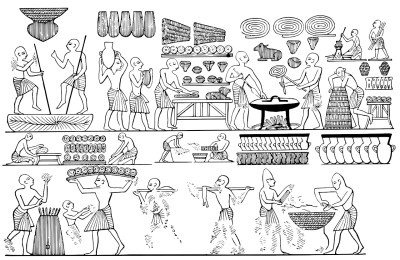
Perhaps there are few foods with as much cultural significance as bread. If your distant ancestors took the path of growing grain as their major subsistence carbohydrate, the chances are there will be some form of bread woven into your identity. Where this is being written for example were I to head for the cathedral of a Sunday morning I would recite the Lord’s Prayer as part of the service, Give us this day our daily bread. Whether your culture leavens its bread or not, or whatever grain it uses, the chances are that there will be something similar about the humble foodstuff within it.
Sitting in a coffee shop writing this a few streets away from that cathedral in a British county town, the bread here is made from wheat flour and leavened using yeast. I’d hazard a guess that it’s the loaf most of you reading this will find at your local store, and with apologies to people whose bread takes a different form it’s the bread I’ll be examining here. It’s the loaf the wheat fields where I grew up supply grain for, so it’s the one whose production I’m most familiar with.
The Ideal Bread, At Least For The Adverts
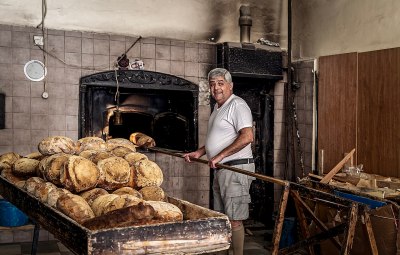
Advertising for bread is steeped in a tradition both real and imaginary, but behind the image does lie an artisan past. Very few English villages did not have a mill or a baker, whether the stone grinding wheels were driven by water or wind. The bread would have been made in much the same way as you’d make it in your 21st century kitchen, with the flour being mixed with water to a dough, before being slowly proved and leavened using a yeast culture, and baked. The oven would have been a wood-fired domed clay or brick affair rather than a gas or electric device, and perhaps our artisan baker of yore wouldn’t have used a neat rectangular tin, but the final product would be something you’d recognise.
You can still buy artisan bread made this way and it’s a fine product, but despite the industry leaning heavily on such imagery the loaf in your supermarket is not quite the same. This is not a judgement on its quality but a statement on the technological advancement that has given us an affordable, consistent, and often high quality mass produced product.
First, Chase The Ingredients
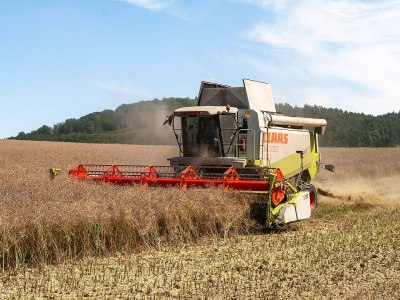
So to start with 21st century bread making, we need to stand in an Oxfordshire field like the one surrounding where I grew up. It’s the end of July, so the wheat is being harvested. The field will be part of a crop rotation scheme, so it may have had canola, beans, or any of a number of other crops grown in it the previous year. The wheat may be so-called hard wheat, usually a winter wheat with a high gluten content planted last autumn, or depending on the bread process it can be a spring-planted variety with a lower gluten content.
The wheat will be stored by the farmer in a silo until the best price can be had for it, then once sold it goes to a mill. A modern industrial mill rather than the rustic watermill of our previous description, but the principle is the same. The grain may be moistened to aid the separation of its outer husk, and then it’s passed through sets of rollers to grind it. This results in a flour, but it’s not the flour you buy, nor is it the flour that goes into your bread.
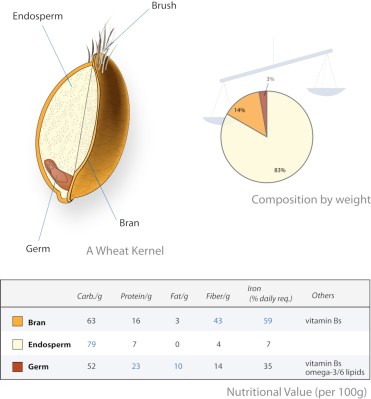
A single piece of grain, a wheat seed, is loosely comprised of three components. The endosperm is the white flour portion you may recognise, the wheatgerm is the embryo, the part of the grain which germinates, and the outer husk is referred to as bran. The raw flour is wholewheat flour and you can bake with it, but it has the problem of a limited shelf life as the wheatgerm will spoil after milling if left. This the three components are separated, and the wheatgerm is heat treated to render it inert. The flour used for baking bread is thus compounded from these components to the formulation required, along with a set of additives to preserve it, improve its baking qualities, or add vitamins and nutrients. For a flour to be referred to as wholemeal its proportions of these components are defined by law, at least where this is being written.
The other major bread ingredient is yeast, which for a modern baker is a carefully maintained monoculture of a yeast strain selected for best performance in baking. The traditional method of farming a yeast strain is something we had a look at back in the pandemic when there was a shortage of the stuff, and its industrial equivalent is a much more sterile and scientifically controlled version of the same thing. It will arrive at the baker not as the dried yeast you’ll pick up at the supermarket but as a damp paste, which will be activated by dissolving it in a sugar solution.
A Loaf That’s Better Bread
For a traditional or specialty style bread then, the baker will take a compounded strong flour and fresh yeast, and follow a surprisingly similar process to that of the rustic baker mentioned earlier. The equipment will be stainless steel and the quantities may be greater, but our baker from the past would recognise it. It makes lovely bread, and you have no doubt enjoyed it in your time.
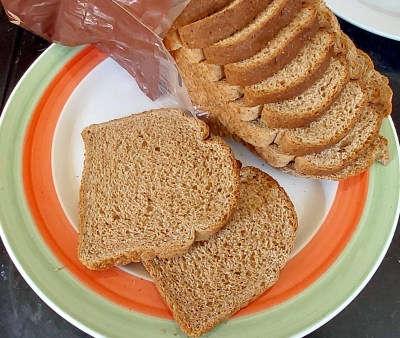
The more mundane loaves in your supermarket though, are not made in quite the same way. They take flour and yeast and make a leavened dough just as with a traditional loaf, but the process is very different indeed. The Chorleywood process, named after the town hosting the research institution where it was invented, is a high-speed baking process designed to use a wheat with a much lower gluten content than traditional bread. The problem facing the mid-20th-century researchers who created it was that the UK’s climate and agriculture isn’t suitable for growing the quantities of hard wheat its bread market demanded. Their innovation was to replace the leavening and proving of the traditional bakery with high-speed mechanical mixing, which since some of the gluten is broken down in the traditional fermentation, requires less gluten. The result is an extremely fast industrial process that produces an extremely consistent light and fluffy bread, and over the last three quarters of a century it has become the dominant loaf. It’s likely that wherever you are, a similar process tailored to your country is also responsible for most of your bread.
So you now know a little about where your daily bread comes from, and how it is made. As is usual for this series, it’s now time to look at the various claims and controversies surrounding the modern loaf, which can sometimes even take on a political dimension. Is the nutritional value of a supermarket load less than that of an artisan loaf made by that village baker? This is a question which has caused some considerable controversy over the years.
As we said earlier, modern flour is a refined and processed product whether it’s wholemeal or bleached white, and a process such as the Chorleywood one is designed to make a loaf from a cheaper ingredient. It’s then not unreasonable to suppose that the artisan loaf might be a better product, and in the sense of flavours and textures imparted by the traditional process you would probably be right to take that view. An artisan loaf is a high quality culinary experience.
But from the nutritional perspective it becomes a much less clear-cut assessment, because while a true artisinal loaf contains all the nutrients of the raw grain, the formulated flour used by the industrial baker has its nutrition precisely controlled. If the recipe uses a high-nutrition flour then the resulting bread has a high nutritional value, and since at least where this is being written such things are regulated, you can eat a Chorleywoord loaf with confidence that it’s not a nutritional desert.
As a parting thought I’d say this: eat the highest quality bread you can, support artisan producers if you can, you’ll eat some really nice bread. But don’t worry too much about the cheaper stuff, it’s only cheaper because it’s mass-produced, not because it’s worse for you.











I only had to read a few lines before realising this article was written stylishly and elegantly by someone who cares and, sure enough, I looked at the author and it was Jenny. Keep up the good work!
I bang out a loaf of whole wheat bread every 4-5 days. Cheap bread maker machines last about 4 years before the bottom falls off the basket. Unfortunately, the baskets cost almost as much as a complete machine. Still worth it economically and epicureally (is that really a word?!).
What’s your current daily-driver bread maker?
I have a zojirushi two-paddle machine that’s pretty spiffy. I like it a lot. Usually I just use it to make dough and then do the final kneading and shaping by hand, but one big advantage to any bread machine is you can put it outside and run it and not heat up the house in the summer.
What about people in Bavaria? Old bread can be made into delicious brottranke.
I’ve been through several machines. Currently using a “Hamilton Beach” branded one. There are probably only 3 factories that churn out bread makers and a whole lot of companies slapping their names on them. The LCD and buttons and “menus” seem to be the same on all the (cheaper) machines I have seen.
Panasonic SD 2501. Have had it over 10 years, and I make 4-5 loaves a week. Absolute unit
I do the same. Being able to regularly get fresh baked bread is fantastic, and it tastes great.
Although, I must be lucky, because my bread maker is still working and it’s a “White-Westinghouse” which means it must be over 20 years old (mostly used the past few years though). The only issue with it is that the non-stick has come off the paddle and I don’t know where to get a replacement.
Maybe swap brands!
I make a loaf pretty much every day in a Panasonic machine. The paddle bearing assembly has needed replacing once so far, after about 1500 loaves, and it was a fraction of the price of the machine.
Baking bread at home is not difficult. It does not take a lot of time. It even is fun. Sourdough is not too difficult. The important thing is to knead enough, the gluten net needs to form, water needs to be absorbed. I did even bake my own bread when I stayed in the US as a guest scientist (the only thing is: use bottled water for the sourdough starter).
To all who want to give it a try: please do! If people scare you with mumbo-jumbo go somewhere else.
Now baking great bread at home is more difficult and involved. I’m OK with “good” bread.
I have fully embraced bread tray for sourdough and don’t need to knead a lot. Very easy. As you say, makes good enough bread for me and anyway, so much better than industrial bread.
I hate bread because it’s full of empty calories that make you fat. For my daily eating I prefer paprika-flavored diet rice cakes. They’re spicy and very light on the body.
Why am I not surprised?
Empty calories? Maybe American bread. Proper bread has fiber, protein, vitamins and minerals apart from the carbohydrates that supply most of the calories.
I am not sure you read the article fully. It’s pretty-much impossible to make bread, even white bread, without protein.
Most of the protein in wheat is gluten. The biological value of gluten is really low (you can check the PDCAAS). Sourdough fermentation helps to break up gluten.
There’s a theory that too much industrial bread (or more precisely, high gluten content) leads to gut inflammation and the ever increasing incidence of non-celiac gluten allergy. So sourdough bread should be healthier in the long run – but I exercise my right not to have an opinion on this particular matter.
You can make bread with bean flower, lentils, etc. But it won’t have the same crumb, ie, it will have more crumbs.
Sourdough doesn’t break up gluten, if it did you’d lose the crumb.
Gluten allergy affects about 1 in 700,000 people. The health problems with white bread has nothing to do with gluten, and everything to do with glycemic index.
The yeast eats sugars and combine protein strands, if they get combined into longer “gluten” strands or shorter stands is mostly irrelevant to health because they break all the way apart as part of digestion. If they didn’t digest, ie they didn’t break apart, you’d be looking at indigestion, maybe a little bloating, not any of the nonsense stuff.
I am not sure you read the post I responded to, or if you’re even responding to my post.
it ain’t me, folks
It sounds like you.
“were I to head for the cathedral of a Sunday morning”
-> on a Sunday morning
“This the three components are separated”
-> Thus
“Is the nutritional value of a supermarket load”
-> loaf
Well done, you found two typos. My editor should hang their head in shame. :)
The first one however is 100% normal in British English, and not a typo.
I would use my normal retort of “ooh, I don’t remember you among my colleagues during my many years working for the Oxford Dictionaries”, but in this case since you don’t know enough English for the first one, it seems inappropriate.
“of a Sunday morning” is less common, but certainly accepted usage in the USA, also.
Or maybe I just read too many books by English authors.
I have literally never heard the use of “of a Sunday morning” so perhaps the snark is not warranted.
Just get Paul Merton to read it doing his best Alan Bennet impression and it absolutely works.
Maybe you aren’t the kind of person who spends a lot of time writing about English cathedrals. :)
Probably not, since I’m not English. I think the overall point stands.
Also, when looking at the source sentence closer, it seems like your “for example” should likely be encapsulated with commas.
I’d have to think about it more, but there should likely also be a comma after “Sunday morning”. You should also have the prayer in quotes.
Oddly not. A comma is loosely where you might draw breath when reading the sentence, in the context of that sentence. Americans are taught to overuse commas, and often write with the appearance of having shaken a pepper pot full of them all over the page.
The prayer? Italics. Quotes aren’t the only way to differentiate speech.
Oddly yes*. Or at least it there is enough debate about some of these rules, that I don’t think your snarkiness in response to reasonable corrections was appropriate.
At least according to Purdue: https://owl.purdue.edu/owl/general_writing/punctuation/commas/extended_rules_for_commas.html
I know that I wouldn’t typically boulder through that sentence when reading aloud; I’d pause to emphasize and separate “for example”. I’d defend that choice because it’s easily something that could lead the sentence as an introductory phrase but was just slide deeper in the sentence.
The prayer might also be debatable; I’d have to look at the common rules used. Personally, I dislike it because I think it looks bad (harder to parse), and it doesn’t copy-paste well.
Well, English is not my first language, so these typos trip up my reading.
But if I were to publish articles read by thousands, I’d make sure to reread them and the reread them again to make sure not a single typo would remain.
“…of a Sunday morning… is not only acceptable, but formally and historically accurate. It was the more common way of expressing the thought in the not-too-distant past; we have, sadly, moved on to incomprehensible emails. Now, “LOL” means “…of a Sunday morning…” as well as everything else contained in the OED.
Old(er) joke (perhaps from vaudeville days):
“So he died, you say. What did he die of?
“He died of a Tuesday.”
Found a bread maker completely new in the box still with original purchase receipt from 4 years early. Never used. A mystery why it was left by the rubbish bins. Been making bread regularly using the solar panels to provide the electricity. Delicious bread!!
I agree that a bread maker is very convenient. But why didn’t you ever make a bread before you found the bread maker? The kneading is a good workout. :) And it only takes some 10 minutes. Everyone can make a bread.
The only thing is that my baker can do it cheaper, because of the economies of scale. And my baker makes great bread too. So it’s cheaper just to buy it.
These days I mainly make flatbread, mostly when my purchased bread runs out and I don’t want to go to the baker to get a new loaf.
Kind of a fad at one time. Now it’s air fryers.
You can bake your bread in an air fryer too. Just be careful of the rise, or you may never remove it.
There’s one key thing you missed: You should use fresh milled flour when baking bread. The longer the flour sits the more nutrients you are losing. Bread made from fresh milled flour is practically a different food than anything you find in the store. Sue Becker has a few books on Amazon that explain the differences in detail.
I sometimes eat deep fried bread rolls with pork offal filling so I guess I’m not the person to be concerned whether it’s fresh milled or not.
We had a bread maker for a while and then a pretty good local bakery opened and so we used them for a long time. Unfortunately the owner/baker passed, so we went back to super market bread. Sounds like it might be time to pull the ol breadmaker out again and give it another try :) Plus it makes the house smell delicious.
I do not get the love of breadmakers.
I bought a used Bosche Universal Mixer for $300 off ebay. Its one of the early US models. It had 8 years of use on it before I bought it and Ive been using it for 12 years now. Its a powerful well built machine. It can make up to 15lb of dough at once but can also make a single loaf without a problem. It will nead a single loaf in about 5 minutes, Fully loaded it takes around 8 minutes.
You really want good bread add a Nutramill classic and grind your own flour. I paid $250 for mine on ebay. The difference in flavor and quality between a bag on preground industrial flour and fresh ground wheat berries is SIGNIFICANT. It takes 8-10 minutes to grind 10 pounds of dough for a 15 pound batch of dough but it can grind out a single loaf worth in a little over a minute.
Next tip, Pullman bread pans. They have a lid so you get perfect square sandwich loaves. I like the big 15 inch ones, but have a few of the 9 inch ones for specialty breads like rye and pumpernickel that the family doesnt eat as much.
Next get a Black and decker comfort grip electric knife. Great value at $25 I can slice a 15 inch loaf into sandwich slices in a minute flat with mine.
The right tools take almost all the work out of bread baking.
grumble grumble autocorrect grumble grumble. KNEAD not need
I wish they’d ban the recent practice of harvesting the wheat with a big spray of glyphosate which kills and desiccates it at the same time, so it keeps in storage longer. Some pesticides while it’s growing is fine, but the increase in levels when they started using it to reap are through the roof.
Who wants now to open the last sour cherry jam and first spread some nice butter on a slice of fresh bread, then lay the jam and then eat it like there is no tomorrow?
I think that if you dig deep enough in the current human DNA, you’ll find the smell of freshly backed bread sitting nicely on the display near the wood fire smell and the rain smell.
Chocolate rain
Some stay drain and others fear the pain
Chocolate rain
A baby bomb will die before the sin
Chocolate rain
The school books say it can’t be here again
Chocolate rain
The prisons make you wonder where it went
Chocolate rain
Build a tent and slay the world in drive
Chocolate rain
Zoomba camera and see the lie
Chocolate rain
Punk-ass to be falling yesterday
Chocolate rain
Only in the past is what they say
Chocolate rain
Live your neighborhood ensure it’s rain
Chocolate rain
Makes us happy ‘livin in a game
Chocolate rain
Made me cross the street the other day
Chocolate rain
Made you turn your head the other way
Chocolate rain
History quickly crashing through your veins
Chocolate rain
Using you to fall back down again
Chocolate rain
History quickly crashing through your veins
Chocolate rain
Using you to fall back down again
Chocolate rain
Tell no mention on the radio
Chocolate rain
It’s the fear your leaders coke control
Chocolate rain
Worse than swearing worse than calling names
Chocolate rain
Say it publicly and you’re insane
Chocolate rain
No one wants to hear about enough
Chocolate rain
Which it hard it goes away so now
Chocolate rain
Makes the best of friends begin to fight
Chocolate rain
But did they know each other in the light?
Chocolate rain
Every February washed away
Chocolate rain
Stays behind as colors celebrate
Chocolate rain
The same crime helds the higher price to pay
Chocolate rain
The judge and jury swear it’s not the base
Chocolate rain
History quickly crashing through your veins
Chocolate rain
Using you to fall back down again
Chocolate rain
History quickly crashing through your veins
Chocolate rain
Using you to fall back down again
Chocolate rain
Dirty seekers of economy
Chocolate rain
Turns that body into GDP
Chocolate rain
The Bell Co. blames the baby’s DNA
Chocolate rain
But this scores are how much the parents mean
Chocolate rain
Flippin cause in friends in other light
Chocolate rain
Gleams the super on beneath Mumbai
Chocolate rain
Lost the world and back it’s all the same
Chocolate rain
Angels cry and shake their heads in shame
Chocolate rain
Lifts the ark in paradise and sigh
Chocolate rain
Which part do you think you’re livin’ in?
Chocolate rain
More than marchin’, more than pasted law
Chocolate rain
Remake how we got to where we are
Chocolate rain
History quickly crashing through your veins
Chocolate rain
Using you to fall back down again
Chocolate rain
History quickly crashing through your veins
Chocolate rain
Using you to fall back down again
It would be interesting to mention grain cleaning tech, similar what is found at a plant only blocks from where I live.
Anyway, to be a nuisance, here’s a simple, useful bread:
3-3/4 cups warm water (115 to 120 deg. F)
3 Tablespoons of yeast
6 Tablespoons of sugar
6 Tablespoons of margarine (I’ve always omitted)
4 teaspoons of salt
2 eggs (slightly beaten)
10 cups of flour
Dissolve yeast in 3/4 cup of water. Combine 4 cups of the flour with the sugar, butter and salt in the mixing bowl. Add the dissolved yeast, two beaten eggs, and the remaining water. Beat with an electric mixer for 3 minutes. Stir in remaining flour by hand. Knead for 10 minutes (will require additional flour, amount depending on ambient temperature, too much flour kneaded in will result in a crumbly result). Put in a greased bowl and cover, letting rise in a warm place for 30 minutes. After 30 minutes, punch down and let rest 10 minutes. Shape into 4 loaves (check old cookbooks or the net for how to properly form bread loaves) and put into greased bread pans. Let rise in pans for 30 minutes in a warm place. Pre-heat oven to 350 deg. F, and bake loaves for 30 minutes (my oven does best at 23 minutes, yours may vary). Remove from pans and let cool.
The loaves can be frozen and thawed out as needed. I recommend consuming a loaf within two to thee days, or keeping in a fridge if consumed slower.
Whoa there. Great Britain is a bit of a weird case with yeast in their bread. That’s usually reserved for sunday’ plaited loaf or pastry stuff in most of northern europe.
This surprises me. I find bread with yeast, almost everywhere I go on m European travels, and I’m a frequent Interrail traveller.
Speaking of weird cases—and this is being offered as a fact, folks—…
…”Great Britain is a bit of a weird case with yeast in their bread…”
Soooo…most of the Brits eat unleavened bread, eh?
…Never knew that Great Britain was the bastion of unleavened bread. Thanks for the enlightenment.
[the very next time I feel the urge to clear out the room at some gathering, I’ll throw this fact out…]
The most expensive thing at the industry creating stuff is time in the long run. To make a good bread, you need time and microorganisms. In investing time you get problematic sugars in dough broken down, making the bread easier to consume for the human body. Even better, those people who get problems eating industrial, fast created bread if not really allergic against gluten, can consume this bread without problems. It is not only the presence of nutrients but also the lack of some components which makes a bread good.
Right now, I don’t eat bread anymore. I have organic muesli mixed with a teaspoon of artisanal forest honey and “ribot” milk (https://fr.wikipedia.org/wiki/Babeurre), all served in a small bowl along with various herbal teas depending on my mood (rooibos, fair-trade green tea, mate, etc.).
Another benefit, aside from how delicious it is, is that it helps keep your electricity bill from getting too high.
“Another benefit, aside from how delicious it is, is that it helps keep your electricity bill from getting too high.” because you can run your house on methane instead?
I wish some company would put out a Panko bread maker. I want crustless electrocuted bread!