

We all have that bin in the corner of our shops — the one with all the circuit boards or broken electronics that we are totally gonna do something with. We might rationalize that they’re worth keeping for the parts alone, but the reality is, unless you desolder and sort all the components ahead of time, most of us will never really use these spare parts to their full potential. Except it really doesn’t have to be that way. Junkbin.io is an attempt to improve on the state of that corner bin.
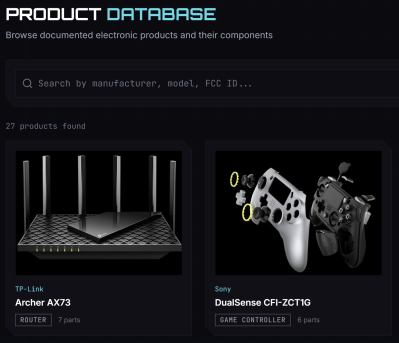
Though in its early years, Junkbin has a variety of the previously mentioned resources as well as many others. Currently, it is ripe to contribute, and we here at Hackaday know how important the community is to get these projects truly off the ground and to their full potential.
Created by [Steve Cap], Junkbin is a community dictionary of sorts to document and reuse electronic components found on many of the devices found around you. Do you need a single small form factor resistor of a specific resistance? That’s where Junkbin comes in to show you where you might find that specific component.
If you want a more macro-scale example of electronics recycling, make sure to check out our other featured projects such as these reused laptops! Or maybe take a look at this graveyard of defunct electronics to add to Junkbin…











Please schedule writing a followup five years from now.
If it was me, it would be something like: “Somehow I managed to becime MORE of a hoarder!”
Also, “Somehow the database is STILL nearly blank.”
Every site that has “user contributed equipment databaee” will perpetually be blank to the point of uselessness.
While it is true nothing ever changes, sometimes it does and it costs you nothing not to shit on the attempts.
And I see a stunning lack of “Mike” contributions to address this.
Ah yes, Wikipedia is famously blank.
lol, we’ll just get another clueless blog post by someone else that barely knows their ass from a hole in the ground like Maya
or just some more AI slop, just like this was
Huge activation energy problem. There’s not enough in it to make it useful to anybody, so nobody’s going to visit it, so nobody’s going to put in any data, so…
I wonder if the AI that wrote it could also populate it. There are a lot of teardowns on the Web.
Repo for the site was removed from GitHub. Gotta be some SuperSlop from Claude.
I’ve always grabbed discarded electronics and either tried to fix them, or I disassemble them for useful parts, and try to dispose of the rest sensibly (eg separating into materials – steel, aluminum, PC boards). Besides gaining some interesting parts and knowledge, i just find the activity of disassembling something carefully to be therapeutic.
I now have more parts than I will ever use – especially metric hardware – so I’m a bit more selective these days about what I’ll grab, and I try not to stockpile the found items; I try to fix or disassemble them as soon as possible.
Anyway, junkbin.io seems to have potential, especially as a lookup to identify devices. Maybe it could become a sort of wikipedia for old parts. Maybe there could be a forum for seeking and trading parts. A “salvage 101” section would be useful, telling people how to remove, test and sort salvaged parts, and how to correctly dispose of the leftovers. And a set of suggested circuits or projects using the most common vintage parts.
Well, they straws and sprue can make Borg ship replicas.
Film it in one of those tunnel-of-love particle accelerators and/or getting hit with Tesla Coils with M-80s under them:
“The ion storm is frying our ship!”
Page doesn’t load products 9/10ths the time on my mobile browser, CRASHED my browser. 27 products, most of em extremely niche. Fck me guys like I try not to be negative, usually I’m not anti-ai either, but the worst type of ai projects are ones that are “great ideas launched untested” why go live on a domain if the web browser can’t even load on mobile. Why go live on domain if the data-set is so small. Its a cool idea. Its a cool idea. There’s lots of cool ideas. Execution. Is. Everything. Perfect may be the enemy of good but you need a decent platform for people to actually want to bother contributing. Thank you for the write-up, if the devs expand it and fix it then awesome.
If your browser crashes your browser has a bug. End stop.
Irrelevant when it didn’t happen for normal media and ad heavy sites
Unfortunately, the introduction of surface mounted parts severely increased the activation energy for home electronics hacking generally. Parts may or may not be easier to solder, but are harder to recognize and harder to reuse. I first learned to use a soldering iron in large part by scavenging from broken devices, and then by doing magazine and Heathkit assemblies, but I am honestly not sure my hands are still steady enough to work on SMC. (Yes, I know there are instructional/practice kits. Yes, I know there are techniques where flux does a lot of the work of directing the solder. Haven’t had cycles to try yet.)
Definitely – modern PCBs with surface-mount components are nearly impossible to extract useful parts from. About the best I’ve managed is to identify a small section of the circuit board with a discrete function – eg a headphone amp. I carefully saw out that section, clean up the cut edges, try to identify unused components and remove them, then tack on some wires to try to get it working.
For something like a surround sound receiver with a blown digital audio board, I found the analog inputs to each power-amp section, brought those out to level pots and input jacks, found out how to get the protection relays to connect, and now it’s a standalone 5-channel power amp.
even with a tremor, it’s surprisingly easy.
Need to find time to try, then. I’ve got a device which I think has a fried USB chip, but no way I’m ready to try to desolder and replace it. Maybe I can hire an EE student…
Actually, that gave me an idea for a hack.
There are special tools for those with severe tremors: cutlery, toothbrushes, etc.
It would interesting to see a soldering iron adapted the same way.
Redundant with https://repair.wiki/ and https://www.ifixit.com/
Why split resources?
Different purpose and focus.
I submitted like 4 things and then was throttled 🤷♂️
Thank for the feedback. I’ll loosen the rate throttling. Also, thank you for the contributions!
Thanks for the feedback and the contributions! I’ve made edits to the throttling, it was to prevent abuse, but it’s clearly set too aggressively.
I just want a database of projects where I can list the components I have and it will suggest the schematics of projects where I already have the parts in the junk bin or nearly all.
There are recipes sites which work like that… Of course, recipes tend to have looser requirements on ingredients.
IMHO every manufacturer should be required to submit detailed CAD drawings to a central database identifying the positions of components, location and types of fasteners, locations and types of hazardous materials (lithium cells, radioactive materials etc.) so that when the product reaches end of life, a barcode on the product could be scanned and the CAD data retrieved allowing disassembly robots to scavenge and recycle as much of the product as possible.
This should be part of our right-to-repair/right-to-own laws.
Once all devices of a specific model are no longer supported by a manufacturer and no longer under warranty, the manufacturer must release detailed schematics and a BOM for repair purposes, and release and open any firmware on the device to allow it to be rewritten.
If I want to turn my old iPhone 4 into a dedicated garage door opener using custom firmware, that should absolutely be my right as owner of the device.
Writing open source code is pretty much like playing chess so I don’t really think it’s possible.
When I was around 8-10 yo I scavenged a lot of components from old junk, but in the 80ies it was much easier to come by through hole components than it is now, everything is 0102 size ie sugar grain size. But OTOH you can order almost anything now and it doesn’t have to cost that much either. An E12 resistor set, capacitor set, couple of transistors, diodes and opamps, maybe a cheap arduino board or 555 and a cheap breadboard, some wires, leds, buzzer or speaker and a battery is all you need to get the journey started.