
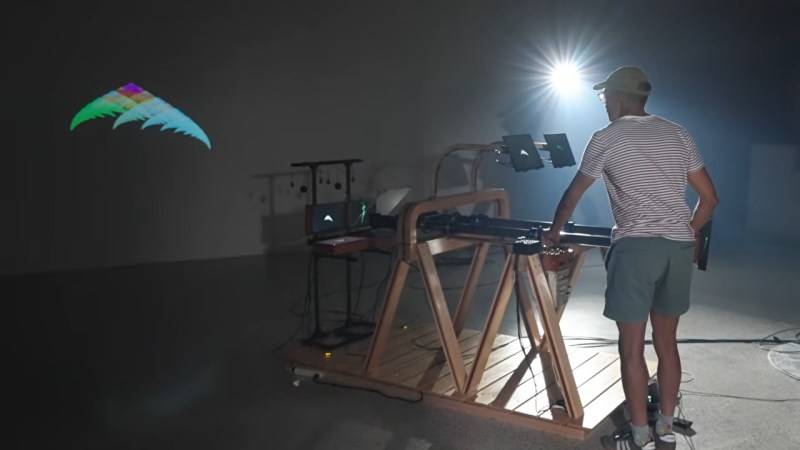
For users of a certain age, fractal patterns and computers are nearly synonymous. Typing in BASIC programs and seeing the Mandelbrot set or other fractals slowly render on screen is a key memory for some of us. Others will have generated recursive patterns mucking about: point an analog camera at the screen showing its video feed, and you’d better believe you get recursion. It’s called video feedback, and it looks a lot better than audio feedback sounds, especially in the hands of a master like [The Light Herder] who has now found a way to take this vintage art into the 4K resolution of the 21st century.
Physically this build is very similar to the “God Machine II” sculpture we covered previously, which in turn built on the first 720p version of his art piece. Getting analog video feedback in HD was hard enough — you need to be able to adjust the hue, saturation, brightness and contrast of the monitor as you go in order to have the full control of the resulting image. Most old TVs had those back in the SD era, but once HD came around it was rare; [The Light Herder] despaired of ever finding a screen that would to this in 4K.
As it turns out, the answer was to embrace digital — all the knobs on his analog control board feed into a Teensy, which is communicating via RS-232 with the LCD driver boards to alter the desired display properties. Obviously judicious selection of driver boards was required. If you watch the build video embedded below, you’ll find there’s an awful lot of tech in this analog, ‘no computer’ setup. If you want to skip the how-to and a master’s explanation of video feedback and just see pretty pictures he’s got a demo video as well. It really has to be seen to be believed.
If you want to create a colorful analog light show that isn’t quite so self-referential and a lot simpler to build, you could always try soap. Actually, we’d love to see him start the feedback with some soap-film colors. The result would likely be as was once said “totally far out, man”.










Amazing to be sure. Reminds me of the days when we would rewire the yoke coils on analog B/W televisions and connect the two coils to each channel of the stereo. The lissajous effect with Pink Floyd was the funMaxxing of that time.
Sounds interesting, I’ve never heard of connecting CRT coils to a stereo before.
Much easier if you have an oscilloscope with X-Y mode.
When I was younger, there was no way I was ever going to be able to afford an oscilloscope, so I decided I would make one from an old 14″ TV. It was never close to being calibrated or temperature stable, but it would display a wave form pretty well after a bit of finoodleing.
Apparently finoodleing isn’t a recognized word in the UK dictionary, but I feel it should be. Feel free to use it. Maybe with enough prominence it might end up becoming a “real” word eventually.
Scratch that I just can’t spell finoodling apparently.
It really does feel like all the best inventions are already taken.
Absolutely incredible.
I’ll second that, having played with this effect in audio and standard definition, the increase in resolution seems to make so much of a difference. The mechanism to precisely move the cameras and monitors is amazing all on its own.
There is nothing “analog” about this, and yes there are computers involved.
A digital camera filming a digital screen, and applying hue/saturation/brightness adjustments with a DSP. The control voltages coming from the adjustment knobs too are instantly digitized by the Teensy, so calling these “analog” is stretching the definition quite a bit.
While the trick itself is pretty interesting, the whole buzzword bullshit and sensationalism is kinda insulting.
It’s clickbait.
I mean you should have known that from the title (for those not playing along analog has no pixels)
Analog could have pixels, or the equivalent of. Analog TV had pixels, or rather a mosaic of aperture holes on the screen.
It’s more about being a physical replica of the original signal in another substance or medium, such as sound waves into grooves in plastic. The main point is that the signal is not interpreted into discrete symbols of abstract data as an intermediate step, but rather recorded as it comes to the best of your medium’s ability to capture it.
15 KHz Monochrome TVs or analog video monitors had operated on lines and had no CRT mask (the CRT used a continous beam with varying intensity).
So resolution could be near “infinite” per line, with the phosphor screen being the limiting factor.
The amount of lines, refresh rate and the beam size (the “dot” size, the focus) were limiting factors, rather.
That’s why some 16c EGA games on DOS used a lesser known 640×200 line mode.
Because they couldn’t use 350 lines on a cheap 15 KHz CGA monitor (mode 10h required EGA monitor) they instead used more details per line.
That allowed more colors via dithering patterns.
Monkey Island 2 offered this trick to simulate 256c graphics similar to 320×200 pixels 256c (mlde 13h).
The point about analog is that it’s continuously variable in some quality or quantity, instead of discrete steps as digital data. The analog thing may be divided into chunks or pixels, lines, bursts, grains on photo paper, etc. but there is something that responds without steps – like the brightness of an individual dot of an aperture mask CRT.
What differentiates it from digital is the fact that digital information is an interpretation and a simplification of the physical quantity that is being measured into a discrete and definite symbol of data. By that, the physical quality of the thing it represents is lost, for example, the property of a radio frequency signal to lag in phase differently at different frequencies when it travels through a cable.
So, an analog phenomenon like light propagating through space, dispersing and reflecting, is “locked” into an abstract representation through a digital camera, and the feedback path back into light through a video monitor no longer exhibits the same or similar quality. The feedback system is no longer “analog”, it’s both analog and digital.
As feedback goes in a loop, we cannot conceptually isolate and credit the “creation” of the image here to the analog portion alone, because the feedback system is the entire loop at once. The dog that chases its own tail is a dog from nose to tail. We can flip the whole thing on its head and say the analog path is feed-forward and the digital is the feed-back, and we would still be describing same system.
Since most of the heavy lifting, signal processing and image rendering, is done by the digital part of the loop, and most of the control inputs affect the digital portion, and the novel newsworthy part of having 4K resolution is a property of the digital parts, it would make more sense to call it a digital feedback system over analog rather than analog feedback over digital – if we should wish to make a distinction at all.
Technically, even the camera’s continuous motion is not simply “analog input”. It becomes a timed sequence of sampled images and numerical transformations before it influences the displayed result.
Moving the camera around and calling it analog is the same as pretending that a digitally sampled potentiometer is an analog input, when what you’re really doing is not resulting in an analog signal but selecting from one of the possible digital states of the device when the device decides it is time to change its state.
When the digital path dominates the image creation process like this, there is actually very little truly “analog” about the whole system. It is effectively an optically coupled digital feedback loop, with some analog effects for spice through the optical path.
I assure you this is not clickbate. This is classic analog video feedback. The “analog” in analog video feedback does not stem from there being a computer chip involved or not, it is the process of getting images by pointing a camera at a screen, turning knobs, the lens, the moving of the camera. Back in the 80s, when we were doing analog video feedback, the camera we were using were not Ikegami tube cameras, they were Sony’s, with – you guest it, computer chips. And that was, of course analog video feedback.
Take away the cathode ray tube TV set and replace it with a newer one that has computer chips, the feedback is still analog. Replace the way the hue/saturation/brightness/contrast knobs control those screens – from being installed by the factory, to being installed in a box and a Teensy and – yup, it’s still analog video feedback.
As the video explains, yes, there are computer chips in the switcher, the cameras, etc. But those are incidental to the image creation. All the switcher is doing is switching inputs between the camera and another source. The fact that the switching is triggered by a button that then goes through a computer chip does not all of a sudden make this non-analog video feedback.
What is insulting “Dude” is your dismissal of this without fully understanding what is going on.
It’s also notable that with true analog video you have almost no input or output lag because there were no frame buffering, so the old feedback effects using CRT screens and projectors were virtually seamless and instant, while with this digital system you can see how the changes propagate through the loop at a some handful of frames per second because of the time it takes to process them through a long data pipeline.
There are frame delay units intentionally creating this effect. I can dial in up to 30 frames of delay.
This is intentional – I have two frame delay units in the device and can dial in up to 30 frames of delay.
It is both a loss and a gain. The system cannot respond as seamlessly, but it can easily introduce functions which were not feasible without taking inconvenient steps like long analog delay lines.
The “analog” in analog video feedback does not refer to if there are computer chips in the components – for example, you don’t need to be using an Ikegami tube camera with a CRT TV to be making analog video feedback. You can be using a 1987 Sony pointed at a CRT. Or you could swap out the CRT for a flat screen that does have computer chips, and it would still be analog video feedback. The “analog” refers to the fact that no computer is generating the images, that the camera is being moved in the real world, that there are lenses, there are knobs that turn, etc.
What’s being created in the video is quite complex because of the half-mirrored glass, because one feedback loop can influence the other (while the other is influencing the first), because it can receive a seed from a secondary input – but, it is still classic optical analog video feedback.
But there are “computers” generating the images. That’s what the LCD screen is. What you’re talking about is physical or tactile etc. adjustments, not analog which is more about the signal processing.
Otherwise we might call a digital camera an analog camera because the lens is pointing at real scenery and held in your hand. That’s an abuse of the terminology for petty sensationalism.
What? The LCD is “generating” the image? No, it is displaying an image just as a CRT screen is displaying an image. The image is generated from itself, through iterations, just as audio feedback comes from the ambient sound in the room, then becomes self-perpetuating. Same with the video feedback. It starts either with a seed – an image or video from an external source, or by simply turning up the brightness on one of the screens. After that, the image is created from the image – the definition of video feedback.
I’m not going to go back and forth on this forever. The images created in the video are complex, classic, analog video feedback.
Yes. There is data in the frame buffer, and the computer in the monitor uses that to generate an image on the screen. It is not merely passing it through like a classical analog CRT does: the image gets interpreted into abstract symbols by the camera system, and then regenerated back into an image at the screen.
Imagine a key that turns a lock. There is a physical object interacting through a chain of forces to open a door. Now imagine the same key that is scanned by a camera, a computer that interprets the picture into code, and then a motorized lockpick pushes the pins and turns the barrel of the actual lock. The actual key no longer matters all that much, because the “analog” causal chain is broken at the point where the physical reality turns into abstract data and then gets re-generated into a new physical reality.
Note that I’m not talking about what happens with the feedback, I’m talking about the principle of how these things operate. You’re misapplying the term “analog” to mean “things that happen in the real world” as compared to things that happen in the abstract in a computational system.
Or rather, you’re extending the “analog” portion of the process – what happens with the image between the screen and the camera – to cover the entire thing, when in reality it is a hybrid system of physical processes and abstract digital computation with an increasing emphasis on the latter. The manual camera movements and the interaction of light through mirrors is “analog” but the rest of it isn’t.
It’s like saying you drove your car across the English Channel – which is a possibility if you take the tunnel – but in reality you drove your car onto a ferry and boated across the sea.
The problem is you’re confusing two different things – whether a camera is “analog” like a film camera, or digital, like any modern video camera, and, “analog” referring to the type of video feedback, that is, is it created the classic, analog way, as I am doing, or using a computer with code to do so. Hopefully this settles the issue, because now I’m really tired of the subject. Thanks for your input.
If you draw a circle, what point along the perimeter is the start and what point is the end? What portion is the “feed back”?
It depends on which point you choose to define as the origin, which is arbitrary. The digital portion of the system is feedback to the analog portion, and vice versa.
The main complaint is that by putting too much emphasis on the “analog” factor, you’re creating the impression that there’s something special going on – something which by all accounts shouldn’t exist or should be incredibly rare. That is the clickbait, the manipulation of attention.
If you come clean right away that it’s a digital camera pointing at a digital screen, it becomes rather more mundane. Yes, you can do that. I can do that. It doesn’t diminish the merits of the construction, unless you count the unwarranted attention as “merit” in the first place.
“would to this” -> “would do this”
I need to dust off my analogue gear as the local spot just got a big bright analogue projector from university surplus to do live shows. Extra trick on the camera, the head can rotate which really makes circular effects happen. Also digital “zoom” which makes bold strokes instead of fine detail, lo-def!
I spent countless hours in front of my CRT TV with the family camcorder pointed at one corner, just so, and wiggling it just right to control colors and shapes and movements, and it was just absolutely mesmerizing, great to see the proud tradition evolving to higher resolutions :D
1960’s tech rediscovered. The original Dr Who titles video was made by pointing a camera at it’s own monitor. More Hall of Mirrors than fractal, perhaps