
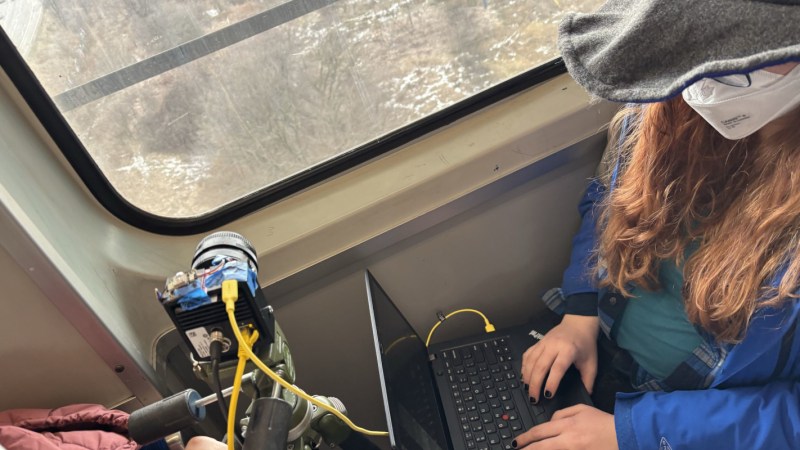
Although digital photography took a big bite of the film industry’s lunch, it wasn’t able to completely eliminate the need — or desire — for photographers to use film in some situations. But digital information from a camera sensor can be manipulated to augment the natural physical capabilities of a camera in ways not really feasible for film. High dynamic range images, focus and exposure stacking, and automatic panoramic stitching. This camera takes the latter example to the extreme.
[Philo]’s proof of concept was a smartphone camera set on a chair and rotated around a room. Some software grabbed a single column of pixels as it moved and stitched them all together to form an image. This came out well enough that the idea was refined a few times, but it wasn’t until a single-line digital camera meant for imaging assembly lines was found that this really took off. Using the camera and some custom software, [Philo] was eventually able to take some of the longest panoramic images we’ve seen, using things like railways and boats as the track the camera rides on, with accelerometer data to help stabilize the image.
The results speak for themselves. There’s a bit of wobble from the movement of the various vehicles despite the accelerometer data, but given that the image is coming from a sensor meant for examining conveyor belts, it’s hard to complain. Of course, if you want to stick to film, there are panoramic film cameras available too even if they don’t quite have the reach of this digital one.









I love her website.
“her” 🤣
Back around 1996 I saw a panoramic photo used to demonstrate the potential of the new-fangled digital photography and printing.
The picture took 8 hours to print as a single image on an HP “CAD” printer. The photo height was the width of the printer (about 1m) and the length was the circumference of a medium size meeting room (perhaps 20m, or more).
You could approach the photo to arms length, and not be aware of pixelation. Remarkable.
The camera was, unsurprisingly, a completely “impractical” custom camera where the sensor was a linear sensor (perhaps from a photocopier).
This is brilliant! Seriously. What a great idea of using this on a train.
Ok, but their use of vw and vh for ontent on their site is infuriating.
what’s vw, what’s vh? And why is it infuriating. I did find something regarding vw, dieselgate and such but I asume it has to be something else. I also asume “ontent” to be just a typo but if it does have another meaning, please let me know.
Regarding furiating, I googled it, and strangly it does not seem to have anything to do with fur, who would have thought.
There has been previous art in that field. Check out this page with lot’s of details on the electronic side. The camera is static while the trains move in this case.
https://elm-chan.org/works/lcam/report.html
This reminds me of when someone uses the bar from a flat bed scanner to take a very high resolution image of a city scape.
I guess phones have been stitching together video into single large images for a while now. Dealing with the total amount of data and being able to display it without bogging down is the tricky part.
Although you need to pull the glass and re use the stepper to turn a lens+sensor combo or else you get vignetting. Do it right and you could probably get 400Mpixel resolution with a nicer Epson and an large format lens these days.
This is very similar to the technology used for the cameras on the Viking spacecraft that landed on Mars in 1976 – they scanned a vertical line as the camera body rotated to make the (panoramic) image.
indeed, it is a proven technology in some types of satellites for many decades, and not only optical. But that’s not the point here. The trick to make it work using modern relatively cheap components and on a shoestring budget and having lot’s of fun doing it. And setting it up in moving and public train and testing debugging it there, requires dedication I deeply admire.
The key difference is this is a pan, not a rotation
Technically she has a digital variation of the streak cameras that used the missile’s speed to photograph them in flight.
Could you use a regular camera and just shoot a single line you think? Or you could just take regular shots and just cut all but a line in the middle afterwards, in rapid succession , so you’d have the same lack of horizontal distortion but can still use a plain camera like a smartphone for instance, which has the sensors to correct wobble too.
I mean a line camera also needs a lens, so it comes down to the same thing.
The problem crops up with parallax. Things in the foreground move more than things in the background from your perspective.
The Hugin library does this, it’s called “mosaic mode.” Here you can see them making use of parallax to remove a foreground object. So you could, for example, take some photos on the train and use parallax to remove the telephone poles and stuff along the side of the tracks:
https://hugin.sourceforge.io/tutorials/Mosaic-mode/en.shtml
That’s what they tried at first, but even at 60fps, there wasn’t enough ‘slices’ to make a good image. Hence shifting to using a (secondhand) professional linear camera, which can capture at ridiculous speeds (up to 19kHz).
You could use a normal camera as long as your movement speed was pretty slow though.
I have been wanting to do something like this for years.. I have tried using FFMPEG to take one colum of pixels from each frame of a movie then stitch them together side by side into a single image, but I can never get it to work. My idea is to make panoramas of a passing parade.
Lmao, Boston is never going to live down that one time they took down an aqua teen hunger force character because of a bomb scare two decades ago
I’ve always wanted to see Google maps or something like this record some of the more scenic Amtrak routes like the zephyr or southwestern chief
Messy stitching.