
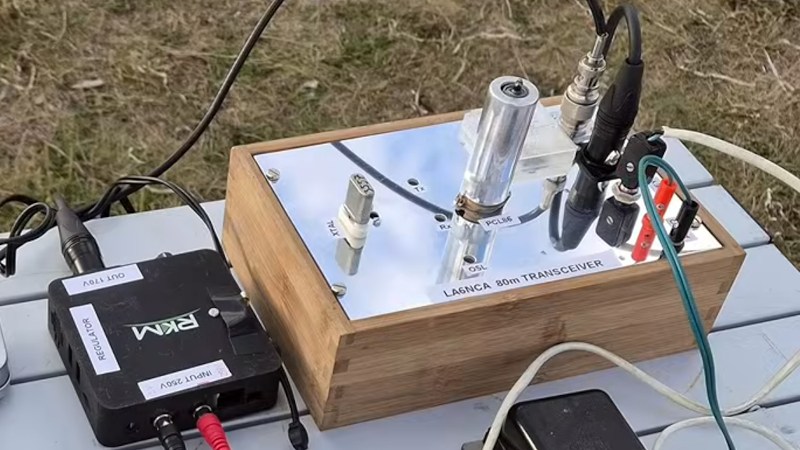
It’s not often we see a tube project here, so [Helge Fykse]’s PCL86 transceiver is a welcome find.
If you know anything about the European Pro-Electron device naming system you’ll be familiar with it as it applies to tubes. The first letter denotes the heater specification, for example “E” is for a 6.3 volt heater. Everyone wants the familiar 6.3 V devices, but they have a set of cousins which often pass unnoticed. “P” tubes have a 300 mA heater designed such that all tubes in a device could be connected in series at the same current. Of those tubes the PCL86 is a mundane example, filling the function taken in the semiconductor years by the LM386. It’s a small-signal triode and a power pentode in one device, and it’s an audio amplifier. Every 1960s TV set in Europe had one, and thus it’s a good choice for experimentation.
This transceiver is a conventional crystal oscillator and power amplifier on transmit, but with a flick of a switch it transforms into a direct conversion receiver in which the triode becomes oscillator and mixer while the pentode becomes an audio amplifier. It’s simple, and the video below the break explains it in great detail. We’re not sure whether or not it could unintentionally radiate in receive mode, but we’re guessing the energy would be tiny.
A simple tube project can make an interesting departure from modern surface mount electronics, so if you get the chance we’d suggest you try one. If you don’t need a transceiver, an audio amplifier is the archetypal PCL86 project.












Many common valves were used for amateur radio and transceivers. The EF80 will happily transmit on 6 meters and give a couple of watts. The ECL80 Triode Pentode will also work on six with more power.
The EL84 can deliver 6 or more watts quite happily in virtually all HF bands..
Amazing, beautiful project! Love the valves and love the look and feel of this project, let alone the incredible level of knowledge required for designing such an effective device! I have some old crackling PCL 86 not suitable for my small tube amp, but possibly perfect for this purpose. I don’t have a ham licence, though…
Hi there! If you’re in an English language country, you can try to obtain the “Technician” license.
It’s very easy and just a short multiple choice test.
In Europe, there are beginner’s licenses, too.
They often cover 2m/70cm but also a few shortwave bands.
Such as 10m, 15m and 80m, 160m.
Popular bands such as 20m and 40m are excluded, maybe, to convice amateurs to upgrade.
Higher classes are allowed to use more power, too.
Alternatively, you can use someone else’s ham call under supervision.
There are hams and club stations with registered training call signs.
Here you can try out amateur radio and communicate with other hams without being licensed yet.
Lovely! Though every valve project I see makes me wonder “Has someone made a guitar amp with this?”
Yes, used as a driver in guitar amps….
That’s great!
…if you can find the tubes nowadays.
Hi, there might be comparison types, just like with transistors or diodes.
Maybe some NOS tubes are left in storage, too. In a barn, an old warehouse etc.
Alternatively, there are other fine battery types, such as EF95 and EF97/98.
The EF95 was still available last time I checked.
It was used in military applications (Russian panzers?), I think.
The EF97/98 were used in 1960s auto radios, I think.
Here they worked fine with a 12v car battery if two tubes were used together (2x 6v heating in series). 12v were enough for anode voltage.
Alternative designations..
EF98.. 6ET6, 6Ж40П (6Zh40P/6SH40P)
EF97.. 6ES6
EF95.. 6AK5, 6Ж1П (6Zh1P/6SH1P), 5654
PCL86..14GW8
The EF98 is also notable for being used in the Kosmos Radiomann onstruction kit. It was very popular once.
The EF98 did replace the antique DM300 tube that was originally used.
An ECC82 (aka 12AU7) was then used in the 70th anniversary edition and used a trick circuit (tube was set high to work with undervoltage).
More information here: https://www.elektronik-labor.de/HF/Radiomann2.html
The Radiomann was also known as “Radio-Gnome” (France) and “Radioman” (Sweden).
An English/American version was known under a different name.
“Radio Technician”, I vaguely remember. There was a website showing it, but it seems gone.
The EF95 has seen some use in recent SDR projects, btw.
For reception of DRM radio, as a DC receiver for the PC sound card.
https://www.elektronik-labor.de/elexs/ef956.htm
What comes to mind is I vaguely remember that EF95 needs about 35v anode voltage to work “properly”.
Those of you reading this may better double-check, though!
PS: A tip: Reducing the heating voltage just a little can enhance life time of a tube significantly!
That’s why my dad used to use the 4,5v latern battery, for example.
The 3LR12, 3R12 (or just called R12) was very common in Europe once.
In its daily use it was the equivalent to the American 9v battery, basically.
Two 4,5v batteries gave 9v, too. But of course we also knew 9v battery (was used in 7 segment alarm clocks).
Anyway, just consider to try to be below 6,2v.. Say, 6v or 5v.
5v is useful because it’s the old TTL standard.
Linear regulators (7805) or PSUs with 5v are readily available.
I have yet to see a USB-powered valve/tube-based project, but I’m sure someone will point me to one!
Just please be careful with the 500 mAh limit.
USB 3.0 and up support more ampère over their cables.
If you’re using USB C, you can measure the voltage on the 5.1K pulldown resistors to see if you’re limited to 500mA, 1.5A or 3A.
If you need more power, you can use USB PD, but you will need a chip to negotiate higher output voltages. 20V 3A power supplies are pretty common, but the standard goes up to 48V 5A.
That would be easy. Practically any small TV RF triode has more than enough gain at 5V on the anode to make an oscillator or amplifier. The are many common types with heater voltages below 5V, like PC900, PC86 or PC88 and their American counterparts.
Beautiful build/presentation. It’s refreshing to see someone not cheap out with hand scrawled labels.
Tubes still used and made for use in musical instrument and hifi amplification as well as microphones and recording gear.
Series heater tubes were used in cheap radios and early guitar amps. They can present a severe hazard without power transformers or isolation transformers .