
Using The SNES Super FX Chip To Run Super Mario 64

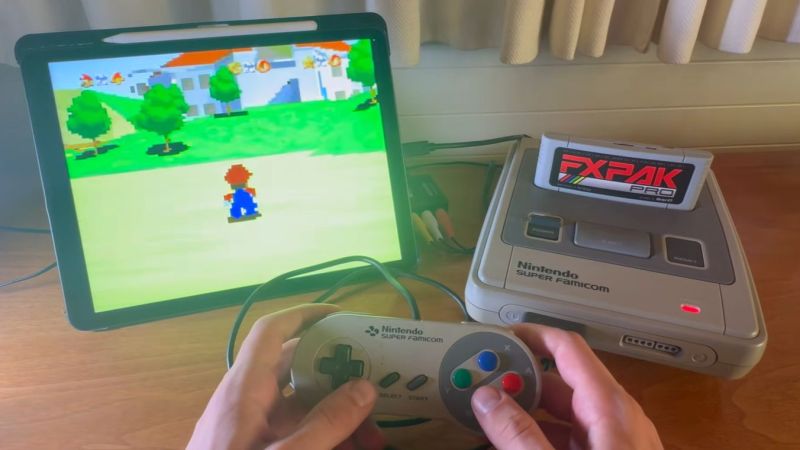
Although the Nintendo 64 was the first to bring real 3D graphics to the table in 1996, the Super Nintendo had an ace up its sleeve in the form of the Super FX chip. One major advantage of using cartridge-based games is that you have the option to add wild features such as a 3D graphics chip to your SNES, something that got used to make games like Star Fox, and as [Tobi] demonstrates in a recent video, can also totally run Super Mario 64 if you squint a lot.

While there’s a rumor that Nintendo was looking to release a ‘Super Mario FX’ game for the SNES, there’s no evidence for such a project. Fortunately these days we got hobbyists prepared to give it a shake to see what a determined group of SNES game developers could have accomplished back then.

The pleasant surprise here is that although a new engine was needed, the SM64 assets could be used with this ‘SMFX’ game and it runs fairly well. There is still room for performance improvement, and the 2 MB memory limit is a problem that may require some culling of parts of levels.

Frames are painted back to front since there’s no advanced Z-culling or similar features, but it shows just how capable the Super FX chip is. [Tobi] has said that he’ll look at releasing the project in some form once he’s happy with how it works and runs, which is definitely something that we’ll look forward to.

Continue reading “Using The SNES Super FX Chip To Run Super Mario 64“ →
An IR Blaster Project, In A Nutshell

The speed that computers have gotten smaller is a bit mind-bending. Most of us now walk around with computers in our pockets that would have rivaled the supercomputers from a few decades ago. And, although it seems like the speed at which things are getting smaller and faster has slowed a bit compared to the rapid pace of the 90s and 00s, some truly minuscule computers are accessible nowadays. So much so that it’s possible to do useful computing inside a walnut shell.

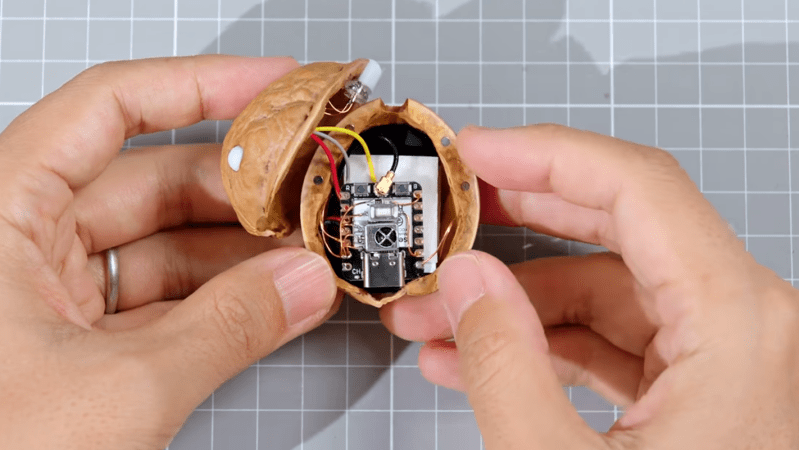
The first step in this build is to crack into a walnut. Most have a natural seam that separates two hemispheres, so splitting it open, enjoying a small snack, and then adding some small neodymium magnets on the inside of that seam to close up the shell is not too difficult. From there, some LEDs were installed at various points in the shell, with an ESP32-C3 installed in the middle to control everything and oriented so that its USB port is still accessible.

Although putting a small microcontroller in a nutshell might seem like a novelty, [JSK-koubou] is actually using the LEDs to perform a useful task. The walnut sits in his living room and connects to a home automation system through the ESP32, and when it receives a command it uses the LEDs to send infrared signals to non-connected devices. Hiding projects in unexpected places is a fun pastime, like this Meshtastic node hidden in a landscape light.

Continue reading “An IR Blaster Project, In A Nutshell” →









