
Testing Coulomb’s Law And Similar Fundamentals Yourself Remains Tricky

How easy is it to build a simple demonstration at home that proves fundamental law of physics, such as Coulomb’s inverse square law, or Maxwell’s equations? This is one of those questions that always nagged at [Casual Physics Enjoyer] as they sought to find ways to develop a more intuitive understanding of these fundamentals with simple DIY-at-home experiments. Unfortunately this turned out to be rather tricky for Coulomb’s law.

Us H. sapiens – courtesy of a few bright individuals – have figured out many of the fundamentals that underlie this physical world over the past few thousands of years. Even if we still got some pretty massive fundamentals left today for equally bright-minded folk to bash their collective heads against, basics like Coulomb’s law or Maxwell’s equations ought to be a snap now for the average person to replicate since they were after all performed in an era before quantum mechanics, computers or even electrification.

To the dismay of the average physics student, experiments that demonstrate these fundamental laws of physics are still pretty hard to replicate without some solid time and monetary investment. This is demonstrated quite succinctly in the linked article, where the question of how to demonstrate the force between two charged particles, as in Coulomb’s law, and that it is an inverse square relationship is attempted.

Whereas the Wikipedia entry claims it to be a ‘simple experiment’ with just two identical spheres, in a DIY setting this is somewhat tricky, including the part where you have to charge up the spheres and measure the force. Using some aluminium foil and wires you can get the two ends to separate as you’d expect, but quantifying the force is a whole other matter.
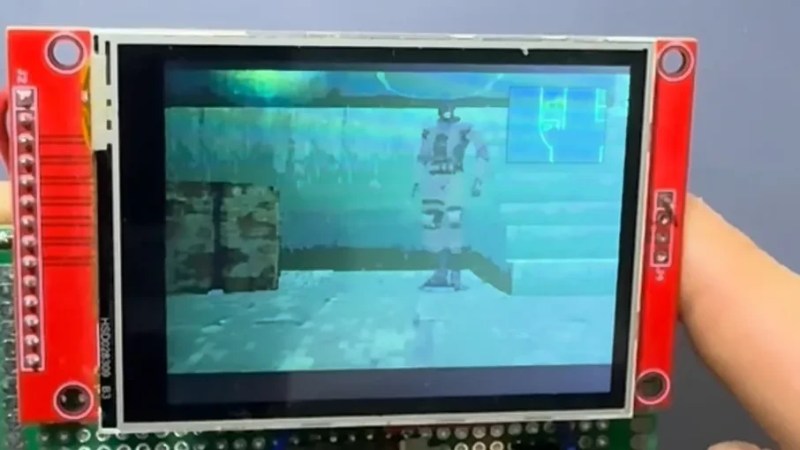

The many polygons of Solid Snake on an ESP-driven LCD

Metal Gear Solid Moves From PlayStation To ESP32

If you haven’t heard of Metal Gear, you probably haven’t played video games these last few decades. The original Metal Gear dates back to 1987 and launched on the MSX, but the real rise to fame probably started with Metal Gear Solid on the original PlayStation in 1998. What needed a hefty console in 1998 can comfortably fit on a microcontroller in 2026, though, as [David Montero Crespo] demonstrates with his port of MGS to the ESP32-S3.

[David] is — as we always are — standing on the shoulders of giants with this hack. Most specifically, the project relies entirely on the [FoxdieTeam] MGS Reversing decompliation project. Of course what one team decompiles, another can recompile, and in this case [David] chose to recompile the game for Expressif’s exceptional ESP32. It wasn’t quite as easy as just forking the repo and compiling with the ESP32 as a target though, as the blog post explains.

We won’t spoil it, but [David] did have to make some changes to account for the different quirks the MIPS processor in the PlayStation has compared to the Xtensa cores on the microcontroller. Then to make it playable, he put the ESP32-S3 module onto some perfboard with an analog stick from a drone controller, an ILI9341 LCD panel, and a resistor ladder to run the buttons for a barebones handheld.

Fans of MSG and its many sequels may appreciate this replica of the codex communicator. Fans of the ESP32 may remember the Wipeout clone we featured earlier, which already proved the popular microcontroller could handle PlayStation-level graphics. If you were hoping for actual solid metal gears, you can cut your own at home.