
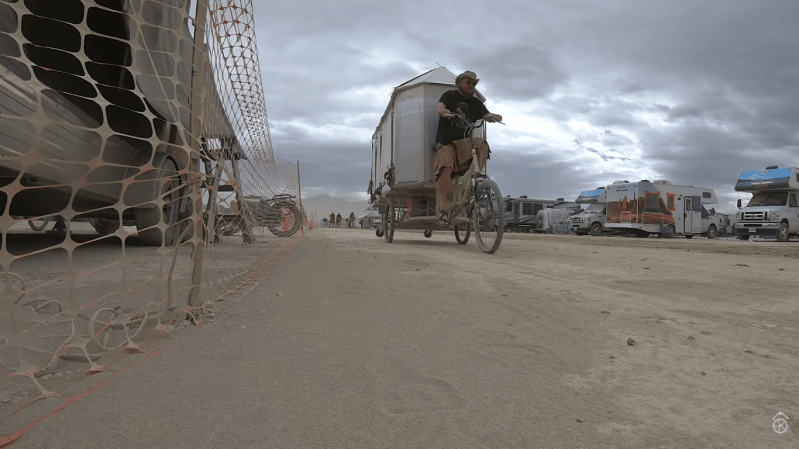
Bicycles are the ultimate form of transportation freedom. They’re easy to repair, parts are cheap, and they will travel almost anywhere for free, as long as the rider has enough calories. Their only real downside is dealing with car-dependent societies, but once a year there’s a place in the American desert that eschews all of this and [Attoparsec] decided to take this custom cargo bike modified into an RV out to Burning Man, a place and time that would be perfect for a build like this.
The build started out as a cargo bike, but not many of them have cargo areas long enough to support a sleeping human. To increase this storage capacity, the bed was extended towards the rear. Without moving the axle further back, though, this created a problem with tail-heaviness so two trailer jacks with wheels were added to the back to keep it from occasionally tipping up too far. The sleeping enclosure was built with rigid foam insulation and taped together, in a modified style common to the Burning Man event which helps keep out sun and playa dust. The bicycle recived one last upgrade to the chain to support the extra weight, and a solar-powered refrigerator, and then it was off to the desert.
The bike RV worked well in the end, and even handled a rain storm without the roof leaking. There were some problems with the customized drive train which were solved in the short term by pounding on one of the wheels occasionally with a hammer. [Attoparsec] left the event early for other reasons, though, and might not be back for a while. But vehicles like these are gaining in popularity, presuming there are safe places to ride them. [Paul Elkins] is often making ones like this gas-powered bicycle and trailer camper.












I was hoping for a continuation on Winnebiko. Needs more miles!
Hey, I am curious…why is it so important that the scene keeps going back to the speaker. Am I here to see him or the project? I stopped the video after two minutes, done, I wanted to see the work, not him. I find this culture very odd, sorry, just my two cent. And I was really curious about the whole concept…oh, well, maybe next time
It’s a story-telling style. If you don’t have patience for a narrative, there’s a video scroll bar for you.
Calling this an RV on a bike is like calling a cardboard box in a Manhattan alley a luxury condo. This guy basically taped together a house of insulation boards on a rickety poorly constructed, poorly assembled bike, Did nothing to furnish it, slept in it in a sleeping bag one or two nights, decided that burning man was hard, and went home.
There, saved you a youtube watch.
Did he also shit in that sleeping bag?
“…decided that burning man was hard, and went home.”
Understandable.
This is a Yurt on wheels. Yurts made from rigid foam palens taped together are very common at burning man
Yurts are round. The circular shape allows high winds to sweep smoothly around the walls instead of catching flat surfaces, preventing the structure from blowing over.
This is not a yurt anymore than its an RV.
Its a mobile shanty. A small, crudely built shack or cabin made from scrap metal, plastic, wood, or other discarded items.
Thank you for your service!
Might have been a different experience if the festival wasn’t the test. There’s some romance to having a mobile tent, I get it, but I really don’t think it’s so much a bad idea as it was simply not ready for the trip. Also, the rain… horrible. Burning man is hard by default on the best of days.
Every tent i have owned was mobile … its kind of their point
„ Their only real downside is dealing with car-dependent societies, but once a year there’s a place in the American desert that eschews all of this…” -but aren’t masses of cars required to get there in the first place?
What the heck is up with these walkable city anti-car people? They creep me out.
Neurotic people make up problems for themselves and others
‘Car tax’ is a lot of the reason. Say I need bread to live, if I can walk to the bread store that’s close to free. If I have to drive then I either have to pay a dedicated driver to take me, or I have to buy a car which in my country means a first year ownership and insurance cost of about 1/5th an average person’s yearly salary. If you can avoid it it’s a choice, if it’s mandatory it’s a tax.
The problem is that shops within walking distance assumes you’re living in a denser urban area, which has higher property prices due to greater demand, thereby higher prices to pay higher rents and other logistics in the first place. If you’re a working class person, without a car you also have worse access to jobs because you can’t commute freely, so you’re likely to earn lower wages or subsist on welfare.
Meanwhile, the money you do earn working some service job in the city is largely coming from people who drive into the city to spend their money. The city itself doesn’t make any new value, it just sells existing value, so to earn anything you need to bring in stuff from the outside. Without the in-out traffic of goods and capital, you would be operating in a closed loop – you would starve.
Blocking access by car lowers demand for services and shuts down businesses, increases poverty, prices, and reduces labor mobility and wages. The “car-free” city is an utopia dreamed up by people who expect to get subsidized public transportation instead, and solve all the social issues by redistributing other people’s money to themselves. It’s a trap, because these people are poor by their lack of options and choices, because they don’t have the mobility or the will to move to better places. “I can’t afford a car, therefore we should ban cars.” is part of the reason why you can’t afford a car.
Panicked reply by a person who has never lived where owning and driving a car isn’t a requirement.
Life goes on just fine in places without cars, and with lower numbers of car owners than is typical in the US.
It doesn’t take a heavily populated urban area to support life without a car in the garage.
I could well live without a car, and have for extended periods of time.
I just don’t want to, because on public transportation you can’t go where you’d really want to, when you’d want to, and you always end up a mile or two off target or having to walk a mile or two to reach it, and you’re always waiting somewhere instead of moving along.
Not in the US.
A garage would be nice, unfortunately I can’t afford that. To make the comparison, for the cost of a small city apartment and a parking space in the open here, you can buy an entire home in the sub-urbs just 20 minutes away – by car.
And if you happen to be unemployed and start looking at the jobs listings, any other job besides telemarketing is going to be…. drumroll …somewhere out in the boonies and you need a car to get there. There’s no entry level jobs in the city, it’s all full because everyone wants to live here, so they “wouldn’t need a car.”
“The city itself doesn’t make any new value, it just sells existing value”
I think you need to read up on the industrial revolution, the Victorians, and the purpose of a factory. Input cheap goods and labour, output expensive goods. Before cars you had to build the factory near the labour.
“all the jobs are out in the boonies”
That is what cars enabled. If the labour can come to you from miles away you can build your factory on cheap land and put the cost of travel onto your workers. That’s not just the car tax and fuel, but the time cost and the inconvenience of being nowhere near anything useful like a grocery store or a hair dresser.
There’s a reason why Marx and the communists leveled their criticism against the “bourgeoisie” (lit. “town dweller”), because most of the productive social activities happened outside of the cities: farming, mining, industry was concentrated up the river where water power was available, etc. while the city slickers existed mainly to skim profits from trade and ownership.
Then for a while in the beginning of the industrial era, town and cities became industrialized because coal became available as an energy source and cheap labor was concentrated where the people were concentrated, so the cities became industrial hubs as well as commercial centers.
Then in the present era the cities became denser and even more populous, and the cost of land and logistics became prohibitively expensive, while the electric grid made it possible to move the industry back out of the cities, and off-shoring removed it entirely. Pollution concerns, zoning, gentrification (i.e. “move your smoke stack elsewhere”, “don’t drive your car here.”) made cities again places of trade and higher order white collar and administrative jobs, pushing the working class out. The people who remained became increasingly polarized into a poor servant class and the rich upper class with limited social opportunities in between. Health care, education, construction, etc. still exists, but those are more “higher order services” that depend on the demand from and serve the higher order business more than supporting the productive base of the society. It’s the city working to support the city, rather than to support the fundamental means of production.
This is sometimes called the “Latte stage of capitalism”, characterized by the appearance of way too many coffee shops as people try to invent jobs by serving each other coffee in the absence of other opportunities. It’s the proliferation of trivial luxuries and the promotion of consumption as a substitute for economic renewal when the people are unwilling or unable to take their exit and move out in search of other jobs.
Having no cars or not being able to afford cars and fuel is a part of that problem.
Now remove the car: can the factory return to the city? Will it return?
Pot, kettle, say hello to black.
Lol, nice irony.
Meanwhile, on a trip to Amsterdam in 2022, I saw the “BeTriton” e-bike/houseBOAT from Latvia.
“Gas-powered bicycle”…. I believe there is a term for that.
I think the term gas powered bicycle was used to separate a hacked together lawnmower engine powered bicycle from a factory designed, properly constructed MoPed.