
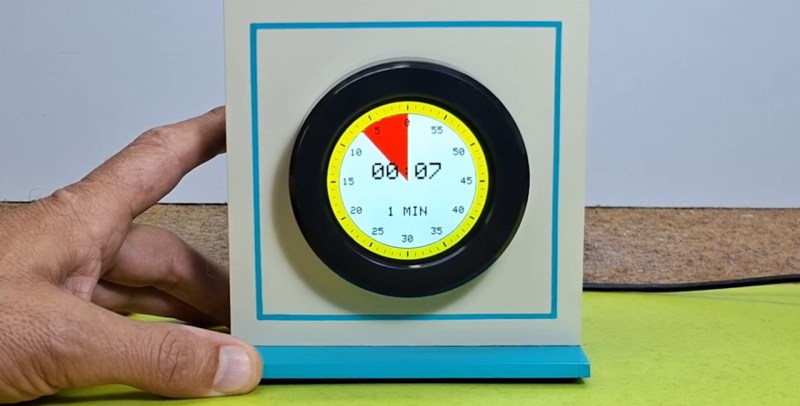
We’re big fans of pushing hardware into situations it wasn’t designed for here at Hackaday, but sometimes you’ve got to appreciate a nicely designed gadget doing more or less exactly what it was intended for — especially when it’s courtesy of code that’s freely available for you to run and hack on however you like.
That’s precisely what [mircemk] has done with their “Universal Timer” project. The 2.1 inch CrowPanel “Rotary Display” at the heart of the build combines an ESP32-S3 with a 480×480 round touch screen display and a rotary encoder.
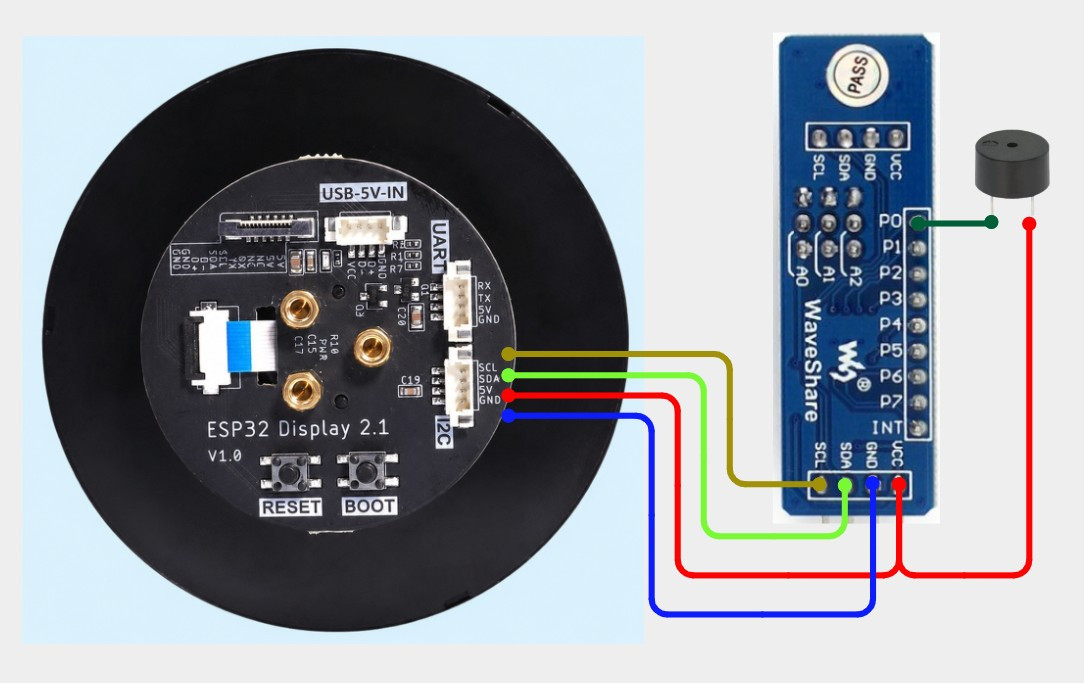
The all-in-one device — clearly meant to be reminiscent of the Nest thermostat and similar commercial offerings — is technically all you need, but in this case it’s been joined by a PCF8574 I2C I/O expander which in turn is used to drive a buzzer that provides a bit of audio feedback at the end of the countdown.
With the code [mircemk] has provided flashed onto the board, the rotary encoder ring built into the housing makes for an exceptionally intuitive input for setting the desired time. It’s a bit like a high-tech version of the classic kitchen timer, as shown in the video below, you simply twist the ring and the graphics on the display rotate accordingly. Unlike grandma’s clockwork timer of old however, this one can change color as it nears zero, which makes it easier to estimate how much time remains from across the room.
As the popularity of smartwatches has brought the cost of these circular displays down, we’ve started to see some very slick projects utilizing them. The various efforts to turn them into desktop “radar” displays for nearby flights are a particular favorite.












CCW?
After I watched a little I realize you are not reading those numbers as negative to T=0. The “hand” moves CW. Perfectly normal.
The hand on analog countdown timers usually rotates counterclockwise so that the reference time scale increases clockwise like for a normal clock. Also, for analog timers where you set the time by twisting the “clock hand”, you twist clockwise to increase the time since that’s typically more comfortable for right-handers (sorry, left-handers.)
Stupid to use a border on the casing that fits a square display with a round window.
“Stupid”? A bit harsh for an aesthetic choice, don’t you think?
I’m more annoyed that it isn’t centered.
If the housing were round, it would likely roll off the counter. Shortly thereafter, it would be jagged and irregular shaped.
You too can have a $5 timer for just $50.
My. Thoughts exactly. It’s got 240mHz dual core wifi, Bluetooth, e fuses, flash encryption, hardware rng, adcs, capacitive touch and a million other things.
Reminds me of that robot rick made. “what is my purpose?”
“You pass the butter”
…Sigh
I hate any product that uses these cheaply made and poorly implemented rotary encoders. This project is a perfect example of just how cumbersome it is to use, and the whistling audio noise really fits in with the overall picture and the impression the product gives. When you combine three different types of controls, you can pretty much say the project has failed before you’ve even started.
This is not a product.
Great project. This has so many applications. The receding red wedge is reminiscent of so many movie prop bomb timers (not advocating for that usage) or rocket countdown timers or well you probably have seen what I mean.
Cool project for those who want to experiment with these kind of display, but i stick to my regular egg-timer that operates on a mechanical clockwork with a simple spring (no batteries to replace/recharge every week).
Seems a bit wasteful to use an PCF8574 to drive one buzzer, when a single GPIO and a transistor would have done the job.
But the silkscreen says “I2C”, not “GPIO”!
/s
I rationalized the choice as exposing more pins for future expansion.
I don’t think this display exposes any GPIO pins.
I think this is a great project. I like the display and the functions. You can see easily that red wedge from across a room. I’d probably make the beeper run longer when the time hits zero.
Maybe instead of fixed values for the timers, like 1 minute, 60 minutes, etc., you could just use the rotary encoder to set the desired time on the numerical display and then the red wedge would always start at full screen and slowly narrow to a wedge and eventually disappear at t=0.
Someone give that man a 3D printer to make the housing!