
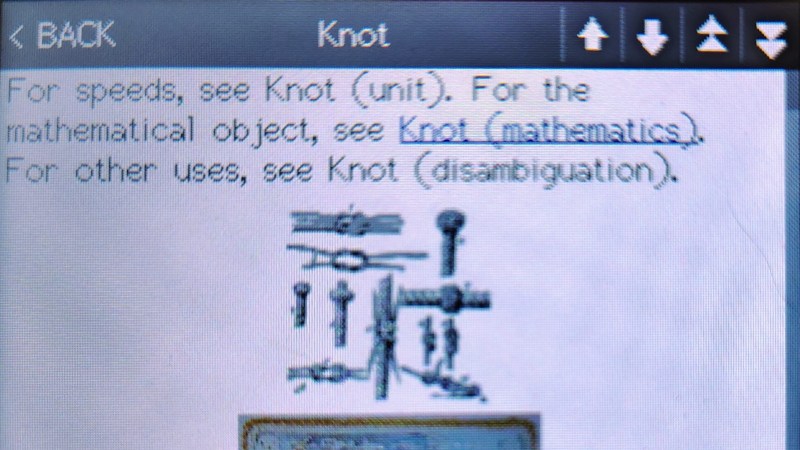
The Cheap Yellow Display (CYD) is a board carrying a slightly older ESP32 variant, a display with a resistive touchscreen, an SD card, and not much else. It’s often used for straightforward microcontroller applications that need a user interface, but that’s not the limit of its possibilities. [Alun Morris] has a CYD on which you can brows an entire offline Wikipedia.
The trick is to take the offline Wikipedia builds from the Kiwix project, and process them further into a custom format suited for a browser firmware on the ESP32. A modern SD card can hold so much data that a full Wikipedia is well within its abilities even with images included.
We like this idea, because it takes the knowledge away from the center of the network to its edge. We expect to see it gaining a following among enthusiasts for offline living, because all that knowledge without a network can only be useful. If you recognize [Alun]’s work, it might be because of his ESP32 web browser.









Looks nicer than the wikireader…. which I have in a box around here somewhere.
You beat me to that observation, and I think the Wikireader was based on a super slow and weird little Epson processor from memory. Having said that, I kinda loved the wikireader! I used to do 20+ hour flights prior to widespread inflight Internet, and I carried one just to look stuff up. It worked well for that use case, and I have my wikireader(s) still somewhere around here.
If you check Archive.org there are pretty recent updates for the WikiReader, User @GW98, has a zim for up to April 2026.
Hm. It uses “Simple English” for obvious reasons (“Shorter articles and simpler language — well-suited to a small screen”).
And I guess that’s fine to both types of speakers from both ends of the spectrum.
Say, native English speakers and foreign Engrish speakers from India/Asia.
But to me, personally, the simple wording is not relaxing at all. 😟
Rather, the other way round, because it lacks information my mind must compensate for.
I know, that sounds highly arrogant, but it’s my honest experience.
Maybe that’s because back in school (English class, German school),
we quickly switched from Kindergarden English (simple present, simple past) to present perfect and similar advanced forms.
The whole “-ing” stuff, basically. “I’m walking” instead of “I walk”.
I’m a native English speaker and I also find “simple English” slightly harder to read for the same reasons you mention.
Much like the famous xkcd strip that explains the “up goer five” (Saturn V rocket) using only the thousand (“ten hundred”) most common words in English. It’s even simpler, and a lot of fun, but definitely not easier to understand!