TOMOS Moped Becomes Electric Beast

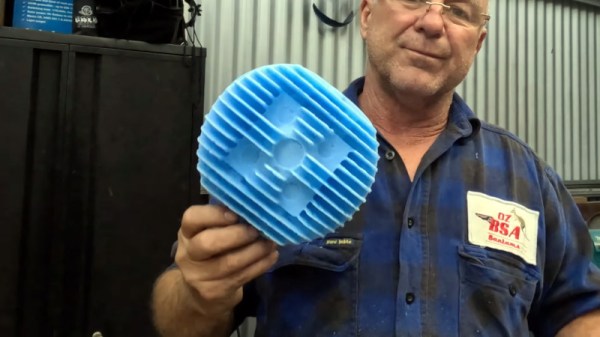
The TOMOS 50cc moped, a small motorcycle produced in Yugoslavia and the Netherlands, has for decades been a common sight on European roads and provided the first taste of transport independence for countless youngsters. Unfortunately the company went bankrupt a few years ago, but there are still plenty of them about, and it’s one of these that [Doctor D.S.] gives an electric conversion in the video below the break.

The electronics are a standard 5 kW off-the-shelf Chinese kit, but in this they aren’t the star of the show so much as the work on the bike. As with any old moped it’s a bit ropey, and he strips it down and reconditions every part of it alongside his work fabricating brackets, a battery box, and a seat. It’s a long video, but it’s one of those workshop sequences that you can become engrossed in.

The result appears to be a very practical, powerful (for a moped) and rideable bike, and it’s one we’d have for buzzing around town any day. We’d like to take a look at that battery box and seat combo on the interests of safety, but otherwise it’s pretty spot-on. Sit back and enjoy a bit of quality workshop video!

If you’re hungry for more, this is by no means the first road bike electric conversion we’ve brought you.

Continue reading “TOMOS Moped Becomes Electric Beast”

How Much Thrust Is Your Prop Really Making?

The problem of components not conforming to their claimed specification is one that must challenge engineers in all fields, including it seems, that of multi-rotors and remote controlled aircraft. A motor can boast an impressive spec on the website which sells it, but overheat or just not deliver when it’s on your bench. Thus [Valkyrie Workshop] has come up with a simple but ingenious rig to evaluate a motor and propeller combo without breaking the bank.

It tales the form of a L-shaped wooden bracket clamped to a pivot point at its corner with one arm pointing upwards, with motor and propeller in a 3D printed holder on the upwards arm. The other arm extends horizontally and lies on a digital kitchen scale the same distance from the pivot as the motor. The same force as is exerted by the motor is transmitted via the bracket to the kitchen scale, allowing a direct readout of the thrust in grams or kilograms. This is a first version of the rig, further work will move to a load cell and Arduino for more flexibility in measurement.

We’ve featured similar devices here in the past, including one version which can be mounted to an automobile so it can be tested at speed.

Continue reading “How Much Thrust Is Your Prop Really Making?”

A NanoVNA As A Dip Meter

A staple of the radio amateur’s arsenal of test equipment in previous decades was the dip meter. This was a variable frequency oscillator whose coil would be placed near the circuit to be tested, and which would show an abrupt current dip on a moving coil meter when its frequency matched the resonant frequency of what it was testing. For some reason the extremely useful devices seem hard to come by in 2024, so [Rick’s Ham Shack] has come along with a guide to using a nanoVNA in their place.

It’s a simple enough technique, indeed it’s a basic part of using these instruments, with a large sensor coil connected to the output port and a frequency sweep set up on the VNA. The reactance graph then shows any resonant peaks it finds in the frequency range, something easily demonstrated in the video below the break by putting a 20 meter (14 MHz) trap in the coil and seeing an immediate clear peak.

For many readers this will not be news, but for those who’ve not used a VNA before it’s a quick and easy demo of an immediate use for these extremely versatile instruments. For those of us who received our callsigns long ago it’s nothing short of miraculous that a functional VNA can be picked up at such a reasonable price, and we’d go as far as to suggest that non radio amateurs might find one useful, too. Read our review, if you’re interested.

Continue reading “A NanoVNA As A Dip Meter”

Recovering A Physically Broken SD Card

There is much to be found online about recovering data from corrupt SD cards, but [StezStix Mix] had an entirely different problem with his card. He’d filmed an important video to it, then dropped it and ran his office chair over it, snapping it almost in half. He’s put up a couple of videos showing how he recovered the data, and we’ve put them below the break.

A modern SD card is mostly just plastic, as in the decades since the format was created, the size of the circuitry on it has decreased dramatically. So his stroke of luck was that the card circuitry was a tiny PCB little bigger than the contact pad area on a full size SD card. There was a problem though, it wouldn’t be easy to fit in an SD card socket. So in the first video he goes through physically wiring it to a USB card reader, which results in reading the data after a false start in remembering that an SD card activates a switch.

This however is not the end of the story, because he had viewers asking why he didn’t simply attach an SD card shaped bit of cardboard. So the second video below goes through this, trying both card, and an SD to micro SD adapter. We find that making something to fit an SD socket is a lot less easy than it looks, but eventually he manages it.

Meanwhile those of you with long memories may recall this isn’t the first SD surgery we’ve brought you.

Continue reading “Recovering A Physically Broken SD Card”

The Apple They Should Have Made, But Didn’t

Whenever there is a large manufacturer of a popular product in the tech space, they always attract tales of near-mythical prototypes which would have changed everything on the spot had they just not been cancelled by the bean counters. The Sony-Nintendo PlayStation prototypes for example, or any of a number of machines inexplicably axed by Commodore.

Apple is no exception. They brought the instantly forgettable twentieth anniversary Mac and the pretty but impractical G4 Cube to market, but somehow they rejected the Jonathan, a razor-sharp modular machine from the mid-1980s.

It’s easy after so long associating Apple with the Mac to forget that in the mid-80s it was simply one of their several computer lines, and not the most successful one at that. The 16-bit machine was something of a slimmed-down evolution of the Lisa, and it thus it doesn’t necessarily follow that every other Apple machine of the day also had to be a Mac. Into this would have come the Jonathan, a high-end modular machine bridging the gap between domestic and business computing, with a standard bus allowing processor modules for different operating systems, and upgrades with standard “books”, hardware modules containing peripherals, not all of which would have come from Apple themselves. It would have been Apple’s first 32-bit machine, but sadly it proved too adventurous for their management, who feared that it might tempt Apple users into the world of DOS rather than the other way round.

What strikes us about the Johnathan is how out of place it looks on a 1980s desk, it would be the mid-1990s before we would come close to having machines with these capabilities, and indeed we’ve never seen anything quite as adventurous hardware-wise. It’s certainly not the only might-have been story we’ve seen though.

Wear Testing Different 3D Printer Filaments

Over the couple of decades or so since it started to be available at an affordable level, 3D printing has revolutionized the process of making custom objects. But as anyone with a 3D printer will know, sometimes the materials don’t quite live up to the application. There is a huge variety of available filaments to help make better prints, but which one really is the most hard-wearing? [My Tech Fun] set out to measure the resistance to wear of a variety of different 3D printed materials.

The test takes a standard print made across a variety of different materials, and several of each using different manufacturers’ offerings. These are then put on a test rig that moves backward and forward twice a second, with the test piece rubbing against a steel shaft under pressure from a 2.5 kg weight.

As might be expected, the common and cheap PLA performed the worst while PETG, PA, and TPU performed the best. But for us the interesting part comes in the variance between brands; the best PLA sample outperforms the worst ABS and nearly equals the worst of the PETG. Proof that maybe you do get what you pay for.

The whole test is well worth a watch, and if you 3D print anything that might be subjected to mechanical stress you should find it to be of interest. If comparing filaments is something you’d like to see more of, we’ve featured some tests before.

Continue reading “Wear Testing Different 3D Printer Filaments”

Espressif’s ESP32-P4 Application Processor: Details Begin To Emerge

Every now and then there’s a part that comes along which is hotly anticipated, but which understandably its manufacturer remains tight-lipped about in order to preserve maximum impact surrounding its launch. Right now that’s Espressif’s ESP32-P4: a powerful application processor with dual-core 400 MHz and a single-core low power 40 MHz RISC-V processors. Interestingly it doesn’t appear to have the radios which have been a feature of previous ESP parts, but it makes up for those with a much more comprehensive array of peripherals.

Some details are beginning to emerge, whether from leaks or in preparation for launch, including the first signs of support in their JTAG tool, and a glimpse in a video from another Chinese company of a development board. We got our hopes up a little when we saw the P4 appearing in some Espressif documentation, but on closer examination there’s nothing there yet about the interesting new peripherals.

Looking at the dev board and the video we can see some of what the thing is capable of as it drives a large touchscreen and a camera. There are two MIPI DSI/CSI ports onĀ  the PCB, as well as three USB ports and a sound codec. A more run-of-the-mill ESP32-C3 is present we think to provide wireless networking, and there’s a fourth USB port which we are fairly certain is in fact only for serial communications via a what our best blurry photograph reading tells us is a Silicon Labs USB-to-serial chip. Finally there’s large Raspberry Pi-style header which appears to carry all the GPIOs and other pins. We’ve placed the video below the break, if you see anything we’ve missed please tell us in the comments.

We first covered this chip back in January, and then as now we’re looking forward to seeing what our community does with it.

Continue reading “Espressif’s ESP32-P4 Application Processor: Details Begin To Emerge”