2025 One Hertz Challenge: 4-Function Frequency Counter

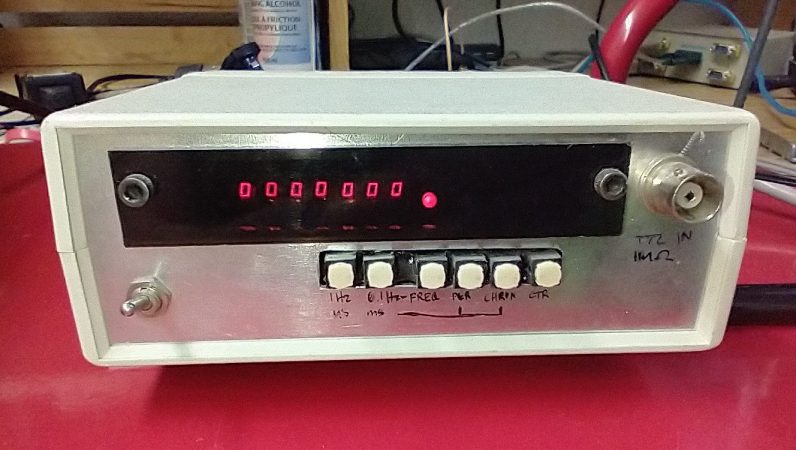
Frequency! It’s an important thing to measure, which is why [Jacques Pelletier] built a frequency counter some time ago. The four-function unit is humble, capable, and also an entry into our 2025 One Hertz Challenge!

The build began “a long while ago when electronic parts were still available in local stores,” notes Jacques, dating the project somewhat. The manner of construction, too, is thoroughly old-school. The project case and the sweet red digits are both classic, but so is what’s inside. The counter is based around 4553 BCD counter chips and 4511 decoder ICs. Laced together, the logic both counts frequency in binary-coded decimal and then converts that into the right set of signals to drive the 7-segment displays. Sample time is either 1 Hz or 0.1 Hz, which is derived from an 8MHz oscillator. It can act as a frequency meter, period meter, chronometer, or a basic counter. The whole build is all raw logic chips, there are no microprocessors or microcontrollers involved.

It just goes to show, you can build plenty of useful things without relying on code and RAM and all that nonsense. You just need some CMOS chips and a bucket of smarts to get the job done!

2025 One-Hertz Challenge: A Software-Only AM Radio Transmitter

We’ve been loving the variety of entries to the 2025 One-Hertz Challenge. Many a clock has been entered, to be sure, but also some projects that step well outside simple timekeeping. Case in point, this AM transmitter from [oldradiofixer.]

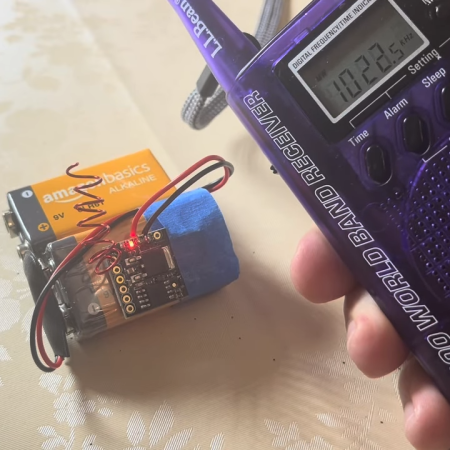
The software-only transmitter uses an ATTiny85 processor to output an AM radio signal in the broadcast band. It transmits a simple melody that you can tune in on any old radio you might have lying around the house. Achieving this was simple. [oldradiofixer] set up the cheap microcontroller to toggle pin PB0 at 1 MHz to create an RF carrier. Further code then turns the 1MHz carrier on and off at varying rates to play the four notes—G#, A, G#, and E—of the Twilight Zone theme. This is set up to repeat every second—hence, it’s a perfectly valid entry to the 2025 One-Hertz Challenge!

It’s a simple project, but one that demonstrates the basics of AM radio transmission quite well. The microcontroller may not put out a powerful transmission, but it’s funny to think just how easy it is to generate a broadcast AM signal with a bit of software and a length of wire hanging off one pin. Video after the break.

Continue reading “2025 One-Hertz Challenge: A Software-Only AM Radio Transmitter”

2025 One-Hertz Challenge: Fixing The Clock That Once Synced The World

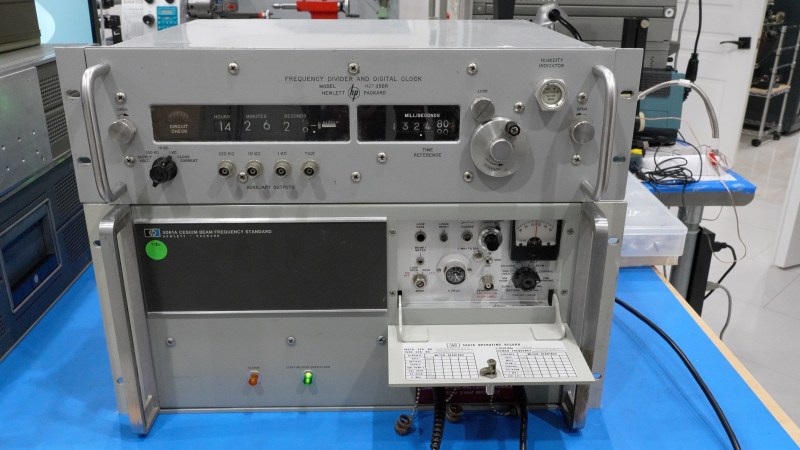
The HP 115BR is not one of the most well-known products from Hewlett-Packard. And yet, it was remarkably important nonetheless. This hardware once synced time around the world. Now, for our 2025 One-Hertz Challenge, [curiousmarc] has taken on the job of restoring it. 

The HP 115BR itself was not used alone, but in concert with the HP5060A atomic clock. The latter would output a 100 KHz reference output. It was the job of the HP 115BR to divide this frequency down to provide a superbly accurate 1-second tick.

The example on [curiousmarc]’s bench showed up in poor shape. It was “very broken,” and he reported that it had also previously been hacked to some degree. However, he has been able to restore it to proper functionality, including the special modification for continuous tick adjustment, as used in the 1964 flying atomic clock experiment. He was even able to sync it to NIST’s current atomic clock signal from Fort Collins using the WWW radio signal.

We’ve seen plenty of old HP metal restored over the years; it’s always pleasant to see how well things were built back in the day. Video after the break.

Continue reading “2025 One-Hertz Challenge: Fixing The Clock That Once Synced The World”

2025 One-Hertz Challenge: Clock Calibrator

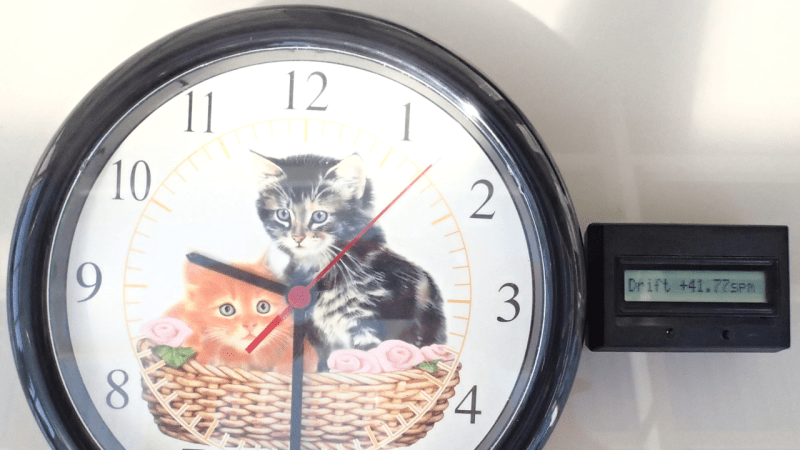
Wall clocks! Are they very accurate? Well, sometimes they are, and sometimes they lose minutes a day. If you’ve got one that needs calibrating, you might like this device from [Lauri Pirttiaho].

Most cheap wall clocks use very similar mechanisms based around the Lavet-type stepper motor. These are usually driven by a chip-on-board oscillator that may or may not be particularly accurate.

[Lauri] desired a way to tune up these cheap clocks by using GPS-level timing accuracy. Thus began a project based around a CY8KIT evaluation board from Cypress. The microcontroller is paired with a small character LCD as a user interface, and hooked up to a cheap GPS module with an accurate 1-pulse-per-second (1PPS) timing output. The concept is simple enough. Clock drift is measured by using counters in the microcontroller to compare the timing of the GPS 1PPS output and the pulses driving the Lavet-type stepper motor. The difference between the two can be read off the device, and used to determine if the wall clock is fast or slow. Then one need only use a trimmer capacitor to tweak the wall clock’s pulse rate in order to make it more accurate.

Few of us spend much time calibrating low-cost wall clocks to high levels of accuracy. If that sounds like a fun hobby to you, or your name is Garrus, you would probably find [Lauri]’s device remarkably useful. Believe it or not, this isn’t the first clock calibrator we’ve seen, either. Meanwhile, if you’ve brewed up your own high-accuracy timing hardware, feel free to let us know on the tipsline.

2025 One-Hertz Challenge: Shadow Clock

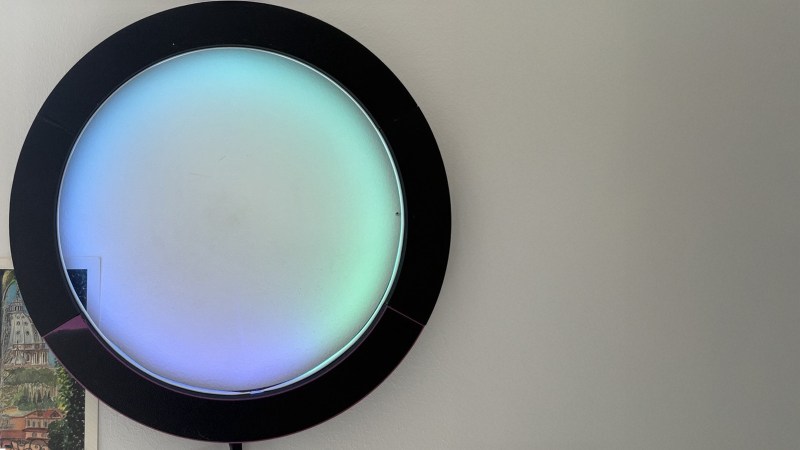
You can buy all kinds of conventional clocks that have hands and numbers for easy reading. Or, like [Fabio Ricci], you could build yourself something a little more esoteric, like this neat shadow clock.

The heart of the build is an ESP8266 microcontroller, which gets the current time via Wi-Fi by querying an NTP time server. It also uses a DS3231 real-time clock module as a backup, keeping accurate time even when a network connection is unavailable.

Time is displayed via a 60-pixel ring of WS2812B addressable LEDs. These 60 LEDs correspond to the usual per-minute graduations that you would find on a regular clock. Current hour is displayed by lighting the corresponding LED red, while minutes are shown in blue and seconds in white. It’s called a “shadow clock” because of its method of activation. IR distance sensors are used to activate the time display when a hand or finger is placed near the clock. As Fabio puts it, “shadow play” will make the clock display the time. Otherwise, it switches to be a simple round device on the wall that displays colorful animations.

It’s a neat build that looks quite unassuming as a decor piece, and yet it also serves as an easy-to-read timepiece. We’ve seen LEDs put to all sorts of good uses in clock builds around these parts. Meanwhile, if you’ve found your own unique way to display the time—either in readable fashion, or totally oblique—don’t hesitate to let us know.

2025 One-Hertz Challenge: A Clock Sans Silicon

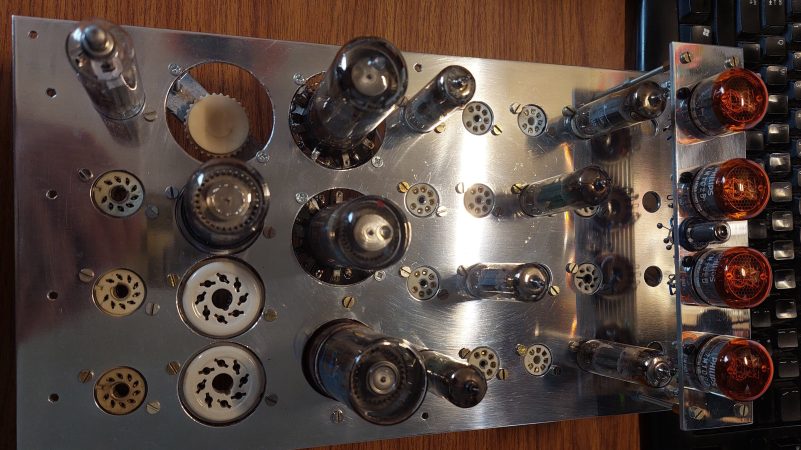
Just about every electronic device has some silicon semiconductors inside these days—from transistors to diodes to integrated circuits. [Charles] is trying to build a “No-Silicon digital clock” that used none of these parts. It looks like [Charles] is on the way to success, but one might like to point out an amusing technicality. Let’s dive in to the clock!

Instead of silicon semiconductors, [Charles] is attempting to build a digital clock using valves (aka tubes). More specifically, his design relies on seven dekatrons, which are the basic counting elements of the clock. By supplying the right voltages to the various cathodes of the dekatrons, they can be made to step through ten (or sometimes twelve) stable states, used as simple memory elements which can be used as the basis for a timepiece. [Charles] will set up the first dekatron to divide down mains frequency by 5 or 6 to get down to 10 Hz, depending on whether the supply is 50 Hz or 60 Hz. The next dekatron will step down 10 times to 1 Hz, to measure seconds. The next two will divide by ten and six to count minutes, while a further two will divide the same way to create an impulse per hour. A final dekatron will divide by 12 to count the hours in a day.

Naturally, time will be displayed on Nixies. While silicon semiconductors are verboten, [Charles] is also considering the use of some germanium parts to keep the total tube count down when it comes to supporting hardware. Also, [Charles] may wish to avoid silicon, but here’s the thing about tubes. They use glass housings, and glass is made of silicon.

Cheeky technicalities aside, it’s a great project that promises to create a very interesting clock indeed. Progress is already steaming along and we can’t wait to see the finished product. We’ve seen dekatrons put to good use before, too. If you’re cooking up your own practical projects with mid-century hardware, don’t hesitate to let us know!

Listening To Ethernet Via Eurorack

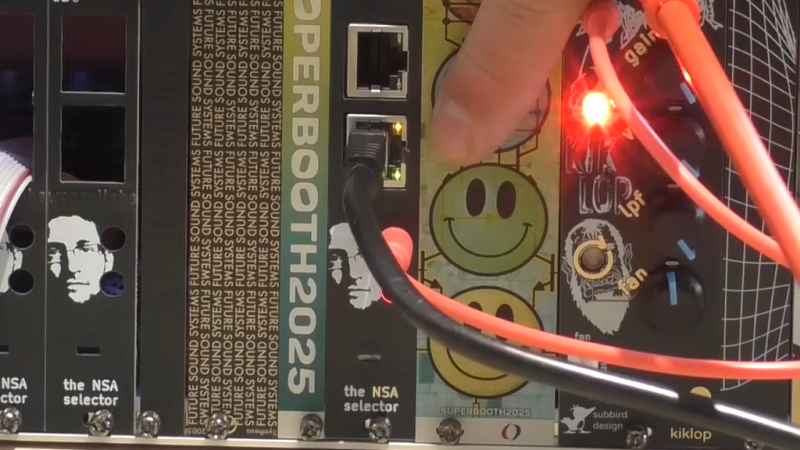
Ethernet is how we often network computers together, particularly when they’re too important to leave on a fussy WiFi connection. Have you ever thought about listening to Ethernet signals, though? Well, you totally could, with the NSA selector from [wenzellabs].

The NSA selector is a Eurorack module, designed for use as part of a larger modular synthesizer. There are lots of fun jokes and references on the PCB, but the front panel really shows you what this module is all about. It’s got a pair of RJ45 jacks, ready to receive your Ethernet cables through which data is flowing. They’re paired with a single audio output jack. “Any bit on the network will be sent to the audio output,” [wenzellabs] explains.

The device operates in a relatively simple fashion. Network traffic from one jack is forwarded to the other, unmodified. However, it’s also spat out to a simple digital-to-analog converter and turned into audio. This thing doesn’t play digital audio formats or anything like that—it just turns raw Ethernet signalling into audible noise.

Raw signal noises might not sound very appealing, but let’s be real here. If you liked nice sounds, you wouldn’t be into Eurorack. Skip to 25:46 in the video below if you just want to hear the final product.

Continue reading “Listening To Ethernet Via Eurorack”