Storage Media Forgotten

These days, cheap removable storage is no problem. USB sticks are virtually free at moderate capacity and not unreasonable, even at relatively large sizes. They are rugged, work across platforms, and don’t require any exotic interfaces. But this hasn’t always been the case.  In the 1990s, people wanted to store too much data for floppies, but weren’t willing to shell out for removable hard drives or tapes. Many companies identified this opportunity with, perhaps, the most successful being Iomega with the Zip drive. But there were others, including the Avatar Shark that [This Does Not Compute] remembers in a video you can see below.

Haven’t heard of the Shark? We had not either, but reviewers seemed to like it. The drive would fit in your pocket if you had a fairly large pocket. The 250 MB cartridge was smaller (but thicker) than a 3.5-inch floppy. It performed ok and connected to the parallel port which was common in those days.

Continue reading “Storage Media Forgotten”

The Hot Chocolate Effect Explained

This is the time of year when people in the Northern Hemisphere like to enjoy hot beverages like hot chocolate. [The Action Lab] uses hot chocolate to demonstrate an odd acoustic effect. Tapping a container of hot chocolate — or even just hot water — will make a sound at a certain frequency. But if you keep tapping, the frequency of the sound will gradually increase. Don’t know why? Don’t worry, neither did scientists until around 1980.

The secret is bubbles and the speed of sound through air vs a liquid. The speed of sound in the liquid and the height of the liquid in the cup set the frequency. However, the speed of sound changes based on the bubbles, which alters the frequency.

Continue reading “The Hot Chocolate Effect Explained”

Mind Control… No, Not Like That

[Vintage Geek] found an interesting device from 1996 called “MindDrive” which claims you can control your computer with your brain. Oddly, though, it doesn’t connect to your head. Instead, it has a little finger sensor that looks like a pulse-ox sensor. Did it work? The video below will show you what it can and can’t do.

The company claims the device is the result of seven years of research. We suspect it is little more than a galvanometer, like a kid’s toy lie detector. There is a gold sensor and a Velcro strap. It is hard to imagine that it was feasible that “thinking left” would cause a change in your finger that the device can interpret.

Continue reading “Mind Control… No, Not Like That”

Calculation Before We Went Digital

We have to like [Nicola Marras]. First, he wrote a great mini-book about analog computers. Then he translated it into English. Finally, he opened with a picture of Mr. Spock using an E6-B flight slide rule. What’s not to like? We suggest you settle in when you want to read it — there are almost 60 pages of text, photos, and old ads for things like slide rules and adding machines.

There is a lot of research here. We couldn’t think of anything missed. There’s a Pascalina, Ishango’s bone, a Babylonian spreadsheet, an abacus, and even Quipu. Toward the end, he gets to nomographs, adding machines, and the early calculators.

Continue reading “Calculation Before We Went Digital”

Roll Your Own SDR

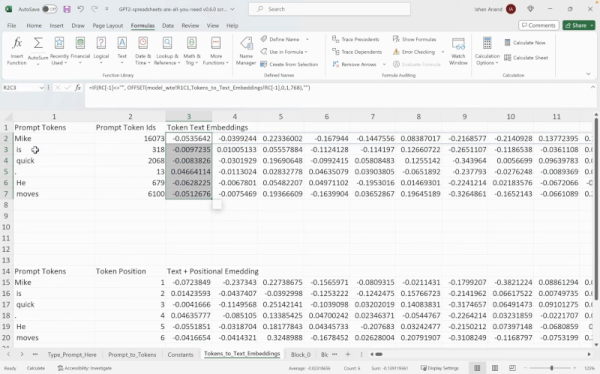
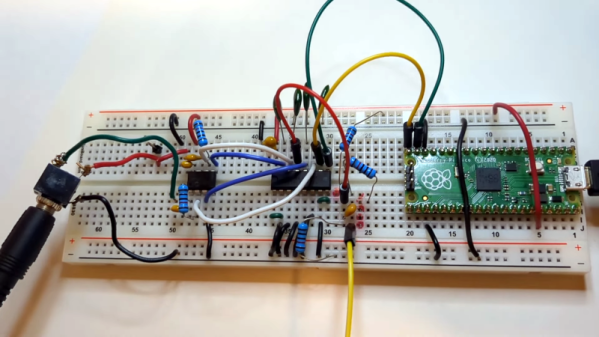
If you have software-defined radio hardware and you are only using someone elses’ software, you are missing out on half of the fun. [Tech Minds] shows you how easy it can be to roll your own software using GNU Radio Companion in a recent video.

GNU Radio usually uses Python, but with the companion software you rarely need to know any actual Python. Instead, you simply drag blocks around to represent filters, DSP processing, and other functions you need to create the processing for your application.

Continue reading “Roll Your Own SDR”

Hubless E-Bike Is Nostalgic

[Chris Makes Stuff] is an aptly named channel. His recent video shows how he took a kid’s electric motorcycle toy and built a “penny farthing” bicycle. You might not know the bike by that name, but when you see it in the video below, you’ll recognize it. These Victorian-era bikes used a single large wheel before chain drives on a bike became a thing.

Of course, the big part of this — literally and figuratively — is the giant front wheel. There’s a second video showing how it was built in layers using wood.

Continue reading “Hubless E-Bike Is Nostalgic”

Forget The Altair! Remember The Mark-8!

Calling any one computer the first hobby computer is fraught with peril. Most people think the MITS Altair 8800, first featured in Popular Electronics back in January 1975, was the first. Some might argue that others were first, but there is no doubt that the Altair started the hobby computer revolution from a practical standpoint. However, there was another computer that almost took the crown. It, too, appeared in a magazine — Radio and Electronics. But it was in the July 1974 issue. That computer was the Mark 8, and [Artem Kalinchuk] is building a replica that you can see started in the video below. This isn’t some Arduino work-alike. He has a pile of parts and some almost authentic-looking PCBs.

The Mark 8 used the 8008, not the 8080, so it was less powerful. [Artem] has been building a replica Altair, too. Check out his YouTube channel if you are interested in those.

Continue reading “Forget The Altair! Remember The Mark-8!”