Raspberry Pi Controlled Chicken Door

We’re not sure if the Chickens know it yet, but they could be one of the reasons for all this IoT craze now a days. Look for chicken coop, and out come dozens of posts from the Hackaday chest.

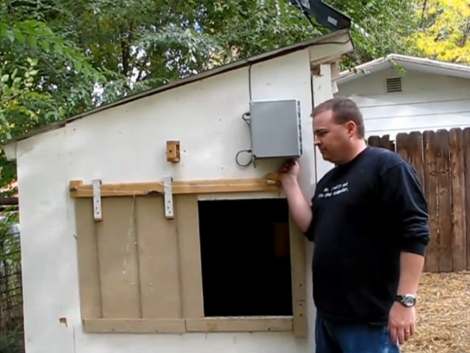
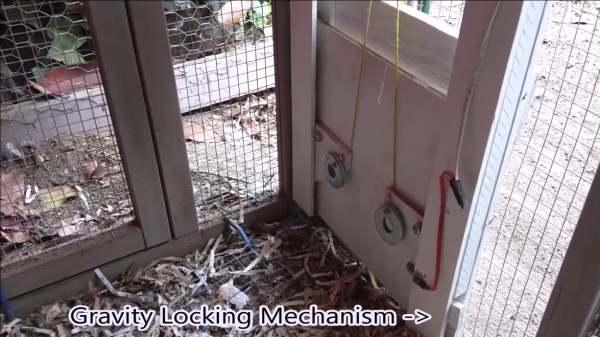
Here’s another one from self confessed lazy engineer [Eric]. He didn’t want to wake up early to let his chickens out in the morning, or walk out to the coop to lock them up for the night to protect them from predators like Foxes, Raccoons and Opossum. So he built a Raspberry-Pi controlled chicken coop door that automates locking and unlocking. The details are clear from his video which you can watch after the break. The door mechanism looks inspired from an earlier anti-Raccoon gravity assist door.

The hardware (jpg image) is simple – a couple of hall sensors that detect the open/close status of the coop door that is driven by a DC motor via a bridge controller. The whole setup is controlled using a Raspberry-Pi and this is where the fun starts – because he can now add in all kinds of “feature creep”. Motion sensor, camera, light array, and anti-predator gizmos are all on his drawing board at the moment. Add in your feature requests in the comments below and let’s see if [Eric] can build the most advanced, complicated, gizmo filled chicken coop in the Universe. Combine that with this design, and it could even turn out to be the most beautiful too.

Continue reading “Raspberry Pi Controlled Chicken Door”

Chicken Coop Door Performs In Harsh Environment

One of the pitfalls of modern engineering is that it’s entirely possible to end up in a situation where a product or solution has been designed by someone who has never left a desk. Which wouldn’t be a problem if things didn’t have a tendency to work differently in real life than they do in theory.

One of those things is automatic chicken coop doors, which have to operate reliably in not only a wide range of climates but with a number of possible physical limitations as well. [Vinnie] has taken on the challenge of building one which actually accomplishes all of these tasks, after realizing that the off-the-shelf solutions were victims of design over practicality.

[Vinnie] designed this door to be operated by the one thing that’s always 100% reliable: gravity. A linear actuator lifts the door at the beginning of the day, and then at night it’s allowed to fall back down in its track. A latch secures it against smarter intruders like raccoons. [Vinnie] has found that this lifting mechanism holds up much better in mud, snow, ice, and other difficult conditions than any other method he’s tried so far.

The system is built around a ATmega1284P, and calculates the sunrise and sunset times each day to know when to open or close the door. He’s built the system as a state machine which makes it more robust during power outages, which is a necessity since his chicken coop is mobile and is frequently out of range of WiFi and is battery powered.

The approach [Vinnie] takes to automation is something that has application outside of his own farmstead. Using state machines instead of schedules, ensuring the design is as simple as possible and works within its environment, and minimizing reliance on electric and data infrastructure can go a long way to solving problems that might not appear when designing something on paper.

He’s been automating many other things on his farm as well, and it’s worth checking it out if you haven’t seen it already.

How A DIY Chicken Coop Door Opener Went From Simple To Complex

How hard could it be to make a chicken coop door that can be configured to open and close automatically using a straightforward interface? That’s the question that [Jeff Sandberg] set out with, after three years of using a more basic off-the-shelf unit that offered no remote access nor a convenient user interface. The use case for [Jeff] was rather straightforward: the door would be open during the day and closed at night to keep the hens safely inside the coop.

The commercial solution offered an RTC-backed programmable interface as well as a light sensor, but the latter wasn’t always reliable in inclement weather and making simple changes to the programming when e.g. the hens had to stay inside a day due to work on the yard, was much more complicated than needed, plus had to be done on the spot. The new system would solve all these ills.

That said, the existing door mechanism was doing a fine job and could be kept. This just left making a new box with electronics to control it, starting with an ESP32C3 with the ESPHome firmware that is hooked into the local Home Assistant system, along with a motor to lift and lower the door and with magnetic contact sensors.

So far so easy. The hard part came with the installation, which involved trenching to the hen house for mains power, repairing the damage from this, and troubleshooting a power issue that turned out to be due to a dodgy power adapter. The payoff is that now the chicken coop is also part of the smart home and their owner never has to trudge through a soggy garden again to adjust the programming on a dim LC display with far too few buttons.

Irising Chicken Coop Door

What’s cooler than a door that irises open and closed? Not much. They add a nice science-fictiony detail to any entryway. [Zposner]’s dad wanted an automatic door for his chicken coop, so [zposner] took some time and came up with a nice door for him with an iris mechanism. You’ll need to watch the video.

[Zposner] used a combination of laser cutting and a CNC router to cut the pieces, then sanded and painted the wood. After assembly, [zposner] started work on the control mechanism. He’s controlling the door with an Arduino and a motor shield; to let the Arduino know to stop the motor, [zposner] used limit switches which get hit as the mechanism rotates. Once the switches were in the right place and the code written, it was time to finish assembly and install the door on the coop. To keep the Arduino that safe, it was installed in a plastic container with a screw lid, and then hot-glued to beside the iris.

Unfortunately, chickens don’t necessarily care how cool something is, and in this case, they didn’t realize that the iris was a door – they refused to exit the coop through it. [Zposner] tried a few things before settling on putting the chicken on the edge of the door – then the chicken would realize that it could go through it.

[Zposner]’s dad now has a snazzy door that opens with a switch. It was a great project for [zposner] and his dad to work on and, even if the chickens seem unimpressed, they did a great job. Check out the iris porthole that a Detroit Hackerspace built into its door, or, if you really want to build an iris mechanism, but don’t have access to a CNC router, a laser cutter, or, you know, wood, you could build this out of bits you have lying around.

Continue reading “Irising Chicken Coop Door”

IoT Coop Door Cares For Chickens, Tests Home Automation

Most chickens are pretty good at putting themselves to bed when the sun sets, and [Eddy]’s chickens are no exception. But they’re not terribly thoughtful about closing up after themselves, so he set about on a long-term project to automate the door of their coop.

An open door overnight leaves chickens and their food vulnerable to predation. Rather than handle the chore manually and risk one forgetful moment that could wipe out his flock, [Eddy] used a servo to power the door and an Arduino to control it. To keep track of bedtime and wakeup, a Raspberry Pi looks up the local civil dawn and twilight times online and tells the Arduino when the moment is at hand. The Pi cleverly caches the times for use the next day in case the WiFi connection is down, and also provides a web interface to check on the door’s status and manually override the cycle. Result: safe, happy chickens.

If all this seems a bit much for a simple job, [Eddy] agrees. But he’s using this as a testbed to develop a home automation framework that can be retasked at will. Sounds like he’s on the right track to us, but for more IoT animal husbandry tips, he’ll want to check out this small farm automation effort.

Continue reading “IoT Coop Door Cares For Chickens, Tests Home Automation”

Chicken Coop Door Using Threaded Rod

There’s no rooster to wake them up, and [Steve] and his wife are fine with that. What they’re not fine with is having to get up early anyway in order to let the chickens out of the coop. Like many small-scale egg farmers they sought out an automatic solution for opening the coup in the morning.

[Steve] had seen a bunch of different automatic coup door hacks kicking around the Internet. But all of the ones he could find used a vertical door and pulleys. His setup has a door that opens horizontally and he realized that he needed to build some kind of linear actuator. What he came up with is a system built with hardware store parts. He’s using a plain old piece of threaded rod along with a coupling nut (they’re usually 3/4″ long or so). The nut is held firmly on the door using a conduit mounting bracket, while the threaded rod is turned by an electric screwdriver mounted to the jamb. Two limiting switches are made up of magnetic sensors often used to ring the door entry bell when you enter a store. An Arduino takes care of scheduling and controlling the motor for opening and closing the door. See for yourself in the high-production-value video after the break.

For what it’s worth, we have seen at least one rope and pulley door that slides horizontally.

Continue reading “Chicken Coop Door Using Threaded Rod”

Motorized Coop Door Lets The Chickens Out For You

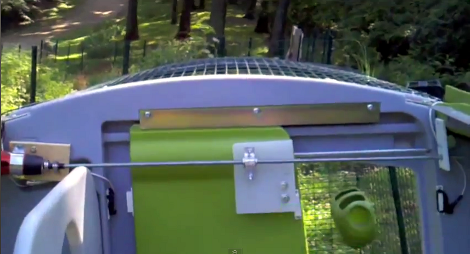
[Larry] and [Carol] just upgraded the coop to make their lives easier, and to help keep the chickens happy. The image above is a chicken’s-eye-view of the newly installed automatic door. It’s a guillotine design that uses the weight of the aluminum plate door to make sure predators can’t get in at night. This is much easier to fabricate than a locking coop door would have been. Some leftover aluminum channel guides the door on either side, with a spool above it to wind up some rope, thereby lifting the door.

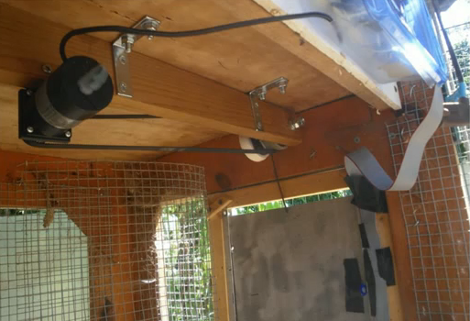
You can see the belt-drive motor is also mounted inside, out of the element. To the right of the image you can just make out a plastic food container. This protects the electronics from the elements. Inside you’ll find an H-bridge to drive the motor, a real-time-clock to make sure the schedule is well-timed, and an Arduino. There are a couple of reed switches which let the microcontroller sense the position of the door.

After the break you can see a demonstration video, as well as a slide show with build details. The motor is pretty quiet and, although it spooks the chicken in the demo just a bit, we’d be they’ll be used to it in no time.

Continue reading “Motorized Coop Door Lets The Chickens Out For You”