Google Glass? How About This Home-brew Solution?

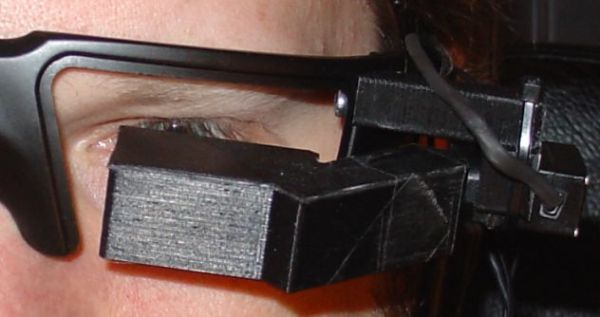
[Codeninja] has been sending us some great hacks over the years, and we’ve just learned that his attention has been on building wearable computers lately! He’s currently on his third iteration of a Google Glass-like prototype, which features a motorized element which allows for the retraction of the screen.

There’s not too much info on his blog about them, but we do know he’s using a Raspberry Pi, a few small servos, and a pico LCD screen. Most of the frame is 3D printed, and it also features a hidden camera, accelerometers, and a few environmental sensors.

He’s uploaded an animated gif of the mechanism that moves the display away from his eye, and it looks straight out of some science fiction movie — check it out after break!

Continue reading “Google Glass? How About This Home-brew Solution?”

3D Printed Velcro

Velcro

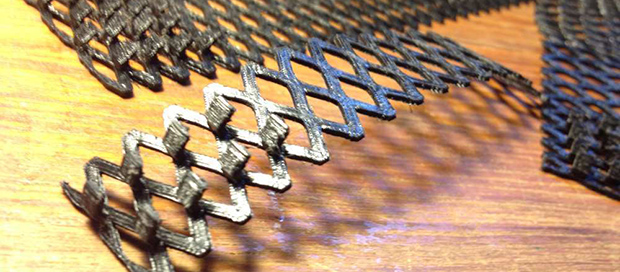
With new materials comes new possibilities in fabrication, and with 3D printers, this observation is no different. In the past year or so, there have been a few very interesting new filaments that have come into mainstream use – a printable sandstone, high impact polystyrene, and a flexible PLA. When [Rich] saw a bike light that had an integrated hook-and-loop fastener – think Velcro – built in to its enclosure, he thought to himself, ‘I could do that too.’

[Rich]’s “ElastoStraps” are printed with Makergeek’s Flexible PLA, and the entire device works surprisingly similar to other hook and loop fasteners with a registered trademark. The design is up on Thingiverse, and since the object was designed with OpenSCAD, the 3D printed Velcro can also be opened up in the Customizer for hook-and-loop straps that perfectly suit your needs.

Why You Shouldn’t Care About The All-Metal 3D Printed Gun

Solid Concepts, one of the world’s largest rapid prototyping outfits, just printed a gun. Unlike previous 3D printed guns like the Liberator, this 3D printed version of an M1911 is made out of metal. It’s a real gun, with rifling in the barrel – something the Liberator doesn’t have – and has the look and feel of what the US military has been using as a service pistol for decades.

The Solid Concepts 1911 was made using the selective laser sintering process, using a combination of stainless steel and nickel-chromium alloys. Every single part of the gun, save for the spring, was 3D printed without any machining. It’s an impressive feat of rapid manufacturing – firing .45 ACP rounds, this gun will see 20,000 psi every time the gun is fired. It’s already chewed through a few magazines so far, and it apparently shoots pretty well, to boot.

Here’s why you shouldn’t care.

Solid Concepts business is to make things using rapid prototyping. They make everything from plastic baubles, tooling for injection molds, architectural models, and stuff that doesn’t get past the prototype stage. This 3D printed 1911 is simply a demonstration of Solid Concept’s capabilities, nothing more.

The printer used to manufacture this printer is an EOS SLS printer that costs many tens of thousands of dollars. Our limited research can’t pin the price of the printer down more than that, but let’s just say you could buy a very, very nice sports car for the same price, and we’re not talking about that awesome ‘vette down at the Chevy dealership.

This is just a neat little advertisement, that’s it. Someone at Solid Concepts realized if they made a gun using 3D printed parts, it would be picked up by blogs and wire services. They were right. It’s an excellent demo of what Solid Concepts’ capabilities are, but that’s just about it. You’re still not able to manufacture an M1911 on a desktop 3D printer, and even if you could, you could set up a machine shop in your garage and end up with a similar product for less money.

As an aside, and this is just me throwing an idea out there, can we please stop using guns as an example of what 3D printing can do? I respect your right to manufacture, own, and operate a gun, but as I write this paragraph, I’m cringing at the thought of all the pro and anti-gun comments this post will see.

If you’re looking for a way to demonstrate your 3D printing prowess, how about something like an engine? Given the right design, they’re more complicated than a gun, and a really small Wankel engine would be really cool.

Video of the Solid Concepts 1911 available below.

Continue reading “Why You Shouldn’t Care About The All-Metal 3D Printed Gun”

3D Printing With Metal… At Home!

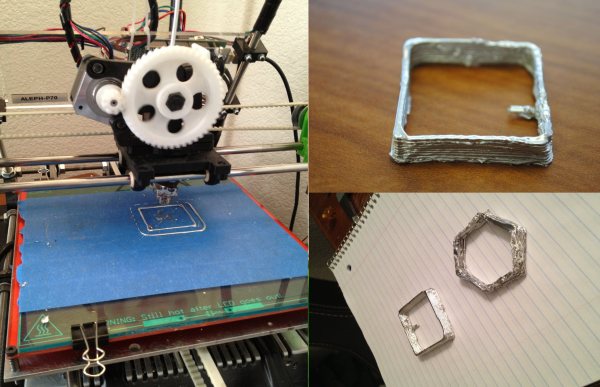
[Bam] from the LulzBot forums  has successfully printed metal using his 3D printer and a Budaschnozzle 1.1 hot end. Well, solder to be specific — but it’s still pretty awesome!

He’s making use of 3mm solder purchased from McMaster (76805a61), which has a blend of 95.8% tin, 4% copper and 0.2% silver. It took quite a few tries to get it extruding properly, and even now it seems to only be able to print about 15mm before jamming up — a more specific hot end with a larger thermal mass might help. He plans on trying a thinner filament (1.75mm) as it might help to keep it at the proper extrusion temperature, which in this case is around 235C.

During our research we found another user from the RepRap blog who has also been experimenting with printing low-melt point alloys — and he’s even successfully created an Arduino compatible Sanguino board using the printer!

If you want to try this yourself, you’ll need a nozzle you don’t care about, bored out to about 1mm — any smaller and it won’t extrude at all. Be warned though, the solder will corrode brass and aluminum, and [Bam] notes that after going through 1lb of solder, the nozzle was closer to 2mm in diameter when he was done! Oh and for the love of hacking — use ventilation!

Stick around after the break to watch a video on a professional version of this system — which is essentially a repurposed welding robot, using electron beam direct manufacturing. These technologies can’t make nicely finished parts, but they excel when considering they can make near net-weight parts, requiring only a small amount of machining to finish.

Continue reading “3D Printing With Metal… At Home!”

The Trials Of Printing Mil-Spec Connectors

conn

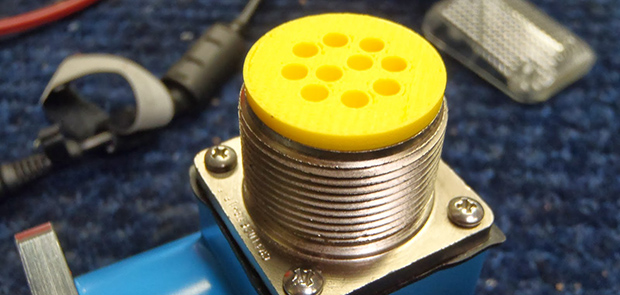
[Chris] over at the 23B hackerspace had a bit of a problem – a project required the use of a very old rotary encoder with a mil-spec connector. While it might be possible to simply buy one of these mating connectors on Digikey or Mouser, that’s not [Chris]’ usual MO. He has a nice 3D printer, and this connector is basically a cylinder with some holes. How hard could printing out one of these connectors be?

The dimensions for [Chris]’ first attempt at creating a mating connector came from Solidworks’ “Sketch Picture” command where an image can be superimposed over a model and the 3D features created from that guide. If it worked, it would be far too easy, and the printed model didn’t fit at all.

This failure led [Chris] to page through MIL-STD-1651, a portly tome of 200+ pages covering every circular connector possible.  After 20 minutes of scanning the specs, [Chris] found what he was looking for: the correct specification showing him where all the pins and holes should go.

After some fine modeling in Solidworks, [Chris] had his very own custom printed Mil-Spec connector. Sure, he ate up more time than it was worth for one connector, but now that he has the STL file, he can print out as many as he needs.

Low Cost Filament Extruder

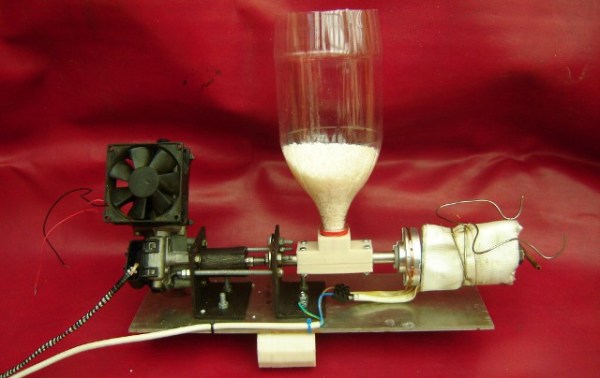
Here’s a great low cost filament extruder solution. It uses basic parts available from any hardware store, and a few 3D printed ones — estimated cost is well under $100.

It’s very similar to the Lyman Filament Extruder, but can be built for even less money. By using 200C set-point heaters, his setup requires absolutely no electronics — although a cheap PID controller from China could give him more extrusion capabilities with temperature control… Regardless, the system appears to make good filament and he uses it exclusively for his personal filament consumption in his Delta printer. He’s even hacked up the ABS casing of a refrigerator, ground it down, and turned it into filament using this machine! If you’re hungry for more details, the full build log and discussion can be found on the RepRap forums.

He also has a guide on making your own ABS color masterbatch to make your own filament colors!

[Thanks Liam!]

UK Cops Fear Gun; Pointlessly Seize 3D Printer

quoteGUNquote

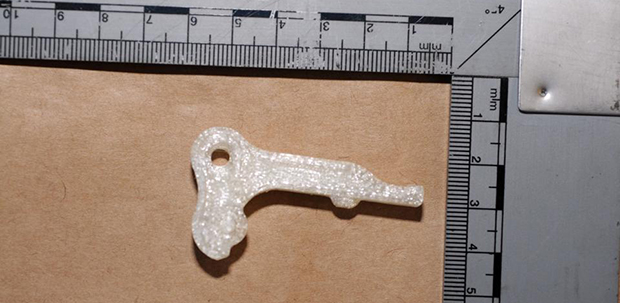
Above, according to the greater Manchester Police force, is a 3D printed gun. Well, the rozzers say it’s merely a trigger for a gun. In part they’re actually correct; it is a trigger. For a spring-loaded extruder for the Makerbot Replicator.

For the past few days, the media has been abuzz about the first seizure of a 3D printer (a Makerbot Replicator 2) in Manchester, UK during a raid on suspected gang members. Despite numerous complaints and comments by makers across the UK (thanks, guys), Assistant Chief Constable [Steve Heywood] says, “We need to be absolutely clear that at that this stage, we cannot categorically say we have recovered the component parts for a 3D gun.” The seized 3D printer parts are being sent to ballistics experts to determine if a random piece of plastic can be used in the manufacture of handguns.

Alright kiddos, editorial time. We’re quite aware that the UK is a little…. different… than the US when it comes to firearms regulation. Nevertheless, we feel the need to defend anyone with a 3D printer, in a handy Q&A format:

What this has also done is open up a wider debate about the emerging threat these next generation of weapons might pose.

No, it doesn’t. I don’t know what the British equivalent of a Home Depot is, but I could go to that store, buy some stuff, and build a zip gun. Of course I wouldn’t, because that’s not safe. I could also use a mill and lathe to make a proper gun.

But it’s made of plastic and thus undetectable

Bullets aren’t. Also, I could machine some Delrin. You should really watch In the Line of Fire.

But plans for 3D printed guns are available, making it easy for anyone to fabricate their own gun

Yeah, and Hackaday made one. There were a lot of problems with those 3D printer files. The spring wouldn’t slice, the hammer wouldn’t print, every part was out of scale, and you’d need a lot of experience in 3D modeling and design to turn those ‘plans available on the Internet’ into something you can send to a printer.

Your posting this article further sensationalizes the role of 3D printers in gun control.

You’re right. Here’s what you do: every time someone mentions 3D printed guns, say, “You can build an even better gun with a combo mill/lathe that costs the same as a 3D printer. Equal skill is required to operate both machines. Do you intend to ban the sale or use of machine tools?”

But UK gun laws are weird.

Then print a knife.

via reddit