2025 One Hertz Challenge: Drop The Beat (But Only At 60 BPM)

Mankind has been using water to mark the passage of time for thousands of years. From dripping stone pots in Ancient Egypt to the more mechanically-complicated Greco-Roman Clepsydrae, the history of timekeeping is a wet one — and it makes sense. As an incompressible fluid, water flows in very predictable patterns. If you fill a leaky pot with water and it takes an hour to drain, it will also take an hour the next time you try. One Hertz Challenge entrant [johnowhitaker] took this idea in a different direction, however, with an electromechanical clock that uses dripping water as an indicator.

This clock uses a solenoid to briefly pop the plunger out of a water-filled syringe. This allows a drop to fall from the tip, into a waiting beaker. In addition to the satisfying audio indication this produces, [johnowhitaker] added a bit of food coloring to the dripping water for visual flair. The entire thing is controlled by a Raspberry Pi Pico and a motor driver board, so if you’ve got some spare parts lying about and would like to build your own be sure to head over to the project page and grab the source code.

While this clock isn’t exactly here for a long time (either the syringe will eventually empty or the beaker will overflow), it’s certainly here for a good time. [John] and commenters on his project even have ideas for the next steps: a 1/60 Hz beaker changer, and a 1/600 Hz spill cleaner. Even so, the first couple of drops hitting the beaker produce a lovely lava lamp-esque cloud that is a joy to watch and has us thinking about other microfluidics projects we’ve seen.

And remember — it’s not too late to enter the 2025 One Hertz Challenge!

2025 One-Hertz Challenge: Clock Calibrator

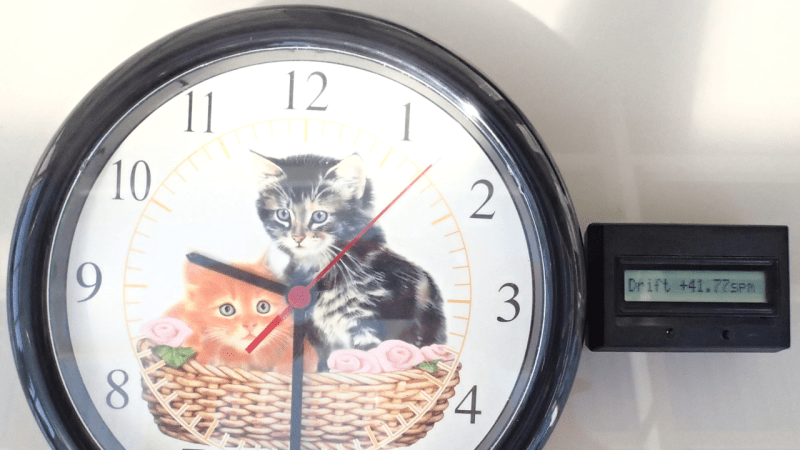
Wall clocks! Are they very accurate? Well, sometimes they are, and sometimes they lose minutes a day. If you’ve got one that needs calibrating, you might like this device from [Lauri Pirttiaho].

Most cheap wall clocks use very similar mechanisms based around the Lavet-type stepper motor. These are usually driven by a chip-on-board oscillator that may or may not be particularly accurate.

[Lauri] desired a way to tune up these cheap clocks by using GPS-level timing accuracy. Thus began a project based around a CY8KIT evaluation board from Cypress. The microcontroller is paired with a small character LCD as a user interface, and hooked up to a cheap GPS module with an accurate 1-pulse-per-second (1PPS) timing output. The concept is simple enough. Clock drift is measured by using counters in the microcontroller to compare the timing of the GPS 1PPS output and the pulses driving the Lavet-type stepper motor. The difference between the two can be read off the device, and used to determine if the wall clock is fast or slow. Then one need only use a trimmer capacitor to tweak the wall clock’s pulse rate in order to make it more accurate.

Few of us spend much time calibrating low-cost wall clocks to high levels of accuracy. If that sounds like a fun hobby to you, or your name is Garrus, you would probably find [Lauri]’s device remarkably useful. Believe it or not, this isn’t the first clock calibrator we’ve seen, either. Meanwhile, if you’ve brewed up your own high-accuracy timing hardware, feel free to let us know on the tipsline.

RPI TinynumberHat9

2025 One Hertz Challenge: RPI TinynumberHat9

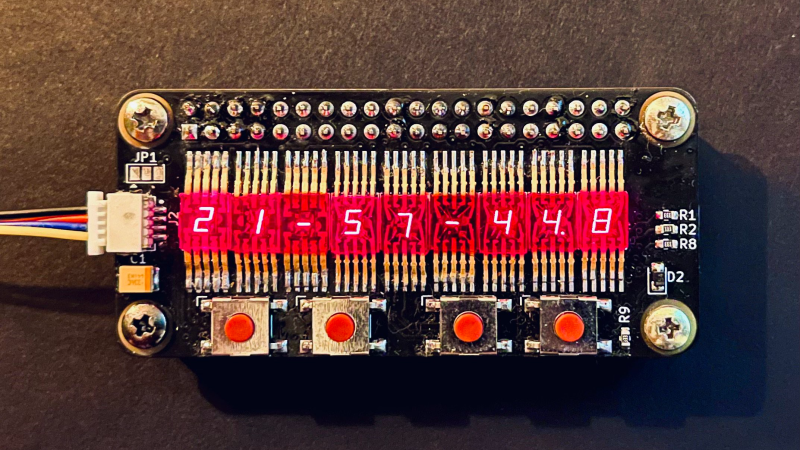
This eye-catching entry to the One Hertz Challenge pairs vintage LED indicators with a modern RPi board to create a one-of-a-kind clock. The RPI TinynumberHat9 by [Andrew] brings back the beautiful interface from high end electronics of the past.

This project is centered around the red AL304 and green ALS314V 7-segment display chips. These 7-segment displays were produced in the 1970s and 1980s in the Soviet Union; you can still find them, but you’ll have to do some digging as they are only becoming more rare. [Andrew] included the data sheet for these which was a good find, it is written in Russian but doesn’t hold any surprises, these tiny LEDs typically forward current is 5mA at 2V. One of the things that jumps out about these LEDs is the gold leads, a sure sign of being a high-end component of their day.

When selecting a driving chip for the LEDs, [Andrew] looked at the MAX7219 and HT16K33; he settled on the HT16K33 as it supports I2C as well as allows the easy addition of buttons to the HAT. Due to being driven by I2C, he was also able to add a Qwiic/Stemma I2C connector, so while designed initially to be a HAT for a Raspberry Pi Zero 2 W board, it can be connected to other things in the Qwiic/Stemma ecosystem.

Thanks [Andrew] for submitting this beautiful entry into the One Hertz Challenge. We love unique 7-segment displays, and so it’s pretty awesome to see 40-year-old display tech brought into the present.


2025 One-Hertz Challenge: A Clock Sans Silicon

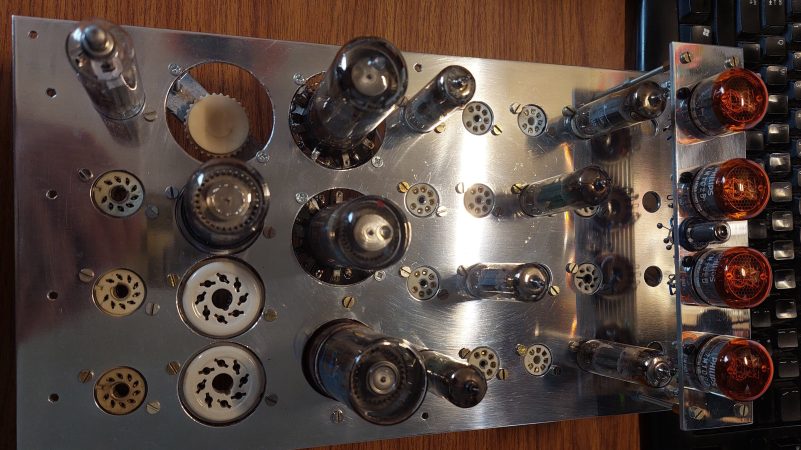
Just about every electronic device has some silicon semiconductors inside these days—from transistors to diodes to integrated circuits. [Charles] is trying to build a “No-Silicon digital clock” that used none of these parts. It looks like [Charles] is on the way to success, but one might like to point out an amusing technicality. Let’s dive in to the clock!

Instead of silicon semiconductors, [Charles] is attempting to build a digital clock using valves (aka tubes). More specifically, his design relies on seven dekatrons, which are the basic counting elements of the clock. By supplying the right voltages to the various cathodes of the dekatrons, they can be made to step through ten (or sometimes twelve) stable states, used as simple memory elements which can be used as the basis for a timepiece. [Charles] will set up the first dekatron to divide down mains frequency by 5 or 6 to get down to 10 Hz, depending on whether the supply is 50 Hz or 60 Hz. The next dekatron will step down 10 times to 1 Hz, to measure seconds. The next two will divide by ten and six to count minutes, while a further two will divide the same way to create an impulse per hour. A final dekatron will divide by 12 to count the hours in a day.

Naturally, time will be displayed on Nixies. While silicon semiconductors are verboten, [Charles] is also considering the use of some germanium parts to keep the total tube count down when it comes to supporting hardware. Also, [Charles] may wish to avoid silicon, but here’s the thing about tubes. They use glass housings, and glass is made of silicon.

Cheeky technicalities aside, it’s a great project that promises to create a very interesting clock indeed. Progress is already steaming along and we can’t wait to see the finished product. We’ve seen dekatrons put to good use before, too. If you’re cooking up your own practical projects with mid-century hardware, don’t hesitate to let us know!

2025 One Hertz Challenge: A Discrete Component Divider Chain

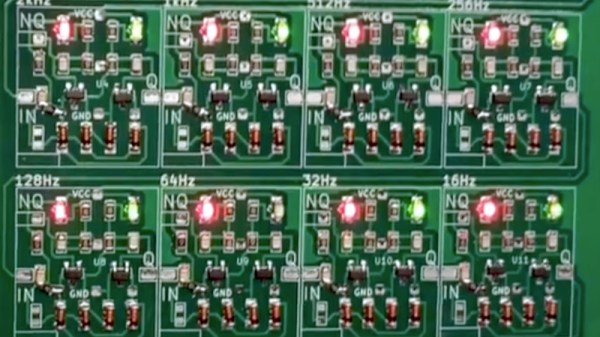
Most of us know that a quartz clock uses a higher frequency crystal oscillator and a chain of divider circuits to generate a 1 Hz pulse train. It’s usual to have a 32.768 kHz crystal and a 15-stage divider chain, which in turn normally sits inside an integrated circuit. Not so for [Bobricius], who’s created just such a divider chain using discrete components.

The circuit of a transistor divider is simple enough, and he’s simply replicated it fifteen times in surface mount parts on a PCB with an oscillator forming the remaining square in a 4 by 4 grid. In the video below the break we can see him measuring the frequency at each point, down to the final second. It’s used as the timing generator for an all transistor clock, and as we can see it continues that trend. Below the break is a video showing all the frequencies in the chain.

This project is part of our awesome 2025 One Hertz Challenge, for all things working on one second cycles. Enter your own things that go tick and tock, we’d live to see them!

Continue reading “2025 One Hertz Challenge: A Discrete Component Divider Chain”

2025 One Hertz Challenge: 555 Timer Gets A Signal From Above

One of the categories we chose for the One Hertz Challenge is “Could Have Used a 555.” What about when you couldn’t have, but did anyway? The 555 is famously easy to use, but not exactly the most accurate timer out there — one “ticking” at 1 Hz will pulse just about once per second (probably to within a millisecond, depending on the rest of the circuit), but when you need more precise timing, the 555 just won’t cut it. Not on its own, anyway.

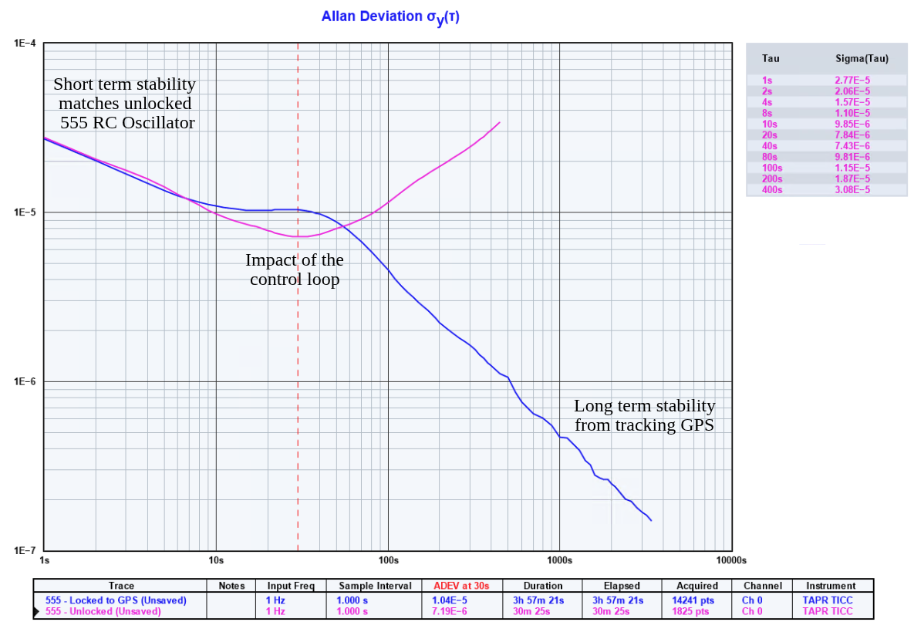
An Allan deviation plot
Allan Deviation can be a bit confusing, but generally — lower is more accurate

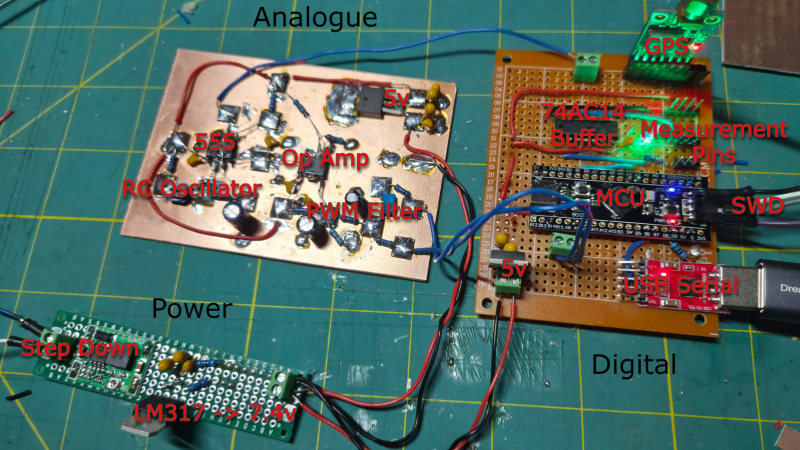
This entry by [burble] shows us how the humble 555 can hold its own in more demanding systems with some help from a GPS receiver. He used the One Pulse per Second (1PPS) output from a GPS module to discipline the 1 Hz output from a 555 by modulating the control voltage with a microcontroller.

Okay, this sounds a bit like baking a cake by buying a cake, scraping all the icing off, then icing it yourself, but what better way to learn how to ice a cake? The GPS-disciplined 555 is way more accurate than a free running one — just check out that Allan Deviation plot. While the accuracy of the standard 555 begins to decrease as oscillator drift dominates, the GPS-disciplined version just keeps getting better (up to a point — it would also eventually begin to increase, if the data were recorded for long enough). Compared to other high-end oscillators though, [burble] describes the project’s accuracy in one word: “Badly.”

That’s okay though — it really is a fantastic investigation into how GPS-disciplined oscillators work, and does a fantastic job illustrating the accuracy of different types of clocks, and some possible sources of error. This project is a great addition to some of the other precision timekeeping projects we’ve seen here at Hackaday, and a very fitting entry to the competition. Think you can do better? Or much, much worse? You’ve got a few weeks left to enter!

Most complex blinking light

2025 One Hertz Challenge: 16-Bit Tower Blinks At One Hertz

We’ve seen our share of blinking light projects around here; most are fairly straightforward small projects, but this entry to the 2025 One Hertz Challenge is the polar opposite of that approach. [Peter] sent in this awesome tower of 16bit relay CPU power blinking a light every second.

There’s a lot to take in on this project, so be sure to go look at the ongoing logs of the underlying 16-bit relay CPU project where [Peter] has been showing his progress in creating this clicking and clacking masterpiece. The relay CPU consists of a stack of 5 main levels: the top board is the main control board, the next level down figures out the address calculations for commands, under that is the arithmetic logic unit level, under the ALU is the output register where you’ll see a 220 V lamp blinking at 1 Hz, and finally at the base are a couple of microcontrollers used for a clock signal and memory. [Peter] included oscilloscope readings showing how even with the hundreds of moving parts going on, the light is blinking within 1% of its 1 Hz goal.

It’s worth noting that while [Peter] has the relay CPU blinking a light in this setup, the CPU has 19 commands to program it, enabling much more complex tasks. Thanks for the amazing-sounding entry from [Peter] for our One Hertz Challenge. Be sure to check out some of the other relay computers we’ve featured over the years for more clicking goodness.

Continue reading “2025 One Hertz Challenge: 16-Bit Tower Blinks At One Hertz”