Hacking SD Card & Flash Memory Controllers

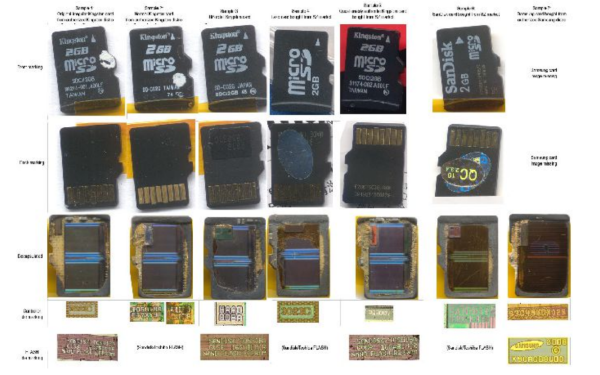
We hope that some of our readers are currently at this year’s Chaos Communication Congress (schedule can be found here and live streams here), as many interesting talks are happening. One of them addressed hacking the memory controllers embedded in all memory cards that you may have. As memory storage density increases, it’s more likely that some sectors inside the embedded flash are defective. Therefore, all manufacturers add a small microcontroller to their cards (along with extra memory) to invisibly ‘replace’ the defective sectors to the operating system.

[Bunnie] and [xobs] went around buying many different microSD cards in order to find a hackable one. In their talk at 30C3 (slides here), they reported their findings on a particular microcontroller brand, Appotech, and its AX211/AX215. By reverse engineering the firmware code they found online, they discovered a simple “knock” sequence transmitted over manufacturer-reserved commands that dropped the controller into a firmware loading mode. From there, they were able to reverse engineer most of the 8051 microcontroller function-specific registers, allowing them to develop novel applications for it. Some of the initial work was done using a FPGA/i.MX6-based platform that the team developed named Novena, which we hope may be available for purchase some day. It was, among others, used to simulate the FLASH memory chip that the team had previously removed. A video of the talk is embedded below.

Continue reading “Hacking SD Card & Flash Memory Controllers”

Developed On Hackaday: First Version Of The Hardware

mooltipass-schematic-featured

The Hackaday writers and readers are currently working hand-in-hand on an offline password keeper, the mooltipass (click to see the project description). 

Next in our Developed on Hackaday series, we present the first version of our schematics. There’s already been a lot of discussions going on in our dedicated Google group, mainly about the project’s basic functionality. Because our firmware developers wanted to get to work, we decided to send the first version of our hardware into production a few days ago. Before going through the schematics, let’s review the required list of the mooltipass’s core components:

  • an easily-readable screen
  • a read-protected smart-card
  • large flash memory to store the encrypted passwords
  • an Arduino-compatible microcontroller with USB connectivity

We’ve been drowning in component suggestions from motivated hobbyists, so we figured we’d make the mooltipass v1 as simple as possible and then move from there. Given this device is developed on Hackaday, we also wanted future users to modify it, building completely new projects based around these main components. Keep reading for our schematics…

Continue reading “Developed On Hackaday: First Version Of The Hardware”

Testing Six Hundred Fish

fish

That’s the best and most obtuse title you’ll ever see for a Hackaday post, but surprisingly it’s pretty accurate. [Bob] over at the Sector67 hackerspace took part in a 111-day accelerator program in Shenzhen last year to improve his manufacturing skills. He’s just about ready to release his first product, a Bluetooth device that connects to an ice fishing tip-up. The blog for the device recounts the challenges of taking a project from a circuit to a finished product, and illustrates the difference between building something with an Arduino and selling thousands of devices.

The circuit boards for BlueTipz come in panels of eight, but what’s the best way to populate and solder five thousand devices in a reasonably short amount of time? [Bob] hired a few students from the local college to help him out in assembling all these devices. The plastic enclosures were made at a local plastics manufacturer, but the molds were made in China. The manufacturer needed to modify the molds a bit, but after a few days, [Bob] had five thousand enclosures ready to stuff full of electronics.

With the devices assembled, it’s time for programming, and that means building a programmer. [Bob] put all the guts for the device into a plastic box and 3D-printed a mount for the bare BlueTipz board. Put a board on the mount, press a button, and the tech now has a functioning device in his hands.

Besides manufacturing, there’s also a whole lot of testing that went into the design of BlueTipz. Because this is a device for ice fishing—a cold and potentially windy operating environment—[Bob] built a test rig in a freezer. The test rig triggers the device’s sensor, waits two minutes (the amount of time it would take for an ice fisherman to check the tip-up) and resets. They claim the battery life is good for 600 fish, and with this testing rig they were able to verify their calculated battery life with real-world data: without actually catching six hundred fish, of course.

Not only does [Bob] have a good bit of product development under his belt, he was also kind enough to go over the stuff everyday electronic design just doesn’t cover. Developing a product is something you can only learn by doing, and we’re glad [Bob] chose to share his experiences with us.

Reverse Engineering Serial Ports

Can you spot the serial port in the pic above? You can probably see the potential pads, but how do you figure out which ones to connect to? [Craig] over at devttys0 put together an excellent tutorial on how to find serial ports. Using some extreme close-ups, [Craig] guides us through his thought process as he examines a board. He discusses some of the basics every hobbyist should know, such as how to make an educated guess about which ports are ground and VCC. He also explains the process to guessing the transmit/receive pins, although that is less straightforward.

Once you’ve identified the pins, you need to actually communicate with the device. Although there’s no easy way to guess the data, parity, and stop bits except for using the standard 8N1 and hoping for the best, [Craig] simplifies the process a bit with some software that helps to quickly identify the baud rate. Hopefully you’ll share [Craig’s] good fortune if you reach this point, greeted by boot messages that allow you further access.

Developed On Hackaday: Setting Up The Project’s Infrastructure

2013-12_Developed_on_Hackaday

We’re pretty sure that most of our readers already know it by now, but we’ll tell you anyway: the Hackaday community (writers and readers) is currently developing an offline password keeper. In the first post of our first DoH series, we introduced the project and called for contributors. In the comments section, we received very interesting feedback as well as many feature suggestions that we detailed in our second write-up. Finally, we organized a poll that allowed everyone to vote on the project’s name.

The results came in: the project’s name will be mooltipass. We originally had thought of ‘multipass’ but [asheets] informed us that Apple and Canon had both applied for this trademark. [Omegacs] then suggested ‘mooltipass’ as an alternative, which we loved even more. A few days ago we set up a google group which is already very active.

An often under-estimated side of a community driven project is its infrastructure and management. (How) can you manage dozens of motivated individuals from all over the globe to work on a common project? How can you keep the community informed of its latest developments?

Continue reading “Developed On Hackaday: Setting Up The Project’s Infrastructure”

Developed On Hackaday: First Feedback From Users

2013-12_Developed_on_Hackaday

Holy cr*p guys… we were amazed by the quantity of positive feedback that was left in the comments section of our last article. We have been featured by Slashdot ! We got plenty of project name suggestions, therefore we organized a poll located at the end of this post to let you decide which one is best. I also received many emails from people eager to start contributing to this offline password keeper project. If you missed the call and want to get involved, it’s still not too late. You can get in touch with me @ mathieu[at]hackaday[dot]com. So far, we have many beta testers, several software developers, one security assessor and a few firmware developers. Next step is to create a mailing list and a Hackaday forum category once the project’s name has been chosen.

Obviously, the very first post of our “Developed On Hackaday” series was to gauge your initial reactions to this ‘new’ project. Notice here the double quotes, as when someone has a new idea there usually are only two possibilities that may explain why it doesn’t exist in the market yet: either it is completely stupid or people are already working on it. In our case, it seems we are in the second category as many readers mentioned they wanted to work/were working/had worked on a similar product. As we’re selfish, we offered them to contribute to this new device.

To ensure that all of our readers are on the same page as to how the device will work we embedded a simple block diagram after the break, as well as a list of all new functionalities that we want to implement given the feedback we received. So keep reading to see what the future holds, as well as to vote on this new project’s name…

Continue reading “Developed On Hackaday: First Feedback From Users”

Developed On Hackaday: Let’s Build Some Hardware!

We’re pretty sure that most of you already know that a few months ago Hackaday was bought by SupplyFrame, who therefore became our new evil overlords. We do hope you’ve noticed that they’re actually quite nice, and in their divine goodness they recently gave the go-ahead on this series called Developed on Hackaday.

A new project will be made by the Hackaday staff & community and will hopefully be brought to the consumer market. For those who don’t have the time/experience to get involved in this adventure, we want to show and document what it takes to bring an idea to the marketable product stage. For the others, we would like to involve you in the design/development process as much as possible. Obviously, this project will be open source hardware/software. This time around, the hardware will mainly be developed by yours truly. You may already know me from the whistled platform (currently sold on Tindie) or from all the different projects described on my website, which makes this new adventure far from being my first rodeo.

What’s in it for the contributors? During all the steps of this project, we’ll offer many rewards as well as hand-soldered first prototypes of the device so you can start playing/testing it. Nothing is set in stone so every suggestion is welcome. Should we make a Kickstarter-like campaign to manufacture the final product, we’ll only do so once our prototype is final, our partners are chosen and all details of the production process are set and confirmed. In that case, we will just need to gather the required funds to make the device a reality. What are we going to build? Keep reading to find out.

Continue reading “Developed On Hackaday: Let’s Build Some Hardware!”