LiveLight Is An Expertly Crafted Ambilight Clone

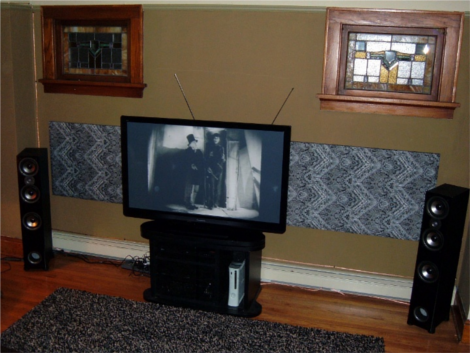
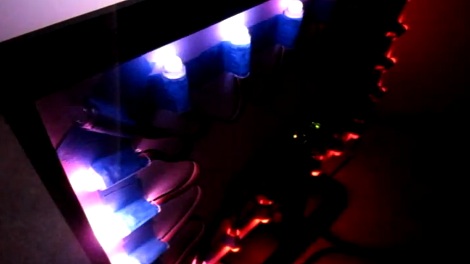
[SunWind] (Edit 2018: who now goes as [nerdaxic]) developed his own version of the Phillips Ambilight system which he is calling LiveLight. We’ve seen more than a few of these hacks, many of them are based around Arduino, and most use LED strip lighting. [Nerdaxic] is using strip lighting as well, but his design is clean and polished quite a bit more than anything else we’ve seen. In our minds this would be welcomed by even the most discriminating of A/V enthusiasts.

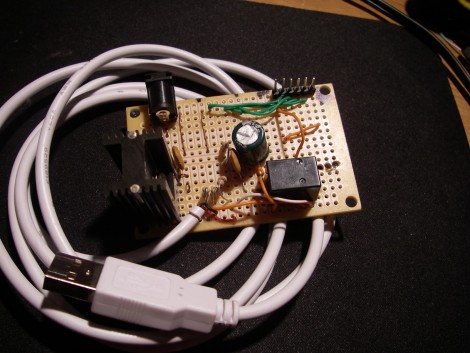
He found just the right size of project box and managed to fit everything in on a nicely milled PCB. The enclosure itself has also been milled to allow the mini USB B connectors for each of the nine RGB LED strips. But he didn’t stop there, the top of the enclosure has labels milled into it to help when hooking everything up.

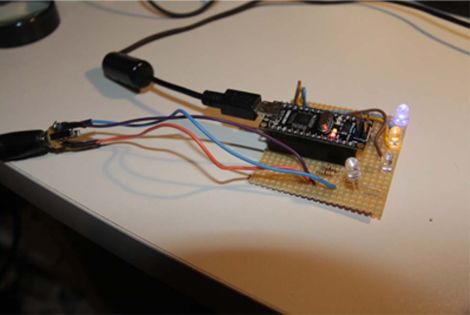
An ATmega32 addresses the LED strips based on data pushed in from a computer. An on-board FTDI chip adds USB connectivity and [nerdaxic] used a hack to rewrite the EEPROM on that chip so that it enumerates with the name “LiveLight USB Interface”. A program called Boblight gathers the data from the currently playing video. You can see the final project in the video embedded after the break.

Continue reading “LiveLight Is An Expertly Crafted Ambilight Clone”

Automated Chess Set Does It From Below

You can get class credit for the coolest things these days. Take for instance, this Automatic Chessboard that [Brian] and [James] built for the final project in one of their classes this spring. We just looked at a robotic chess setup on Monday that used a gripper mounted on a gantry to move the pieces. This one’s a lot more user-friendly and borders on magical. That’s because the moving parts are all located below the board and could be hidden from view if a proper case were built around the edges.

There are two main components to this build. The first is a grid of reed switches that detect the moves made by a human. This works because each piece the human player uses has a weak magnet glued to the bottom which is just strong enough to actuate the reed switch and let the computer sense what move was just made. On the robotic side of things this works like a plotter. Each of the computer’s pieces has a metallic disc glued to the base. What basically amounts to a plotter under the board uses rare-earth magnets to grab the computer’s piece and drag it to the next playing position.

The use of two separate magnetic systems provides some interesting design challenges. You can see the device in action in the video after the break, and a full writeup and source code package is available at the blog linked at the top of this feature. But for your convenience we’ve also mirrored the PDF whitepaper after the break which lays bare all of the juicy details.

Continue reading “Automated Chess Set Does It From Below”

Blowing Up Capacitors

[grenadier] wrote in to show us a video of some capacitors being blown up. Yup, that’s it. Just some capacitors being blown up. You might be wondering what there is to learn from this video. The answer is… nothing. It sure is fun to watch though. We’re all busy trying to find some nice hacks to share with you, so we figured you could watch some stuff getting destroyed while you waited.  Here’s someone using explosives to reveal art behind a thin layer of concrete on a wall. Here’s some high voltage destroying multimeters. How about a turkey being cooked with thermite? Thermite works on hard drives too.

Ok, enough of that. This was a gentle reminder to send us tips to your projects.

Continue reading “Blowing Up Capacitors”

netcast_hack

Hacking LG’s Netcast

LG released a line of Internet-connected TVs in both the US and Europe that utilize Yahoo TV widgets to bring interactive content to the living room. While it sounds like a great idea in theory, users have been disappointed to find that LG has approved a measly 15 widgets since the TVs were released.

OpenLGTV.org.ru user [xeros] has started working on a project that aims to enable more useful content as well as homebrew widgets. The project is known as OpenLGTV BCM, and not only covers LG television sets, but all sets based on the Broadcom platform.

A ton of progress has been made already, as they have been able to install their own busybox environment as well as open the sets to accept more widgets via some clever signature spoofing. The ultimate goal for the project is to completely divorce the sets from the Yahoo platform and replace it with their own open marketplace.

It’s a great start, and we can’t wait to see what sort of progress they make as time goes on.

[Thanks, T]

IR Remote Control Jammer Makes You Lord Of The Livingroom

Bring communications jamming technology into your TV viewing experience by building this infrared LED driver circuit. You’re probably familiar with the TV-B-Gone, which let’s you turn off any television at the touch of a button. But what if you actually want to watch the program that’s currently on the screen when the person with remote-in-hand doesn’t? That’s where this little marvel comes in.

[KipKay’s] IR jammer uses a 555 timer to constantly transmit infrared traffic. The signals it’s sending out don’t correspond to commands the TV (or any other IR remote-controlled device) will respond to. But if the light intensity is strong enough, they will interfere with any signals coming in from a remote or even from a TV-B-Gone. [KipKay] wisely hides this circuit inside of another remote control so that the other couch potatoes you are thwarting won’t get wise to what’s happening. If they want to watch something else they’ll have to get up and walk over to the entertainment center to do something about it, and what’s the chance that’s going to happen?

Don’t miss [KipKay’s] infomercial-esque presentation of this gadget after the break.

Continue reading “IR Remote Control Jammer Makes You Lord Of The Livingroom”

Cocktail Cabinet To Be Proud Of

At a glance you might think it’s the real thing, but if you look closer you’ll see that The Distraction Contraption is an extremely well-executed cocktail cabinet recreation that hosts a MAME setup. [Sam Freeman] took pictures of the entire build process and has posted them, along with captions, as a Flickr collection.

The project started after some inspiration from this diminutive cocktail cabinet. He wanted his own version that was closer in scale to the coin-op versions that would have been found in bars a few decades ago. He designed the case to fit a 17″ LCD screen using Google Sketchup. From there, he cut out the parts and routed the edges. The controls feature buttons and joysticks, as you’d expect, but that red cap on the end works as a spinner. He tried out a few different ideas for this auxiliary control. He found that using LEGO gears to map the spinner’s motion to the axle of a mouse worked best. To give the plastic knob a better feel he loaded it with pennies to increase the mass, bringing momentum into play. The final look was achieved using wood-grain contact paper, and custom printed skins.

Retrofitting LCD Projectors With High-powered LEDs

highpower_led

[Devon] recently repaired a handful of Phillips LCD projectors which he was quite excited to use. The only problem is that he didn’t want to mess with replacing the bulbs after every 2000 hours of use at $100 apiece. He was pretty confident that he could find a better way to drive the projectors, so he disassembled them once more and started looking around for bulb replacements.

He figured that a high-powered LED would do the trick, so he ordered a handful of parts and went about his first retrofit. Using his oscilloscope, he found that the control board pulses the high voltage board when the projector is powered on, and continues to pulse a signal until the machine is turned off. At this point, the HV board powers down the bulb.

He created a small circuit using a PIC that is used to interpret the initial pulse from the control board as well as watch for the steady “heartbeat” pulses that occur while the projector is powered on. This board is used to control the driver board for the high-powered LED he purchased.

His bulb replacement works well as far as color fidelity is concerned, but is not nearly as bright as he hoped for. He has plans to source some far brighter LEDs or automobile HID lighting in the very near future, and we look forward to seeing if he can match the brightness of the original bulbs.