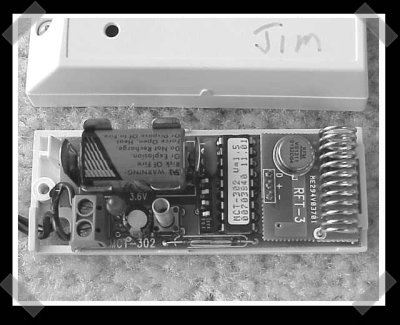
In order to tell his home automation system that he’s home, [Jim] mounted a RF transmitter in each of his cars. When the car is on, the transmitter is powered up. The house picks up the transmitter signal when the car arrives or departs. With that information, he was able to set up some stateful rules that can be activated when people arrive or depart. Some people prefer to use APRS and read vehicle location from the transmitted GPS coordinates, but this is a bit cheaper and doesn’t transmit your position to the entire world all the time. The useful range is about 100 feet, so this can work even if you have to park in the street.
home hacks1916 Articles
Plumb In Your Espresso Machine (cheap)
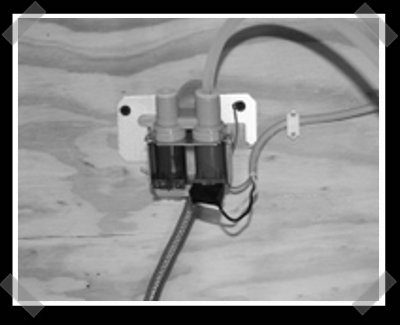
A while back, I wrote up a how-to on some mods I made to my ECM Giotto espresso machine. After giving it some break-in time, I finally wrote up my cheap plumbed in espresso trick. Plumbing kits use a $50 solenoid that requires special plumbing. My version uses a $12 fridge solenoid, easily adds on to my previous mods, and only requires some tubing size adaptation.
DMX Light Control For Home Automation
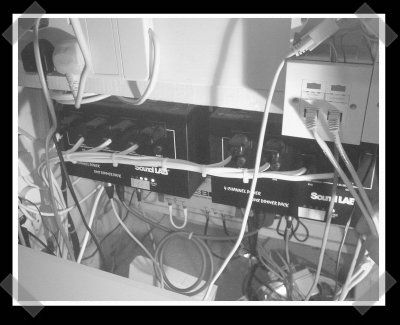
Generally, the only time I’ve ever seen DMX in use is for stage productions. [Dan] sent in his home light control project – he used a RS-232 to DMX interface and a bunch of commercial DMX dimmers. His light switches were replaced with potentiometers connected to the system via CAT5 cabling. The POTs send 0-10v up the line to the dimmers, and the manual control can override the automated(DMX) settings. The system is simple, robust and responsive – avoiding the delay pitfalls usually incurred by systems like X10.
Arduino Controlled Espresso Machine

The arduino is really starting to become prevalent for hardware hacking. [Nash] used one to take control of his Gaggia espresso machine. (They’re really decent little machines) He popped in a LCD display, some solid state relays to control the pump and the heating element, and an AD595 to interface a K type thermocouple. It looks like an excellent hack, but for the love of god man – get a better grinder!
He describes the original mod here, and added a small gallery of internal shots here. From the latest comments, it looks like the guys are RepRap project are even interested in the thermocouple PID control that [Nash] implemented.
Silent X10 Mod (cheap SSR)
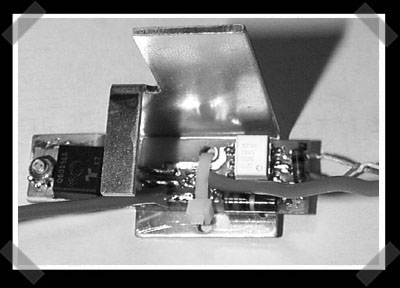
I’m feeling a bit retro for the holidays, so here’s another classic: If you’ve got a non-dimming X10 switch, you’ve experienced the incredibly loud, obnoxious sound that it makes when you switch it on or off. (Mine’s in my stairwell) There’s a simple mod to silence the thing: remove the triac relay and replace it with a solid state relay. SSRs are a bit expensive, running at least $10 each last time I checked. [Willis Dair] realized that he could build his own, inexpensive SSR with an optoisolator and an alternistor(AKA Triac). The resulting circuit runs about $3 in parts.
1-wire Thermostat Control
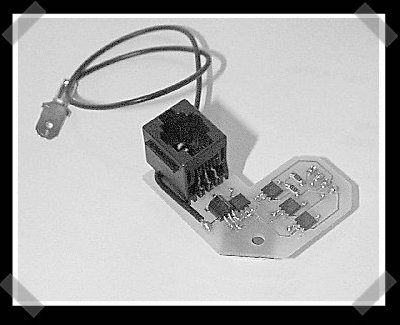
For some reason, computer controllable thermostats are pretty freakin’ expensive. I found a reference to a 1-wire thermostat in this(mirror) sample senior project on home automation. It turns out that Dallas Semiconductor put one together a while back as an application for their TINI platform. (web-application server on a chip). The write-up has since vanished from their site, but I found it thatnks to archive.org. The thermostat used to run about $50, and a similar model still seems to be produced. The 1-wire interface is pretty simple – Maxim’s TINI board to control it: not so much. Just using the 1-wire interface with an inexpensive thermostat and controlling from a PC seems pretty viable to me. Just in case, I mirrored the 1-wire interface schematics here.
Breathing Walls With Shape Memory Alloy Wire
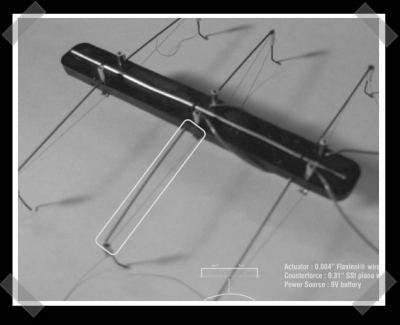
When you need something quietly bending or moving, don’t underestimate SMA’s (or Shape Memory Alloys). The Living Glass project by architects [David Benjamin] and [Soo-in Yang] catalogs an experiment in building interactive, flexible, “breathing”, walls out of SMA wire and microcontrollers. Although they use Basic Stamps, the project could easily be extended to more cost-effective microcontrollers for large surfaces. The project is well documented with videos (AVI) of each prototyping step and even includes the ideas that were ultimately scrapped. Even if you don’t build a wall of interactive gills, this project should give you plenty of ideas for uses of SMA wire embedded in semi-flexible materials.