A White Hat Virus For The Internet Of Things

The Internet of Things is going gangbusters, despite no one knowing exactly what it will be used for. There’s more marketing money being thrown at IoT paraphernalia than a new soda from Pepsi. It’s a new technology, and with that comes a few problems: these devices are incredibly insecure, and you only need to look at a few CCTV camera streams available online for proof of that.

The obvious solution to vulnerable Internet of Things things would be to get people to change the login credentials on their devices, but that has proven to be too difficult for most of the population. A better solution, if questionable in its intentions, would be a virus that would close all those open ports on routers, killing Telnet, and reminding users to change their passwords. Symantec has found such a virus. It’s called Wifatch, and it bends the concept of malware into a force for good.

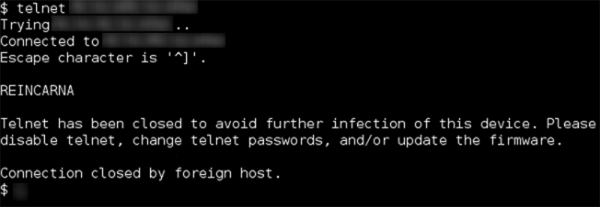
Wifatch is a bit of code that slips through the back door of routers and other IoT devices, closes off Telnet to prevent further infection, and leaves a message telling the owner to change the password and update the device firmware. Wifatch isn’t keeping any secrets, either: most of the code is written in unobfuscated Perl, and there are debug messages that enable easy analysis of the code. This is code that’s meant to be taken apart, and code that includes a comment directed at NSA and FBI agents:

To any NSA and FBI agents reading this: please consider whether defending
the US Constitution against all enemies, foreign or domestic, requires you
to follow Snowden's example.

Although the designer of Wifatch left all the code out in the open, and is arguably doing good, there is a possible dark side to this white hat virus. Wifatch connects to a peer-to-peer network that is used to distribute threat updates. With backdoors in the code, the author of Wifatch could conceivably turn the entire network of Wifatch-infected devices into a personal botnet.

While Wifatch is easily removed from a router with a simple restart, and re-infection can be prevented by changing the default passwords, this is an interesting case of virtual vigilantism. It may not be the best way to tell people they need to change the password on their router, but it’s hard to argue with results.

[Image source: header, thumb]

redbull creation competition

2015 RedBull Creation Competition Is Underway!

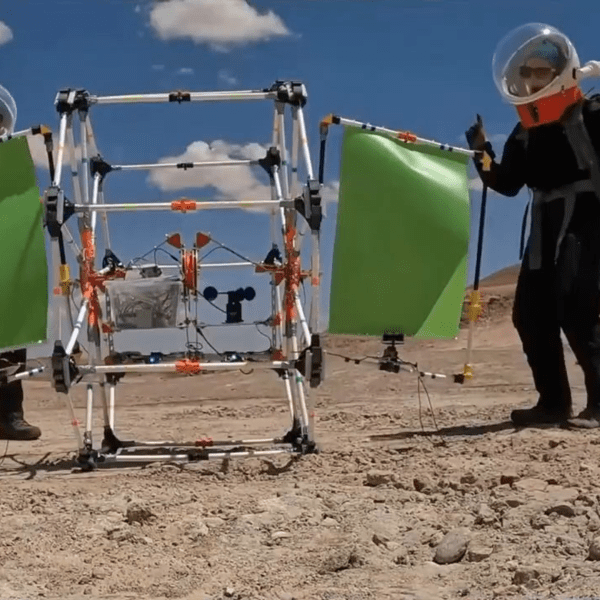
I’m here as a judge at the 2015 RedBull Creation Competition in Detroit — it’s a super intense 72 hour build off where makers, engineers, and artists can come to show us what they’ve got. This year’s theme is pretty broad: Serious Fun.

The event is at Recycle Here and is open to the public, so if you’re in the area, come check it out! A massive recycling depot warehouse has been temporarily transformed into a giant workshop. Teams have access to some serious tools including heavy duty welding equipment, industrial forming tools like pipe benders, brake presses, your standard drill presses, cutting equipment and of course laser cutters and 3D printers.

There are two competition categories — Open Class, which was free for anyone to join with a team, and Invite Only. The six Invite Only teams are working in the Recycle Here workshop, and the teams competing in the open category are scattered across the city, making use of their own workshops or hackerspaces. The theme was only just announced yesterday, and the 72 hour countdown has been ticking away ever since.  I can’t wait to see what awesome interactive projects can be built in time to show off to the public this weekend.

Continue reading “2015 RedBull Creation Competition Is Underway!”

Let’s Make Robots Changes Hands: Kerfuffle Ensues

There’s been a bit of a shakeup at Let’s Make Robots (LMR).

LMR is possibly the most popular DIY robotics website around and was started up by a fun-loving Dane, [Frits Lyneborg]. It grew a large community around building up minimal robots that nonetheless had a lot of personality or pushed a new technical idea into the DIY robotics scene. [Frits] says that he hasn’t had time for DIY robotics for a while now, and doesn’t have the resources to run a gigantic web forum either, so he worked out a deal to let the Canadian hobbyist supply company Robot Shop take it over.

LMR has always been a little bit Wild-West, and many of the members quite opinionated, and that’s been part of its charm. So when the new corporate overlords came in, set up “Rules” (which have seemingly been downgraded to “suggestions”) and clarified the ownership of the content, some feathers were ruffled.

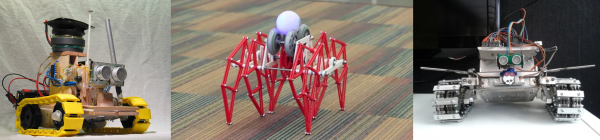
A few weeks later, everything looks to be settling back down again. (Edit: Or has it?!? See the comments below.) We wish LMR all the best — everyone loves robots, and LMR is a tremendous resource for the newbie interested in getting into DIY robotics on the cheap. More than a few LMR posts have been featured here at Hackaday over the years. Among our favorites are this drumming rovera clever 3D printed gripper, and this wicked bicycle-style balancer.

Buttons, Sliders, And Touchpads All 3D Printed With PrintPut

[Jesse Burstyn] and some colleagues at Queen’s University and Carleton University (both in Canada) are delivering a paper at the INTERACT 2015 about PrintPut, their system for printing sensors directly into 3D printed objects. Using a printer with dual extrusion and conductive ABS filament, they have successfully formed capacitive touch sensors, digital resistive sensors, and analog resistive sensors.

In practice, this means they can print buttons, sliders, and even touch pads directly into objects. They also have a design for several pressure sensors and a flex sensor. The system includes scripts for the Rhinoceros 3D CAD package. Designers can create a model in any CAD package they want (including Rhinoceros) and then use these scripts to define the interactive areas.

Continue reading “Buttons, Sliders, And Touchpads All 3D Printed With PrintPut”

Ethics In Engineering: Volkswagen’s Diesel Fiasco

Every so often – and usually not under the best of circumstance – the field of engineering as a whole is presented with a teaching moment. Volkswagen is currently embroiled in a huge scandal involving emissions testing of 11 Million diesel cars sold in recent years. It’s a problem that could cost VW dearly, to the tune of eighteen Billion dollars in the US alone, and will, without a doubt, end the careers of more than a few Volkswagen employees. In terms of automotive scandals, this is bigger than Unsafe at Any Speed. This is a bigger scandal than the Ford Pinto’s proclivity to explode. This is engineering history in the making, and an enormously teachable moment for ethics in engineering.

Continue reading “Ethics In Engineering: Volkswagen’s Diesel Fiasco”

Mergers And Acquisitions: Dialog Buys Atmel

Dialog Semiconductor has announced their acquisition of Atmel for $4.6 Billion.

In recent years, semiconductor companies have been flush with cash, and this inevitably means consolidation. NXP and Freescale merged in March. In June, Intel bought Altera for $16.7 Billion just a week after Avago bought Broadcom in the largest semiconductor deal ever – $37 Billion.

The deal between Dialog and Atmel is not very big; the combined revenue of both companies should be $2.7 Billion, not even in the top-20 semiconductor companies by revenue. However, Atmel is an extremely big player in the Internet of Things and the nebulous ‘maker’ market. Dialog’s portfolio is complementary to Atmel’s, focusing on mobile platforms such as smartphones, e-readers, and tablets. The future is in the Internet of Things, and Dialog wants to get in on the ground floor.

Dialog’s current portfolio is focused mainly on mobile devices, with Bluetooth wearables-on-a-chip, CODEC chips for smartphones, and power management ICs for every type of portable electronics. Atmel’s portfolio is well-established in automotive, smart energy metering, and the maker movement. While the Arduino may be Atmel’s most visible contribution to the industry, the Arduino itself is just a fraction of Atmel’s sales in this space. Atmel parts can already be found Internet of Things products like the LightBlue Bean (an 8-bit AVR), and the Tessel 2 Internet of Things board (a 32-bit Atmel ARM).

Curiously, neither Dialog nor Atmel have many sensor or MEMS products, and the future of wearables, portable electronics, and the Internet of Things will depend on these sensors. STMicroelectronic produces both the microcontrollers and sensors that are packed into phones. TI is nearly a full-stack hardware company, able to produce everything that will go into a wearable or Internet of Things device, all the way from the power regulator to the microcontroller. Although this may be seen as a shortcoming for Dialog and Atmel, both companies combined are still many times smaller than the likes of Avago/Broadcom or NXP/Freescale there’s plenty of room for more acquisitions to round out their future needs.

As for what changes will come to Dialog and Atmel’s portfolio, don’t expect much. Unlike the NXP and Freescale merger where both companies have a lot products that do pretty much the same thing, the portfolios of Dialog and Atmel build on each other’s strengths. You’ll have your 8-bit AVRs for a few more decades, and with Dialog’s focus on connectivity, we can expect even more tools for building the Internet of Things.

Open Source Hardware Certification Announced

Last weekend was the Open Hardware Summit in Philadelphia, and the attendees were nearly entirely people who build Open Source Hardware. The definition of Open Source Hardware has been around for a while, but without a certification process, the Open Hardware movement has lacked the social proof required of such a movement; there is no official process to go through that will certify hardware as open hardware, and there technically isn’t a logo you can slap on a silkscreen layer that says your project is open hardware.

Now, the time has come for an Open Hardware Certification. At OHSummit this weekend, the Open Source Hardware Association (OSHWA) announced the creation of a certification process for Open Source Hardware.

Continue reading “Open Source Hardware Certification Announced”