Static Testing Hybrid Rockets For A Flight To Space

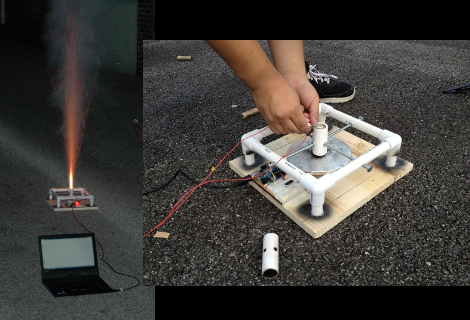
A team of rocketry enthusiasts at Boston University have been working on a small hybrid rocket motor that serves as a test bed for a larger, yet-to-be-designed power plant that will hopefully launch a rocket into space.

The static tests of the BURT Mk. II began last April with a series of tests using HTPB solid fuel and Nitrous Oxide as the oxidizer. The team had a series of failures – mostly due to the JB Weld seal on the igniter leads blowing out – but managed a 10 second burn on April 21st.

For later tests, a vector drive system built by a complimentary Boston University engineering group was used to control the direction of the thrust up to 12 degrees away from the axis of the engine. That’s an impressive bit of kit, especially considering the exhaust from the rocket reaches over 5000 degrees Fahrenheit.

Even though it’s summer now and the Boston University team is on a much deserved break, we can’t wait to see what the BURT team comes up with next year. Hopefully we’ll see a flight test that reaches the team’s goal of the Karman line.

Continue reading “Static Testing Hybrid Rockets For A Flight To Space”

Firing Rocket Engines In The Wrong Direction — This Is Only A Test

LVL1 has a new rocketeering group. This rocket engine testing platform is the first project to come out of the fledgling club. The purpose of the tool is to gather empirical data from model rocket engines. Having reliable numbers on thrust over time will allow the team to get their designs right before the physical build even starts.

The rig uses a pine base, with a PVC frame, threaded bolts, and a PVC cuff for mounting the engine in place. It is set to fire up in the air, directing the thrust down onto a scale. The flex sensor in the scale is monitored by an Arduino, and should be able to hold up to the 5000 pounds grams of thrust max which this type of engines can put out. The data is pushed via USB to a laptop computer where it is stored in a spreadsheet.

Calibration would be an issue here. But as long as they’re always using the same strain sensor the numbers will be accurate enough relative to each other.

Teaching A Computer To Learn

[Łukasz Kaiser] programmed a computer to play Tic-tac-toe. That doesn’t sound very remarkable until you realize he never told his computer the rules of Tic-tac-toe. The computer learned the rules by itself after watching a video of two people playing the game (link to actual paper – PDF warning).

[Łukasz] wrote a small program in C++ to recognize the placement of objects on a Tic-tac-toe, Connect 4, and Breakthough board. This program sifts through winning and losing games along with illegal moves to generate a Lambda calculus-like rule set for the relevant game. Even though [Łukasz] has only programmed a computer to learn simple games such as Tic-tac-toe, Connect 4, and Breakthrough, he plans to move up to more complex games such as Chess.

The fact that [Łukasz] programmed a computer to actually learn the rules of a game gives us pause; in one of the fabulous lectures [Richard Feynman] gave to freshman physics students in 1964, the subject of Chess came up. [Feynman] drew parallels between learning Chess and performing research. Every move is hypothesis testing, and when a very strange move occurs – castling, en passant, and the promotion of a pawn, for instance – the theory of the rules of the game must be reworked. Likewise, when extremely strange stuff happens in physics – particle/wave duality, and the existence of black holes – scientific theory is advanced.

Yes, teaching a computer to learn the rules of Tic-tac-toe may seem irrelevant, but given the same learning process can be applied to other fields such as medicine, economics, and just about every science, it’s not hard to see how cool [Łukasz]’ work is.

via extremetech

Ouya, A $100 Game Console For Indie Developers

With the explosion of mobile gaming (due in no small part to the egg-bombing Angry Birds), the Ouya was bound to happen. It’s a $100 game console powered by Android that puts indie games right into your living room.

The specs for the Ouya means this cube of games isn’t a slouch: the console comes loaded with an NVIDIA Terga3 quad-core processor, 1 GB of RAM, 8 Gigs of flash storage, HDMI, WiFi, Bluetooth, and Android 4.0. A requirement for publishing games on the Ouya is making at least some of the game free to play, a la TF2 or LoL. In addition to being a video game console, Ouya will also pull down Twitch.TV streams allowing you to watch Starcraft championships and other e-sports on your big-screen TV.

Not only does the Ouya play games, its designers made the device easily hackable. There aren’t enough details to know exactly what this means, but we’re sure we’ll see a full-blown Linux distro running on the Ouya within a week of release.

As of this writing, the Ouya Kickstarter has already met their funding goal of $950,000 by taking in two million a freaking ton of money with 29 days left. This might become the most successful Kickstarter to date, and we can’t wait to see all the neat stuff and hacks for the Ouya in the near future.

Library For Driving SSD1289 LCD Displays With Small Microcontrollers

[H. Smeitink] got his hands on a 320×240 color TFT LCD screen. He set out to drive it with a small PIC microcontroller but didn’t find a lot of help out there to get up and running quickly. This is surprising since it’s a really nice display for quite a low price (under $16 delivered on eBay at the time of writing). He decided to write his own library and support tools to help others.

The display includes an SPI touch screen, but since that works separately from the LCD controller, touch input is not supported in this package. The driver that he wrote is coming from a mikroC toolchain point of view, but it shouldn’t be too hard to port to your platform of choice. We took a quick look at the code and it seems all you need to do is tweak the defines to match your hardware registers, and implement your own delay_ms() function.

But he didn’t stop with the driver. You’ll also find a C# program which converts images to an array for easy use on the display. Incidentally, this is the same display which [Sprite_TM] got working with the Raspberry Pi.

Hack A Day’s Entry Into The Red Bull Creation Contest

We had tons of ideas, but the one that seemed most feasible, and had the least probability of causing mortal injury, was this. We created a red bull launching mortar system. The cans are launched and a parachute deploys to bring them down to the eager people below safely. I was the one in charge of construction, so the rest of the team acted as consultants for this round. I was also able to recruit a few people from here at Squidfoo for help.

Continue reading “Hack A Day’s Entry Into The Red Bull Creation Contest”

Spoofing GPS And Getting Your Own UAV

A couple folks over at the Radionavigation Lab at UT Austin successfully spoofed GPS to take control of a small helicopter drone this weekend. Of course, this attracted the attention of the Department of Homeland security, so you’d better stock up on GPS spoofing equipment while there’s still time.

The DHS, CIA, and US Military have a huge interest in spoofing GPS; Iran stole a drone late last year using the same method. The UT Austin team used only about $1000 worth of equipment to take control of an autonomous drone and pilot it away under unauthorized control. Of course with matters of homeland security, the open-source hacker scene has yet to publish how this spoofing attack was actually done, but here’s a paper covering what is needed to remotely control up to four GPS-guided drones.

While waiting on the details of this build to be made public, feel free add your own insight in the comments as to how this attack was actually performed.