Forum Addition: Project Requests

We’ve added a new section to our forums called Requests and Commissions. First, we can’t stress enough that this is NOT a place to ask for help with illegal or illicit actions. Hackaday has always been about hacking for good and that’s what motivated the creation of this forum. Time and again we’ve seen hackers helping out others by modifying gaming controllers for the those in need or bringing mobility to the disabled. The requests forum is a great place to ask for help with these types of projects, or just to team up with hackers that have skills in areas you don’t.

So swing by and check it out. The golden rule is keep it legal and keep it legit. And do remember that this is the Internet, so think about the decisions you are making. We’re not going to swoop in to save you if you end up getting scammed by a Nigerian prince to whom you sent a thousand dollars worth of parts to but didn’t receive a completed project in return. Any arrangements you make with another user are between you two, and do not involve us.

8th ACM Conference On Creativity & Cognition Call For Papers

acm_cnc2011

[Jim Davies] from the Association for Computing Machinery wrote us to let us know about a conference being hosted this fall, the 8th ACM conference on Creativity and Cognition. C&C 2011 has a lot to offer, providing an opportunity for artists, scientists, designers and educators to gather together and share their expertise via a series of group meetings, tutorials, and workshops.

We wanted to bring C&C 2001 to the attention of our readers as it is likely many of you had some level of interaction with your college or university’s local ACM chapter in the past. [Jim] wanted to point out that though the conference is slated for the first week of November, there is a deadline of April 25th for all papers and proposals. If you are interested in submitting something to the conference, it would be wise to get started soon.

The overall theme of this year’s conference is Creativity and Technology, which fits the hacking community quite well. Good luck to any of you who decide to give it a shot!

Open Source Laser Cutter (v2)

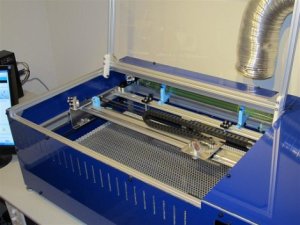
The Buildlog.net 2.x Laser is a second generation open source laser cutter that definitely improves the design of the first model. The 2 axis machine (optional vertical axis is manual or an upgrade is available) boasts a large 12” x 20” x 4” workspace while being smaller than its predecessor, fitting a table top design.

The older model had a goal of being self replicating, which limited the types of materials used, the new 2.x model drops that goal and uses stronger metal parts. Electronics are now modularized that allow easier and cleaner wiring, though you will still need a controller board.

There is an XMOS based controller provided on the main page of BuildLog.net, along with mechanical drawings, schematics, gerbers, instructions for both machines, and kit parts (for the first model) along with resources for the heavy items like laser tubes and power supplies.

Bluetooth Nixie Driver Lets You Go Almost-wireless

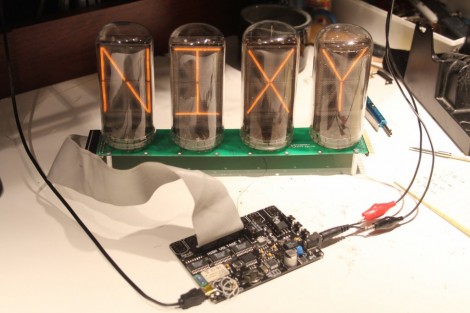
[Bob Coggeshall] has a nice Nixie tube driver board coming down the pipes. It’s not quite ready yet but you can see by the image above, it offers something that isn’t always easy to find; control for B7971 tubes which can display the full spectrum of alpha-numeric characters. This board is not limited to just one type of tube and it can be chained together with other boards to create longer displays. But perhaps the best development is the addition of a Bluetooth module. [Bob] has incorporated a Roving Networks RN-41 Bluetooth module which takes care of all aspects of the wireless protocol. This way the display is not tethered to a computer, or limited to data stored on a chip. We can’t really say that it’s wireless though, as we’d assume a set of these big tubes would rip through batteries pretty quickly. Keep an eye on this project, it will be open source once the bugs are worked out and [Bob] will also sell fully assembled and tested boards for those who choose not to roll their own.

We wonder if it would be easy to pair this with your phone and use it to display incoming call information?

Santa-pede Contest Winners

We received several fantastic entries. We laughed, we cried, we stared at our monitors in confusion, it was fantastic. Now we’re here to announce the winners of the Santa-Pede contest.

If you recall, the rules were pretty simple. Aquire a dancing santa (or other holiday dancing annoying toy thingy in the same fashion), tear it apart, build something that walks out of the pieces. We were aware that most of these have a very similar setup with one or two servos and a bit of plastic. That way everyone has a similar starting point.  We were amazed at what was done with so little.

Keep reading to find out who one each of the three categories: Most over-done,  best walker with no extra parts, and best presentation.

Continue reading “Santa-pede Contest Winners”

Boom Goes The Dynamite – Murals Made With Precision Explosives

explosive_artwork

[Alexandre Farto] is known for some off the wall art displays, but his newest work takes the phrase literally. Using precisely placed explosive charges, he has been sculpting portraits and other murals on walls in various places around London.

The detail at which he is able to produce these images is incredible, considering he is blowing chunks of plaster and brick from walls to form them. We can only guess as to how much preparation time is required to finish even one of these images, let alone to amass the stunning portfolio he has put together.

He has also recently teamed up with musical artist [Orelha Negra] to produce a cool video of his work as it was being sculpted, which is certainly worth the three minutes it takes to watch. The video, embedded below, is chock full of slow-motion shots of the demolition/sculpting in progress.

If you have a few minutes, be sure to check out his site to take a look at some of his work, we think you will be impressed.

Continue reading “Boom Goes The Dynamite – Murals Made With Precision Explosives”

Screen Tracking Projector

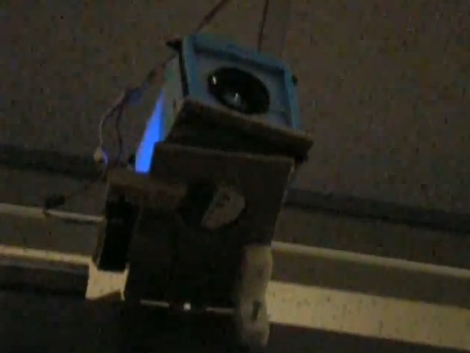
[Jon Howell] came up with what he calls a gratuitous project which projects his name on his office door. The thing is, his office door slides on tracks so he made a projector that can follow the movement of that screen. He used a laser printer to make a black and white pattern that indexes the movement of the door using a quadrature encoder. When it senses door movement a servo motor rotates the projector to match the change in the door’s location. As you can see in the video after the break it works even if the door is moved quickly.

We do agree with [Jon], this is a bit much. But it might be something to build into smart white boards that are mounted on sliding tracks. We guess that if you don’t plan to change the message being projected, which is the case with [Jon’s] office door nameplate, this would be a great way to use the image projector build we looked at yesterday.

Continue reading “Screen Tracking Projector”