phone_mixer

Convert An Old Busted Phone Into A Voice-altering Prank Machine

Have you ever wanted to be someone else, at least over the phone? Do you dream of turning the tables on telemarketers, making them hurry to get off the line instead of you? If so, [Brad] over at LucidScience has the project for you.

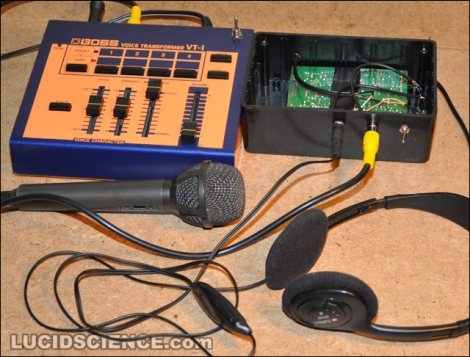
A bit of a prankster at heart, he walks through the conversion of a normal telephone into a Data Access Arrangement device (DAA), allowing you to interface it with either hardware or software-based audio mixers.

The process can be completed in a relatively short time period, and doesn’t require much more than an old telephone, a handful of tools, and some miscellaneous switches and jacks. He disassembled a telephone and trimmed off all of the unnecessary circuitry while retaining most of the original functionality. Line in and out jacks were then installed in place of the handset microphone and speakers, respectively. The final result is a compact box that relays altered audio from any kind of mixing device to person at the other end of the call. Since the majority of the phone remains intact, your calls still sound natural as they pass through the phone’s existing voice filter and preamp circuitry.

Once the DAA is complete, you can use any number of effects on your voice, limited only by your audio mixer. [Brad] says he has long-time friends that don’t even recognize his voice after he has run it through his effects machine, so get started on yours before April Fool’s day arrives!
Terapixel Images And See-through Cameras: Real Or Fake?

invisible_camera_lol

Once again it’s time for you, the sharp-eyed readers of Hack a Day, to decide whether the following video demonstrates technology at its finest, or if it is complete hogwash. This edition of Real or Fake? is brought to us by Hack a Day reader [Wizzard] who sent us a link to “The Invisible Camera

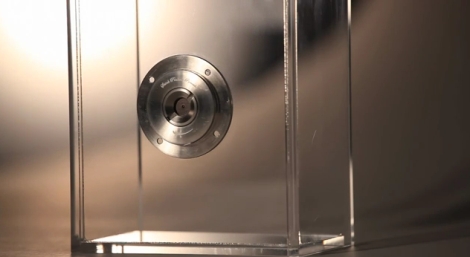
Watch the video embedded below to see the unveiling of this camera as well as a discussion of its new, revolutionary technology by its creator – photographer Chris Marquardt. The camera is composed of a simple, non-moving lens mounted in a completely transparent box made of specially polarized glass. This glass is supposed to align the ambient lighting, which amplifies the energy coming through the lens, in order to expose the special film they created for the camera.

The film was developed using standard film “combined with innovations in chemistry” to produce ultra-low sensitivity image media, which the creators are calling “Directionally Desensitized” film. This film can be handled in full light, as it is only sensitive to the high-energy light directed on its surface by the aforementioned lens. It is claimed that due to this special film, the camera goes beyond the Megapixel, past the Gigapixel, and captures images in Terapixels.

Now, call us skeptical, but isn’t it a bit early for April Fools jokes? We just can’t imagine any scenario where holding a piece of film in the sun as shown in the video would not cause it to be exposed in at least some areas due to the massive amounts of reflected light in the environment.

What’s your take?

Continue reading “Terapixel Images And See-through Cameras: Real Or Fake?”

TI’s Grace – A New MCU IDE GUI (DNFTT)

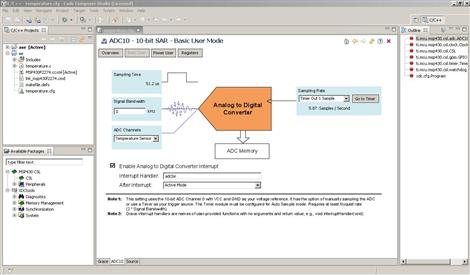
TI has recently been fighting to gain traction in the market of low-cost microcontroller development platforms with products such as the MSP430 Value Line Launchpad.  In order to meet the needs of a rapidly growing customer base and appeal to a broader market they have recently released Grace beta Graphical Peripheral Configuration Tool. Grace is a plugin for TI’s own Code-Composer Studio (CCS) IDE that allows users to graphically control many aspecst of MSP430 development and is compatible with all MSP430F2xx/G2xx MCUs.

Utilizing a simple “wizard-like” interface, Grace allows users to quickly and efficiently control peripherals such clocks, timers, OpAmps,  ADCs, GPIOs, comparators, and even more advanced features such as serial communications or the configuration of low-level register settings. Once everything is configured as desired, Grace outputs standard C code that can be debugged and handled as if it were hand-written.

Although Code-Composer Studio is not free, there is a 30-day full-featured trial available as well as other (restricted) free licensing options as well. Since CCS is based on the Eclipse open-source  software development framework, perhaps we will see other similar development tools in the near future. Although not an apples-to-apples comparison, we could imagine that such a tool might provide many novice users with a simple and cost-effective alternative to the Arduino IDE.

The questions then becomes: If a later incarnation were to raise the MSP430 line to “Arduino-killer” status, would it be rejoiced as such or would it simply then become a new target for those die-hard microcontroller purists who love to shout “overkill” on the forums at the slightest provocation? Of course we would love to hear your take in the comments below!

Ladyada To Be Featured In WIRED Magazine

ladyada_wired_cover

If you haven’t seen the news already, prolific maker [Limor Fried/Ladyada] is set to grace the cover of WIRED magazine in the upcoming April edition.

Not only is it a great day for the hacking/maker community as it puts a bright spotlight on the things we do every day, it’s a big day for female engineers as well. While WIRED has been around for 18 years as of this past January, this is the first time a female engineer has been featured on the cover. [Phillip Torrone] put it pretty well when he said, “She’s one of the most talented people in the world, she works harder than anyone else I know, she puts more value in the world than she takes.” – We couldn’t agree more, nor can we think of a better spokesperson to represent the community and inspire budding hackers around the world.

We would like to congratulate [Limor] on her accomplishment, and we encourage everyone to pick up a copy (or at least leaf through it at the bookstore) when it comes out.

If you’re still unconvinced as to how awesome she is, take a gander at some of her work we have featured in the past:

Kinect Open Source driver bounty

Non-lethal weaponry

The Wave Bubble

Minty Boost

Pi Phone Lulls You To Sleep With The Digits Of Pi

As you well know, today is March 14th – aka “Pi Day”.

Celebrated in math classrooms around the country, this truly is a celebration that belongs to the geeks. Here at Hack-a-Day, we too love Pi day, though we might not outwardly celebrate it with as much gusto as expressed by some of our readers.

[Chris Poole] is one Hack-a-Day fan who knows how to make the most of this mathematical holiday. He has put together a neat SIP-based phone service that reads Pi aloud to anyone who calls. He is running Asterisk in combination with Perl to read off the numbers, and is using a free SIP DID number to accept the calls. We gave it a shot earlier today, and were greeted by a gentle synthesized voice reading off the numbers of Pi. We’re not sure how many digits it is programmed to handle, as we stopped after about 20, so give him a call and let us know how many digits you make it through.

As a parting note, no Pi Day would be complete without a few obligatory Pi-related (albeit old) web comics and pastry concoctions, so here you go!

XKCD – Pi Equals…

XKCD – e to the Pi Times i

XKCD – E to the Pi Minus Pi

Spherical Pi Pie

Guide For Working With AVR Microcontrollers

[Q] wrote in to let us know about the AVR-Guide he’s been working on. It looks like he’s finished posting about 80% of the content he planned for in his initial draft outline. We read through several of the sections and found them to be concise, yet able to present information in a way that’s easy to grasp. The screenshot above shows the most basic block of information to get started with AVR microcontrollers. We’ve covered the same information in our AVR tutorial series and think that reading through both will give you a strong understanding of the knowledge needed to work with 8-bit microcontrollers with confidence. But this resource doesn’t stop after the basics. If you’re looking to bolster your knowledge of all the features the AVR line has to offer there’s also sections explaining Digital I/O, Interrupts, Timers, Analog I/O, Communications, and Miscellaneous topics.

The site is called QEEWiki. We logged in using a Google account (this is hosted as a Google site) but didn’t see a way to edit the information. If this truly is a Wiki and you know how to edit pages please leave a comment about it after the break.

The Traveling Terabyte Project – Helping Those Who Protect Us

ttb_dogtags

Though some people differ on what exactly a “hacker” is, there is one thing that can be said for certain – this global community of tinkerers, experimenters, and hobbyists we belong to is one of big hearts. Through our various projects and tutorials, we lead by example – sharing knowledge and offering help whenever we can. You would be hard pressed to find something that could exemplify this more than the Traveling Terabyte Project.

Started in the summer of 2006 by [Deviant Ollam], the goal of the project was to provide informational content from DefCon 14 to those friends and acquaintances who were deployed overseas in the service of the U.S. Armed Forces and their associates. This was originally done by outfitting durable cases with large portable hard drives stuffed with movies, music, and publications in order help those stationed far from their friends and family enjoy their down time a little bit more.

The project has grown by leaps and bounds while the storage mediums have shrunk accordingly. The project has recently entered a new phase, where they are migrating over to flash drives instead of hard drives, which should help spread the distribution of media immensely.

The Traveling Terabyte Project did not approach us soliciting money or publicity in any way, so by no means should you feel obligated to support the project. Regardless of our individual political leanings and views on war, we believe that helping out people who are subject to extreme amounts of stress while stationed far away from their home, friends, and family is a noble cause.

[Thanks, RenderMan]