DCF77 Signal Filtering And Decoding

dcf77-filtering-and-decoding

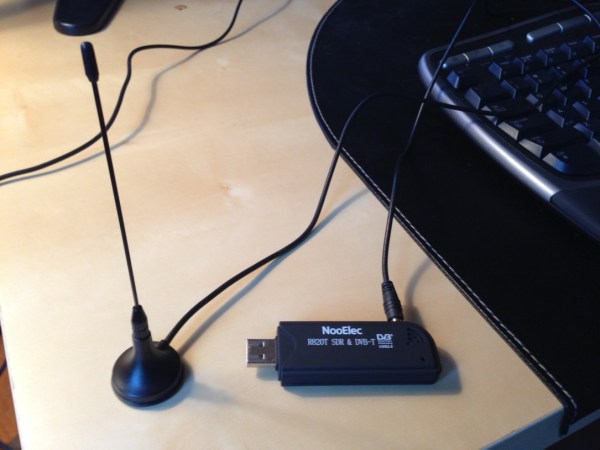
[Udo] decided to build a clock using the DCF77 radio module seen above. This of course has been done before: the hardware draws a clock signal from the atomic clock in Braunschweig, Germany. So he grabbed a library for Arduino and got to work. But he was getting rather poor results and upon further investigation realized that the library had been written for 20 Hz modules and his operates at 300 Hz. This means better accuracy but the drawback is that the hardware is more susceptible to noise.

So began his journey to filter, process, and decode the DCF77 protocol. That link goes to the project overview. It will be in several parts all of which will be linked on that page. So far he has applied a low-pass filter and coded some exponential smoothing. He has yet to write the other four parts, but does mention that early testing shows that this technique will make the reception better than what is achieved with commercially available clocks. He was able to lock onto a signal that had more than 80% noise ratio. That’s impressive!

Just want to see a clock that uses a DCF77 module? Check out this PIC-based atomic clock.

Cheap Biquad Antenna Extends LAN Between Apartments

[Danilo Larizza] is sharing a network connection between a couple of apartments. They are not far apart, but they are also not right next to each other so a set of external antennas is necessary. He built this 2.4 GHz biquad antenna on the cheap (translated) just to test if it improved the signal before he tried to buy a proper antenna. It turns out to work well enough that this is all that he needs.

The antenna itself is about one meter of thick wire bent into two squares which are 31mm on each side. The coaxial cable going to the router connects to the center portion of this antenna. For a bit better directional reception he added some tin foil as a reflector. Since this is outdoors he used a food storage container for protection (the antenna is mounted to the lid, the body has been removed for this picture). The whole things is perched on a stake in a flower pot with proper line of sight to the other antenna.

We’ve seen a very similar design used for an NRF 24L01+ radio. If you need more details that [Danilo] posted that would be a good project to study.

EVE Radio Breakout Board For The Raspberry Pi

The Raspberry Pi is an excellent tool to build the ‘Internet of things’ we’ve been hearing about, but there’s still the issue of connecting the Raspi to other devices. The EVE Alpha – a breakout board for several wireless radio modules for the Raspberry Pi – hopes to change that with their Kickstarter campaign.

The idea behind the EVE is to provide a link between low-power radio modules found in a few of the microcontroller projects we’ve seen and the Raspberry Pi. It does this by simply serving as a breakout board, taking the GPIO pins on the Raspi and connecting them to solder pads for a few of the many radio modules currently available.

Already the EVE supports the RFM12B wireless tranciever, a Z-Wave module, 868-915Mhz SRF modules, and has a breakout for an XBee module, allowing the EVE to communicate using one of the many different XBee boards. There’s also a battery-backed real-time clock and temperature sensor thrown in for good measure making this board the perfect building block for an outdoor weather station or solar array.

It’s an awesome idea, and if you already have a few radio modules, incredibly cheap; just the PCB is only £6, and a board with all the SMD components is only £20.

AM Chiptunes Played By A Modified Antenna Analyzer

Believe it or not, this VK5JST aerial analyzer kit is going to rickroll you. [Erich] wanted to see if he could use the device in a different way. His adventure led him to use it to feed different tones to an AM radio, producing the all too familiar [Rick Astley] offering.

There’s a fair bit of math that goes into getting the correct signals to generate a given pitch. But it basically boils down to patching into the hardware early in the RF generation. This way an audio signal can be rolled into the carrier frequency. Since this kit uses a PicAXE microcontroller with available source code it is rather easy to add audio input to tweak what the chip is putting out. But there is also some hardware tinkering to be done. Read more about that at the article linked above, and don’t forget to check out the bottom of that page to hear the final results.

Building A Better Software Defined Radio (and Transmitting As Well)

By now most Hackaday readers should be familiar with this year’s latest advance in software defined radio. With a simple USB TV tuner dongle, it’s possible to receive FM broadcasts, GPS data from satellites, and even telemetry from aircraft flying overhead. There is one limitation to this setup, though: it’s receive only. Hacker extraordinaire [Michael Ossmann] is looking to make a better software defined radio called the HackRF.

The HackRF is an incredibly ambitious project – able to receive just about anything between 100 MHz and 6 GHz (this includes everything from the top of the FM radio band to cordless phones, cell phones, WiFi, and basically any radio technology that has been commercialized in the last 15 years), the HackRF is also able to transmit. Yes, with the HackRF it’s possible to build your own software-defined WiFi module, or just broadcast bogus GPS information.

Compared to the $20 TV tuner SDR dongles we’ve played around with, the HackRF isn’t exactly cheap. [Mossmann] figures he’ll be able to sell the device for about $300. A fair bit of change, but much, much less than professional, commercial SDR solutions.

A very cool advance in the state of SDR, but reason dictates we must suggest that everyone who wants a HackRF to start studying for their amateur radio exam now. Being a licensed radio operator won’t stop you from any sort of malicious intent, but with at least with licensing comes with the possibility of knowing what evil you’re doing.

You can check out the wiki for the HackRF over on the gits along with the current hardware design

Super Serious Garage Door Opener

Tired of cheap plastic garage door openers? [Yetifrisstlama]’s is probably the most serious garage door opener that we’ve seen. The case is an old emergency stop switch, which has plenty of space for the circuitry and features a big red button.

This build log starts with details on reverse engineering the original door opener’s protocol. It’s an amplitude-shift keying (ASK) signal that sends a 10 bit code to authenticate. The main components inside are a PIC16LF819 microcontroller, a MAX7057 ASK/FSK transmitter, and some RF circuitry needed to filter the signal. There’s a mix of through hole and surface mount components mounted on a prototyping board, requiring some crafty soldering.

[Yetifrisstlama] says that the next step is to add a power amplifier to increase the range. The code and project files are also provided for anyone interested in working with ASK. While the hack looks awesome, it might make bystanders think you’re doing something more sinister than opening a garage door.

APRS IGate Built Using A Raspberry Pi

The hardware seen above is used to bridge a local RF radio network to the APRS-IS network. The APRS-IS is an Internet Service that uses a web connection to communicate between APRS networks in different parts of the world. The Raspberry Pi is perfect for this application because of its ability to connect to a network, and its native use of Linux.

On the software side the majority of the work is done by a Python script. It is responsible for setting up and monitoring a connection with an APRS-IS server. To connect to the handheld radio unit a USB sound card was used. The Multimon package is used to send and receive audio packets through this hardware.

[Sunny] has a few upgrades planned for the system. The device needs to report its location to the APRS-IS server and the plan is to add functionality that will look of the WiFi AP’s location automatically. It may also be possible to get rid of the radio all together and use a DVB dongle as a software defined radio.