Line Following Racers

[youtube=http://www.youtube.com/watch?v=TfeHN37MH1U]

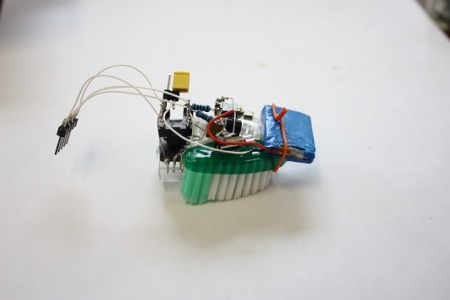
[Tim] sent in these quick little line following bots (translated). They were sent as participants in cosmobot, but due to an unfortunate dropbox mishap, they didn’t have updated firmware. They placed fifth and ninth place. As you can see in the video above, they are quite speedy. You can get the schematics and code on their project page (translated). They are hoping to make improvements to place better with the same bots next year.
Homemade Toroid Winder

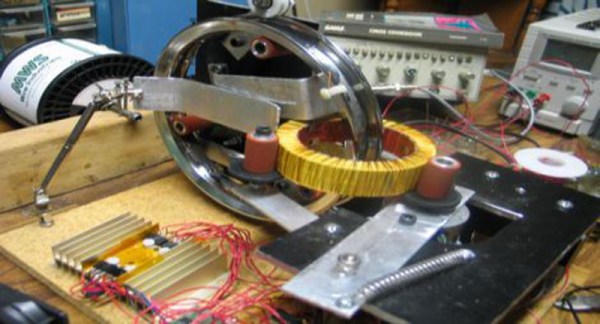
[eclipsed78], built an automatic toroid winder (Internet Archive). The drum splits in order to load the toroid. Then wire is wound on the drum, much like any other coil would be wound. The drum rotates as a slider pulls the wire off the drum, while revolving in and out of the toroid. A side tension keeps the slack out of the wire during operation. The winding coil is stepped as the drum rotates, in order to control the turns ratio. [eclipsed78] created a stepper driver from a schematic, so he could drive the motors. You can watch the winder in operation  as a series of videos. The first of which is embedded below. If you have ever needed to wind a massive toroidal transformer, this is the project for you.

Continue reading “Homemade Toroid Winder”

Arduino Powered CD Changing Robot

arduino cd robot

[ross], a reader is working on a CD changing and ripping robot. The arm picks up a CD and the platform then rotates, stopping in front of the tray to drop the CD. A JB welded tire pump provides the vacuum pick up, while a brake light acts as a resistor to trick a PC power supply into operation. A Motor Shield beefs up an Arduino in order to drive the servos.

Controllable Bristlebot

[sprite_tm], whose projects we have covered in the past, took the popular bristlebot to an extreme and created a controllable version. A bristlebot consists of a small vibrating motor mounted with a battery on the head of a toothbrush. These micro-robots buzz around randomly, and he attempted to tame them. He used a platform of twin bristlebots and added an optical sensor from a laser mouse and an ATtiny13. The optical sensor is used to determine the relative motion of the robot, so that the motors can be adjusted accordingly. He also has a video of the bot using the sensor to find a mark on the floor and stay within bounds. Although it isn’t as accurate, it acts like a traditional line-following robot.

Continue reading “Controllable Bristlebot”

Extra Pleo Battery Pack

pleo-power-pack-top (Custom)

Those of you who have played with a Pleo know exactly where this is going. The Pleo averages about 30 minues per 2-3 hour charge. Just swap batteries you say? Nope, the battery packs aren’t available. Fortunately, you can make your own pretty easily.  The basic frame is a standard battery pack for 6 AA’s. There are only a few modifications necessary to line up the leads and make it fit once you’ve loaded it with batteries.

McBlare: A Robot Bagpipe Player

We all want our very own personal bagpiper. Playing it ourselves is too much effort, and keeping a full time bagpiper around can be a pain. You have to feed them, clothe them, give them union breaks, etc. Luckily, modern technology has come to the rescue again. You can have your very own robot bagpiper. McBlare plays the bagpipe with technical proficiency that would be impossible for most humans. But lets hear it put some soul into it.

[via BotJunkie]

Dice-O-Matic

[youtube=http://www.youtube.com/watch?v=7n8LNxGbZbs]

[Scott] runs gamesbyemail.com. One of his biggest hurdles was producing real random numbers for the games. He had tried various methods like math.random and random.org, but kept getting complaints about the quality of the random numbers. His solution was to build an automatic dice roller. His initial attempts were made from Legos and were never quite reliable enough to be put into the system. The Dice-O-Matic however has proven to be a random number generating monster. It is 7 feet tall and capable of 1.3 million dice rolls per day. Wow.

[thanks Troy]