Low-cost Drift Buoy Plies The Atlantic For Nearly A Year

Put a message in a bottle and toss it in the ocean, and if you’re very lucky, years later you might get a response. Drop a floating Arduino-fied buoy into the ocean and if you’ve engineered it well, it may send data back to you for even longer.

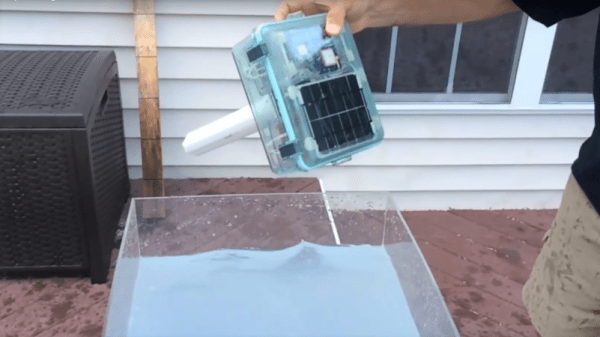
At least that’s what [Wayne] has learned since his MDBuoyProject went live with the launching of a DIY drift buoy last year. The BOM for the buoy reads like a page from the Adafruit website: Arduino Trinket, an RTC, GPS module, Iridium satellite modem, sensors, and a solar panel. Everything lives in a clear plastic dry box along with a can of desiccant and a LiPo battery.

The solar panel has a view through the case lid, and the buoy is kept upright by a long PVC boom on the bottom of the case. Two versions have been built and launched so far; alas, the Pacific buoy was lost shortly after it was launched. But the Atlantic buoy picked up the Gulf Stream and has been drifting slowly toward Europe since last summer, sending back telemetry. A future version aims to incorporate an Automatic Identification System (AIS) receiver, presumably to report the signals of AIS transponders on nearby ships as they pass.

We like the attention to detail as well as the low cost of this build. It’s a project that’s well within reach of a STEM program, akin to the many high-altitude DIY balloon projects we’ve featured before.

Continue reading “Low-cost Drift Buoy Plies The Atlantic For Nearly A Year”

Thermoelectric Dry Ice Generator Does Not Work (Yet)

[Pabr] is trying to make dry ice the hard way by building a thermoelectric dry ice generator. The project is a well planned round trip through thermodynamics and cryogenics with a hard landing on the icy grounds of trial and error.

[Pabr’s] four stage Peltier element on a heatsink.
While dry ice can be obtained with simpler methods, for example by venting gaseous CO2 from fire extinguishers and collecting the forming CO2 flakes, [pabr’s] method is indeed attractive as a more compact solid-state solution. The setup employs a four stage Peltier element, which uses four Peltier stages to achieve a high temperature differential.

With sufficient cooling on the high-temperature side of the element, it should be well capable of achieving temperatures below -78.5 °C, the sublimation temperature of CO2. So far, [pabr] has built three different setups to expose small amounts of CO2 to the cold of the Peltier element, hoping to observe the formation of little dry ice flakes.

Continue reading “Thermoelectric Dry Ice Generator Does Not Work (Yet)”

The Infinite Monkey Cage And General Relativity

If you are British, you probably already know where this is going. For the rest of you, it might help to know that The Infinite Monkey Cage is an odd little show on BBC  Radio 4 (and they’ve been on tour, too). It is the show that asks a question you probably never asked: “What would happen if a physicist and a comedian had a radio show?”

The answer, it turns out, is some science information that is anything but dry. If you are prone to listening to radio programs or podcasts, you might find some interesting tidbits in the Cage. A two-part episode on general relativity was especially interesting although it isn’t exactly like their regular program.

The physicist in question is [Brian Cox] who is an Advanced Fellow of particle physics at the University of Manchester. The comic, [Robin Ince] is not only a comedian, but also a writer, an impressionist, and has an honorary doctorate from Royal Holloway, University of London.

If you poke around the BBC’s site, you can find plenty of episodes to stream or download. General relativity is just one of the topics. You might also enjoy episodes on artificial intelligence or the science of sound.

If you need more comedy connections, consider that [Eric Idle] is responsible for the theme song. Of course, we cover relativity (and other topics) in a hopefully amusing style. Americans typically get British humor, or they don’t.  There’s no in between. The good part about these is that if you don’t get the humor, there’s still the science content. Contrast this to the very funny (if you get it) Look Around You series that is probably not the best place to get scientific information (see the video below).

Continue reading “The Infinite Monkey Cage And General Relativity”