2026 Green Power Challenge: NFC Powers Command Write And Wake Of MCU

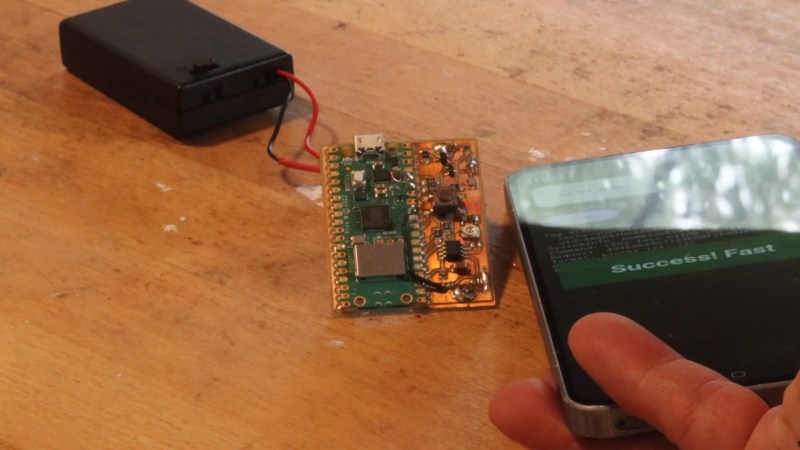
One of the more interesting categories of our ongoing Green Power Challenge is “anything but PV” — and since the radiated power of Near Field Communication is decidedly not photovoltaic, this hack by [caspar] to control a Pi Pico W from his phone using a tuned antenna absolutely counts.

Now, of course you’re not going to power the whole microcontroller that way, but [caspar] figures you don’t need to: the MCU is hooked to a battery, but through a transistor. That means it’s not asleep, but fully un-powered: only the leakage current of the transistor is draining that battery, so it can last a very long time. The waking is handled with a tuned NFC antenna hooked to a ST25DV04KC NFC chip. This chip is designed to be powered via NFC, and of course to accept commands. The ST25 then wakes the Pico — one GIPO on the MCU is used to latch that power transistor ON — and passes on the command via I2C.

Our favorite part might be the script he put on the Pico to live-tune the antenna coil, which you can see demoed in a video below, along with simplest possible demonstration of starting blinky on the Pico from the phone.

You aren’t limited to just a Pico and a blinky LED as in his proof-of-concept demo: [caspar] also uses the same technique with an e-ink display, which is pretty similar to the e-ink price tags you’ve likely seen at the grocery store, without the joy of reverse engineering.

Also without batteries, which is pretty neat, and arguably pretty green. If you’ve been hacking away at something that uses alternative energy, this challenge is still open — just get your project onto Hackaday.io and submitted by April 27.

Continue reading “2026 Green Power Challenge: NFC Powers Command Write And Wake Of MCU”
SolMate Charger

2026 Green Powered Challenge: SolMate Charges On The Move

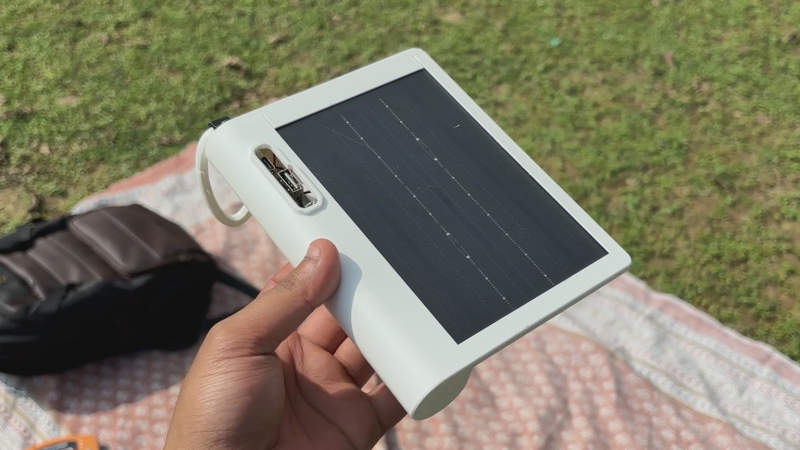
We’ve all had those times when your electrical device of choice is running low on battery. Sometimes you even plan ahead and are also carrying a battery pack, but what happens when you’ve forgotten to charge the battery pack? This is the problem that [Arnov Sharma] addressed with the SolMate, a portable solar panel that keeps a battery bank topped up.

The SolMate is built around an efficient 2 W photovoltaic panel that’s not much bigger than a cellphone. This panel can supply 5 V at 400 mA on a sunny day. The solar output is more than enough to keep the internal 2000 mAh battery topped up and ready for use. Charging the Li-ion battery is handled by an IP5306 power management chip, which pulls double duty: it safely regulates charging while boosting the battery’s 3.7 V to the 5 V expected at the USB charge ports. Speaking of charge ports, the SolMate includes both a USB-A and a USB-C port, plus a switch to enable or disable the unit.

The case is all 3D printed, with some clever design choices. Offsetting the bulk of the battery and PCB storage area to one side lets the SolMate naturally cant toward the sun. Even the clip used to attach it to a backpack is printed.

Be sure to check out the other entries into our latest challenge!

2026 Green Powered Challenge: Solar Powered Pi Hosts Websites In RAM

If you started with computers early enough, you’ll remember the importance of the RAMdisk concept: without a hard drive and with floppies slow and swapping constantly, everything had to live in RAM. That’s not done much these days, but [Quackieduckie]’s solar powered Pi Zero W web server has gone back to it to save its SD card.

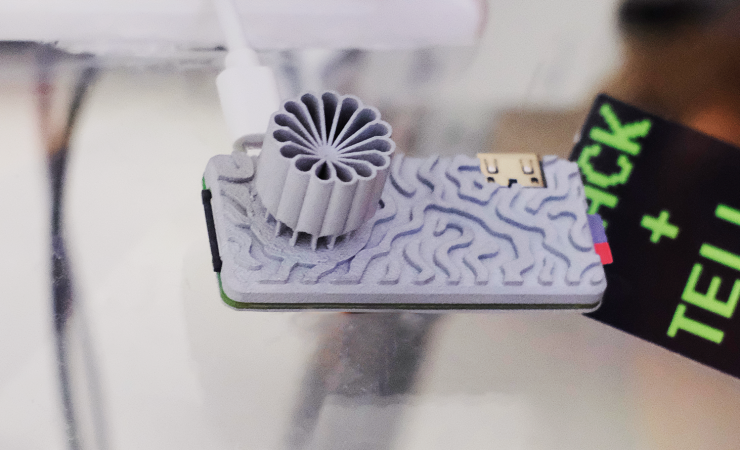
Sustainability and low power is the name of the game. Starting with a Pi Zero W means low power is the default; a an SLS-printed aluminum case that doubles as the heat sink– while looking quite snazzy–saves power that would otherwise be used for cooling. The STLs are available through the project page if you like the look and have a hankering for passively cooled Pi. Even under load [Quackieduckie] reports temperatures of just 29.9°C,  less than a degree over idle.

The software stack is of course key to a server, and here he’s using Alpine Linux running in “diskless mode”– that’s the equivalent of what us oldsters would think of as the RAMdisk. That’s not that unusual for servers, but we don’t see it much on these pages. It’s a minimal setup to save processing, and thus electrical power, with only a handful of services kept running: lighttpd, a lightweight webserver, and duckiebox, a python-based file server, along with SSHD and dchron; together they consume 27 MB of RAM, leaving the rest of the 512 MB DDR2 the Pi comes with to quickly serve up websites without the overhead of SD card access.

As a webserver, [Quackieduckie] tested it with 50 simultaneous connections, which would be rather a lot for most small, personal web sites, and while it did slow down to an average 1.3s per response that’s perfectly usable and faster than we’d have expected from this hardware. While the actual power consumption figures aren’t given, we know from experience it’s not going to be drawing more than a watt or so. With a reasonably sized battery and solar cell– [Quackieduckie] suggests 20W–it should run until the cows come home.

This isn’t the first solar-powered web server we’ve seen, but this one was submitted for the 2026 Green Powered Challenge, which runs until April 24th.

Get Your Green Power On!

Nobody likes power cords, and batteries always need recharging or replacing. What if your device could run on only the power it could gather together by itself from the world around it? It would be almost like free energy, although without breaking the laws of physics.

Hackaday’s 2026 Green-Powered Challenge asks you to show us your devices, contraptions, and hacks that can run on the power they can harvest. Whether it’s heat, light, vibration, or any other source of energy that your device gathers to keep running, we’d like to see it.

The top three entries will receive $150 shopping sprees courtesy of the contest’s sponsor, DigiKey, so get your entry in before April 24, 2026, to be eligible to win.

Honorable Mentions

As always, we have several honorable mention categories to get your creative juices flowing:

  • Solar: In terms of self-powered anything, photovoltaic cells are probably the easiest way to go, but yet good light-harvesting designs aren’t exactly trivial either. Let’s see what you can run on just the sun. (Or even room lighting?)
  • Anything But PV: Harnessing the light is too easy for you, then? How about piezo-electric power or a heat generator? Show us your best self-powering projects that work even when it’s dark out.
  • Least Power: Maybe the smartest way to make your project run forever is to just cut down on the juice. If your project can run on its own primarily because of clever energy savings, it’s eligible for this mention.
  • Most Power: How much of a challenge is building a solar-powered desk calculator in 2026? How about pushing it to the other extreme? Let’s see how much power you can consume while still running without batteries or cords. Does your off-grid shack count here? Let’s see it!

Prior Art

We’ve seen a lot of green-powered projects on Hackaday over the years, ranging from a solar-powered web server to a microcontroller powered by a BPW34 photodiode. Will your entry run off the juice harvested by an LED? It’s not inconceivable!

Solar cells only work when the sun shines, though. As long as your body is putting out heat, this Seebeck-effect ring will keep on running. (Matrix vibes notwithstanding!) Or maybe you want to go straight from heat to motion with a Stirling engine. And our favorite environmental-energy-harvester of all has to be the Beverly Clock and its relatives, running on the daily heat cycles and atmospheric pressure changes.

Your Turn

So what’s your energy-harvesting project? Batteries are too easy. Take it to the next level! All you have to do to enter is put your project up on Hackaday.io, pull down the “Submit Project to…” widget on the right, and you’re in. It’s that easy, and we can’t wait to see what you are all up to.

And of course, stay tuned to Hackaday, as we pick from our favorites along the way.