
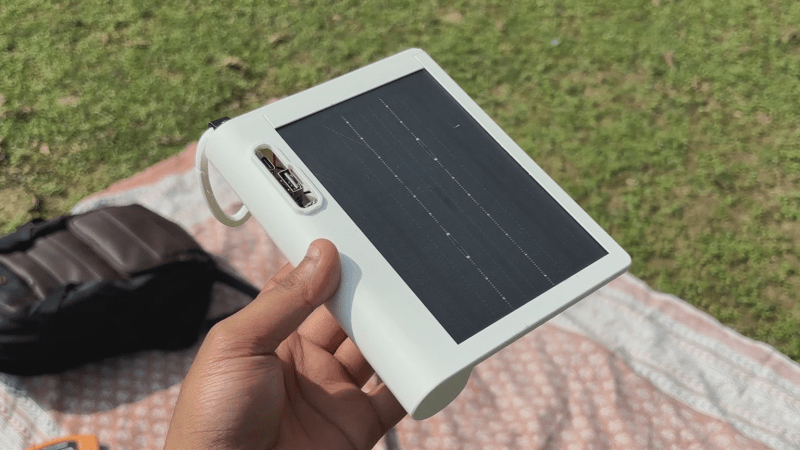
We’ve all had those times when your electrical device of choice is running low on battery. Sometimes you even plan ahead and are also carrying a battery pack, but what happens when you’ve forgotten to charge the battery pack? This is the problem that [Arnov Sharma] addressed with the SolMate, a portable solar panel that keeps a battery bank topped up.
The SolMate is built around an efficient 2 W photovoltaic panel that’s not much bigger than a cellphone. This panel can supply 5 V at 400 mA on a sunny day. The solar output is more than enough to keep the internal 2000 mAh battery topped up and ready for use. Charging the Li-ion battery is handled by an IP5306 power management chip, which pulls double duty: it safely regulates charging while boosting the battery’s 3.7 V to the 5 V expected at the USB charge ports. Speaking of charge ports, the SolMate includes both a USB-A and a USB-C port, plus a switch to enable or disable the unit.
The case is all 3D printed, with some clever design choices. Offsetting the bulk of the battery and PCB storage area to one side lets the SolMate naturally cant toward the sun. Even the clip used to attach it to a backpack is printed.
Be sure to check out the other entries into our latest challenge!













Honestly wish I knee about this challenege when it started. Would have worked on my solar powered Satnogs station.
Implemented 5306s in two of my weather stations about two or three years past. It tended to glitch output upon the removal of input power. Fixed it with a bigger ouput cap and a diode. There could also be issues with min loading. And regardless of whatever the the data sheet specs, it does not work too well > 50C and < 0.7A.
IP5306 : pretty cool chip. Low quiescent current, 10W charging, 10W USB power output. Looks good, at least on the datasheet. Thanks for the insight.
I wish one of these simple charging chips would allow you to DROP the charge termination voltage instead of increasing it in order to maximize calendar lifetime of the cell at the cost of a bit of capacity.
I mean, hell, are there any chemistries that can safely take 4.4v/cell? The highest I’ve seen is 4.35v/cell for some high-capacity chemistries used in mobile phones, and those had very poor calendar lifetime.
ok chalenge offgrid
working browser like firefox, chrome all day. 24h
working AI minimum 16B all day
Nice project. However, PLA would be fine for testing how the prints fit together, but, if he’s going to use it, as stated, outdoors, then I would think that ABS would have been a better choice of material.