Making The Fastest LEGO Technic Air-Powered Engine

Just because LEGO Technic is technically a toy doesn’t mean that you cannot do solid engineering with it, like building air-powered engines. After first building a simple air-powered piston engine, this time around [Jamie’s Brick Jams] sought to not only optimize the engine, but also build a clutch and something to power with said engine.

The four-piston design in radial configuration. (Credit: Jamie's Brick Jams, YouTube)
The four-piston design in radial configuration.

The piston head is one of the handful of 3D printed parts, with the new design featuring twin rubber o-rings as a seal instead of a single big one as in the old design. This incidentally matches the multiple seal rings on an internal combustion engine’s pistons, probably for similar blow-by related reasons. The air hose diameter was also increased from 2 to 3 mm to give the engine a larger volume of air to work with, which along with a new flywheel gave a lot more torque. Next the piston rod length was optimized.

The final radial 4-piston engine turns out to work pretty well, with the clutch engaging smoothly. This was used to drive a DIY generator that turned out to produce about 3 Watt of usable power in its final configuration at 6 V, though it’s admittedly a rather crude generator that could be further optimized. When trying a twin-piston configuration with the highest air pressure before air hoses began to pop off, it hit a dizzying 14,600 RPM.

These aren’t half bad results for some LEGO Technic together with some 3D printed bits, rubber o-rings and some lube.

Continue reading “Making The Fastest LEGO Technic Air-Powered Engine”
A Remote Controlled Air-Plane

The Air Hogs Sky Shark was a free-flying model airplane powered by compressed air. When it was released in the late ’90s, it was a fairly innovative toy featuring a strikingly novel compressed air engine made entirely out of injection molded plastic. Sales of these model planes took off, and landed on the neighbor’s roof, never to be seen again.

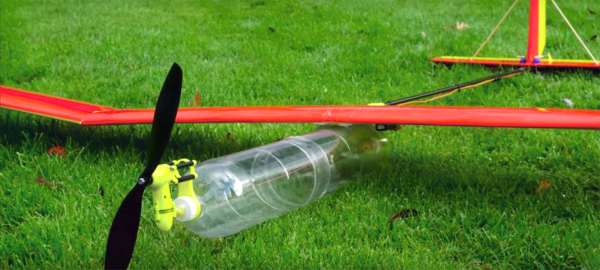
A few weeks ago, [Tom Stanton] revisited this novel little air-powered motor by creating his own 3D printed copy. Yes, it worked, and yes, it’s a very impressive 3D print. That build was just on a workbench, though, and to really test this air motor out, [Tom] used it to propel a remote-controlled plane through the air.

The motor used for this experiment is slightly modified from [Tom]’s original air-powered motor. The original motor used a standard 3-blade quadcopter prop, but the flightworthy build is using a much larger prop that swings a lot more air. This, with the addition of a new spring in the motor and a much larger air tank constructed out of plastic bottles results in a motor that’s not very heavy but can still swing a prop for tens of seconds. It’s not much, but it’s something.

The airframe for this experiment was constructed using [Tom]’s 3D printed wing ribs, a carbon fiber boom for the tail, and only rudder and elevator controls. After figuring out some CG issues — the motor doesn’t weigh much, and planes usually have big batteries in the nose — the plane flew remarkably well, albeit for a short amount of time.

Continue reading “A Remote Controlled Air-Plane”

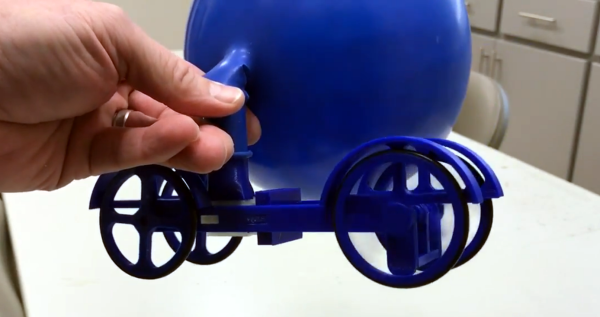
Toy Car Pumps The Wheels With Balloon Power

We’ve had our eye on [Greg Zumwalt]. He’s been working on some very clever 3D-printed mechanisms and his latest prototype is an air engine for a toy car. You can supply the air for the single cylinder with a compressor, or by blowing into it, but attaching an inflated balloon makes the system self-contained.

Last week we saw the prototype of the engine by itself, and wondered if this had enough power to drive a little train engine. We were almost right as here it is powering the front wheels of a little car.

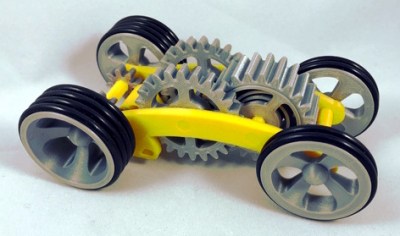
This isn’t [Greg’s] first rodeo. He’s been working on self-contained locomotion for a while now. Shown here is his spring-driven car which you pull backwards to load the spring. It’s a common feature in toys, and very neat to see with the included 3D-printed spring hidden inside of the widest gear.

That print looks spectacular, but the balloon-powered prototype tickles our fancy quite a bit more. Make sure you have your sound on when you watch the video after the break. It’s the chuga-chuga that puts this one over the top. [Greg] hasn’t yet posted files so you can print your own (it’s still a prototype) but browse the rest of his designs as you wait — they’re numerous and will bring an even bigger smile to your face. Remember that domino-laying LEGO bot [Matthias Wandel] built a few years back? [Greg] has a printable model for it!

Continue reading “Toy Car Pumps The Wheels With Balloon Power”

A Wooden Engine Powered By Compressed Air

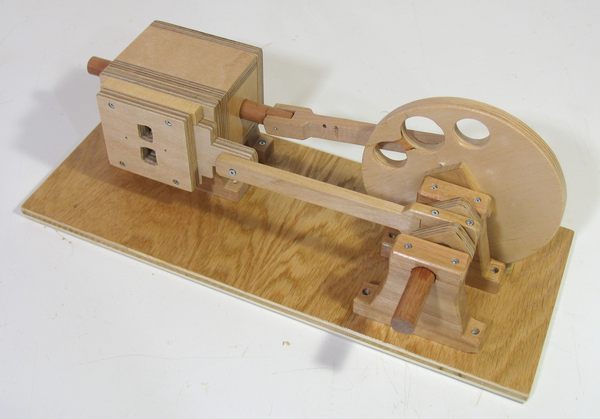
You may have seen an air powered engine at some point, but most are made out of some sort of metal. This engine, however, is made entirely out of wood (and fasteners). One might wonder how a design like this was conceived, but this may be explained by [Woodgears.ca’s] tagline: “An engineer’s approach to woodworking.”  It should also be noted that this is actually [Matthias’] sequel to  “Wooden Air Engine 1.

The engine itself is a neat device in that it uses power from compressed air (or suction from a vacuum cleaner) to make the piston and connecting rod cycle back and forth to spin a flywheel.  The other connecting rod is used to switch which side of the “clyinder” received air pressure (or vacuum).  A really neat mechanical assembly, and one that took a good amount of skill to make out of wood.  Check out the video after the break to see how it all works!

[youtube http://www.youtube.com/watch?v=ngb4SYR74m4&w=470&h=315%5D

If you’d like your woodworking to be more automatic, check out this post about how to set up a CNC router for your personal use.