
Full-Colour, Full-Motion Video – On An Audio Cassette!

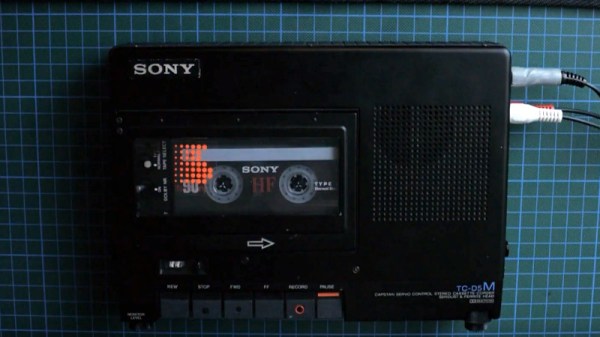
A lot of projects we feature use video in some form or other, but that video is invariably digital, it exists as a stream of numbers in a computer memory or storage, and is often compressed. For some of us who grew up working with composite video there is a slight regret that we rarely get up-close and personal with an analogue stream, so [Kris Slyka]’s project putting video on a conventional audio cassette is a rare opportunity.
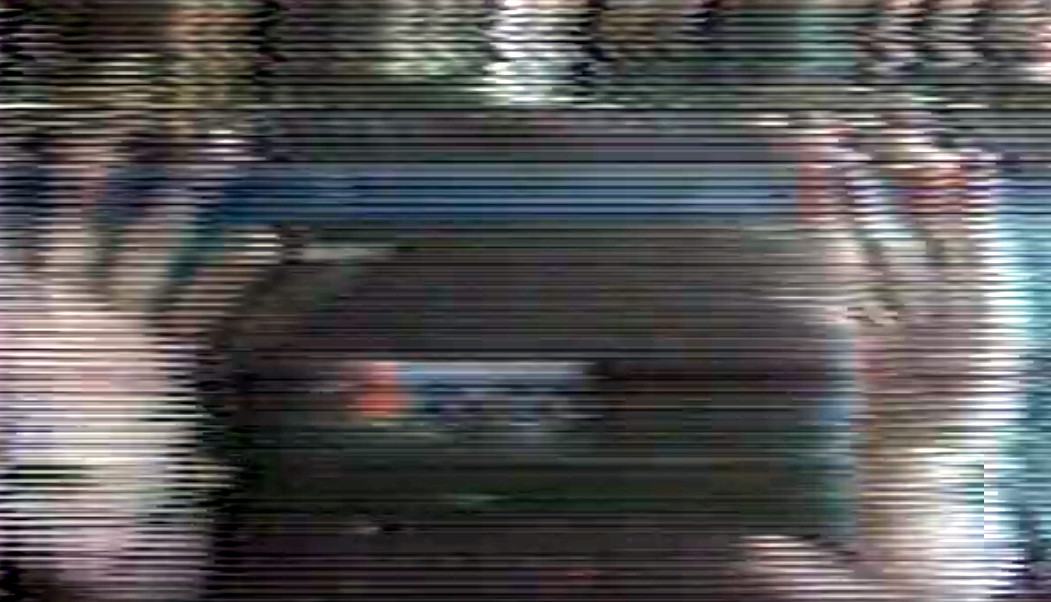
It's fair to say this isn't the highest quality video.
It’s fair to say this isn’t the highest quality video.

Readers with long memories may recall the Fisher-Price PixelVision toy from the late 1980s which recorded black-and-white video on a conventional cassette running at many times normal speed. This system does not take that tack, instead it decreases resolution and frame rate to a point at which it can be recorded at conventional cassette speeds. The result is not particularly high quality, but with luminance on one side of a stereo recording and chrominance on the other it does work.

The video below the break is a run through the system, with an explanation of how video signals work. Meanwhile the code for both encoder and decoder are available through the magic of GitHub. If you’re interested further, take a look at our examination of a video waveform.

Continue reading “Full-Colour, Full-Motion Video – On An Audio Cassette!” →
AV Synth Is Psychedelic Analog Mayhem

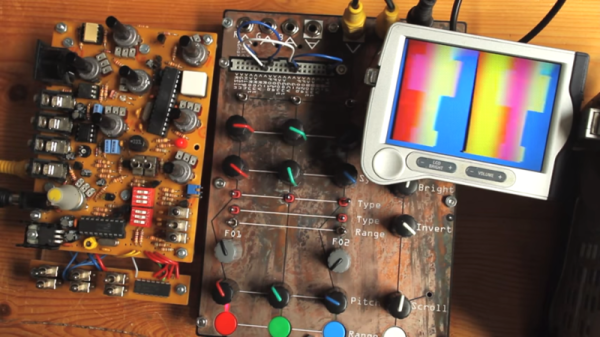
Digital video is cool and all, but it can’t compete with analog in terms of smooth, creamy glitches and distortion. [gieskes] has developed an analog audio-visual synthesizer that is a great example of the old-school retro visuals you can create with a handful of simple components.

Known as the 3TrinsRGB+1c, it’s available both assembled and in kit form. It’s probably best to start with the manual. Synthesis is achieved through the use of a HEF40106 hex inverting buffer – a cheap and readily available part that nonetheless provides for excellent results. Video can be switched between RGB oscillators and a series of inputs, and there are various controls to create those classic scrolling effects and other visual oddities.

Additionally, a series of connections to the underlying circuitry are broken out on a header connector. This allows for extra modules to be plugged in, and several designs are available to expand the unit’s capabilities.

Analog video isn’t used so much on a day-to-day basis anymore, but it’s a great technology to tinker and experiment with. We’ve seen some of [gieskes] experiments in this arena before, too – like this Arduino video sampler. Video after the break.

Continue reading “AV Synth Is Psychedelic Analog Mayhem” →








