Blow Your Mind With The Brainwave Disruptor

rich_decibles_brainwave_disruptor

Whether you believe in it or not, the science behind brainwave entrainment is incredibly intriguing. [Rich Decibels] became interested in the subject, and after doing some research, decided to build an entrainment device of his own.

If you are not familiar with the concept, brainwave entrainment theory suggests that low-frequency light and sound can be used to alter brain states, based on the assumption that the human brain will change its frequency to correspond to dominant external stimulus. [Rich’s] device is very similar to [Mitch Altman’s] “Brain Machine”, and uses both of these methods in an attempt to place the user in an altered state of mind.

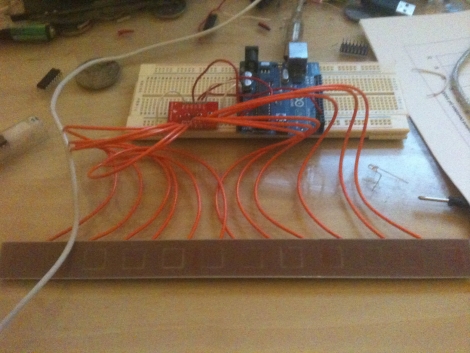
[Rich] installed a trio of LEDs into a set of goggles, wiring them along with a set of headphones to his laser-cut enclosure. Inside, the Brainwave Disruptor contains an Arduino, which is tasked with both generating light patterns as well as bit-banged audio streams.

Well, how does it work? [Rich] reports that it performs quite nicely, causing both visual and auditory hallucinations along with the complete loss of a sense of time. Sounds interesting enough to give it a try!

LAN-connected Washing Machine Lets You Know When Your Clothes Are Done

lan_connected_washing_machine_laundruino

[Micha’s] washing machine is equipped with a rather inaccurate timer, so it is always difficult to estimate when the load will be finished. Since it is located in his basement, he hated having to check on the machine continually to know when his clothes were done. Instead of hauling up and down the stairs over and over, he decided to hack in an “end of cycle” notifier of his own.

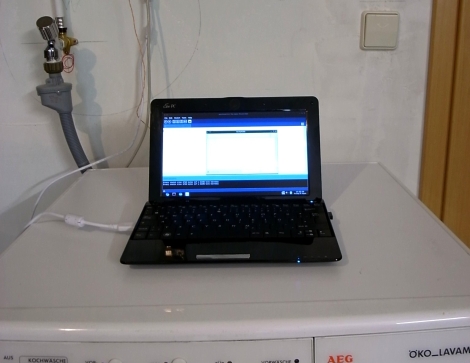
The washer has an LED that lights when it is finally done doing its thing, so [Micha] removed the LED and soldered in two wires, which he then connected to his Arduino. When the washer is finished and the LED should be lit, the Arduino senses that the input has been pulled low, signaling the end of the cycle. The Arduino was hooked into his home network via an Ethernet shield, enabling him to monitor the process from the comfort of the nearest web browser.

It’s a clever implementation, and it sure saves him a lot of time trudging up and down the stairs. Nice job!

Air Conditioner Regulation Using A Hobby Servo

automatic_mechanical_ac_control

For anyone that works in a large office building, odds are you know the pains of dealing with a poorly regulated HVAC system. [Robovergne] and his co-workers recently moved to a new location, and found that the air conditioning control was less than effective, leaving the office as hot as a sauna or as cold as a meat locker.

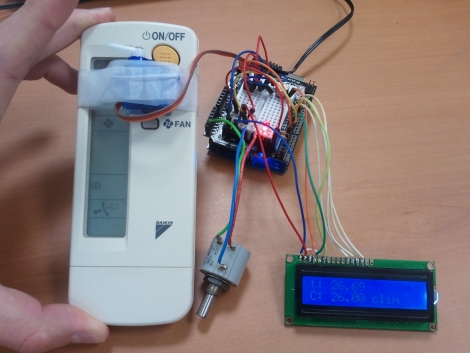
While they manually triggered the A/C on and off every half hour for a while, that grew tiring, so [Robovergne] decided to take things into his own hands. He had never used an Arduino before, and figured that regulating the air would be a great first project. He mounted a small hobby servo onto the front of the A/C remote, and wired a DS18B21 temperature probe to the Arduino. A small pot is used to adjust the temperature setpoints, which are displayed on the attached LCD screen. Now, when the temperature starts to rise, the Arduino triggers the servo to turn the air conditioning on without human interaction.

[Robovergne] says that while his solution is ugly, it works quite well. It definitely gets the job done, we can’t argue with that!

Continue reading to see a video of his automatic A/C controller in action.

Continue reading “Air Conditioner Regulation Using A Hobby Servo”

Come See What’s Cooking In The Arduino Kitchen

arduino_labs

The crew that brought you the Arduino is always hard at work trying to bring the community closer together and to foster collaborative development. They recently rolled out a new feature on their site that is sure to be of interest to Arduino veterans and neophytes alike.

Arduino Labs is a platform which the team plans on using as an incubator of sorts, for projects that are underway, but not fully baked. Currently, they have highlighted two in-progress initiatives, including the Arduino Mega ADK, as well as a GSM/GPRS shield that the team has been developing in collaboration with Telefonica I+D.

As of right now, the site looks to be a one-way information outlet for the Arduino team to the community, but they stress that their aim is to create a more open development process within the Arduino project. While there is no official statement on the matter, we hope that the site will eventually allow members of the community to offer both their feedback and lend manpower to forthcoming projects.

[via Adafruit blog]

Adding Ambilight Clone System To Your Home Theater Just Got A Big Price Cut

Whenever we get a tip claiming a project is cheap and easy we raise a cynical eyebrow. But [Yonsje] isn’t telling us a story, his Amiblight clone really does boil down the complexity and slash the price.

For the uninitiated, this is a clone of the Philips Amilight system that has been an option with some of their TVs over the years. It puts RGB LEDs on the back of the frame, pointed at the wall. They are tuned to the edge colors of the display, linking the color of the ambient light in the room to the colors on the screen. We’ve seen a ton of clones over the years, just search our blog for “Ambilight”.

Like the others, this iteration depends on you playing back video from a computer. [Yonsje] is using an Arduino with his own shield to connect to the HTPC. NPN transistors in the shield drive the RGB LEDs. The real cost savings is in his lighting source. A Deal Extreme RGB LED bar costs just $11.30 including shipping, and can be cut into six different segments for even spacing around your television. Check it out in the clip after the break.

Continue reading “Adding Ambilight Clone System To Your Home Theater Just Got A Big Price Cut”

Google ADK Clones Pack A Few Extra Features, Hopefully Far Cheaper Than The Original

adk_board_clone

[charliex] from Null Space Labs wrote in to share a project that he and the rest of the gang have been working on over the last few weeks. The team has been remixing and building clones of the Google ADK demo board we saw earlier this year, in hopes of getting a huge batch prepped before Defcon 19.

Their version makes subtle changes to the original, such as extra header rows for Mega AVRs, higher quality RGB LEDs, and a nifty pirate-Android logo. They also added the ability for the board to send and receive IR signals allowing it to be used as a TV-B-Gone, as well as in more fruitful pursuits. The Arduino board used with the ADK has only undergone minor revisions, most of which were layout related.

[charliex] hasn’t mentioned a price for their improved ADK boards, but we’re guessing they will be substantially cheaper than the official Google version. In the meantime, check out their site for a boatload of pictures and videos of these boards undergoing various stages of construction.

MIDI Air Drums Let You Play Anywhere

[Maayan Migdal] wrote in to share a really cool drum kit he constructed that has one special twist – no drums at all. Using a simple MIDI device and an Arduino, his “Air Drums” look pretty sweet.

The hack makes use of a pair of garden rakes, which serve as his drum sticks. The rakes were cut down and modified to allow the addition of accelerometers and some USB cables. The left stick contains a single accelerometer for registering hi-hat hits, while the right stick is armed with a pair of the modules, which are used to trigger snare and crash symbol strikes. He modified a pair of sandals to fit better while drumming before adding a sensor to each shoe. The left sandal contains an accelerometer to register bass drum hits, while the right shoe uses a light sensor to simulate the use of a hi-hat pedal.

We think that the results are awesome, but feel free to check out the video below to see what we mean. If Guitar Hero wasn’t dead in the water on hiatus, we think this sort of setup would make a great replacement for the flimsy drum set that comes with the game.

Continue reading “MIDI Air Drums Let You Play Anywhere”