Christmas Tree Low-water Monitor

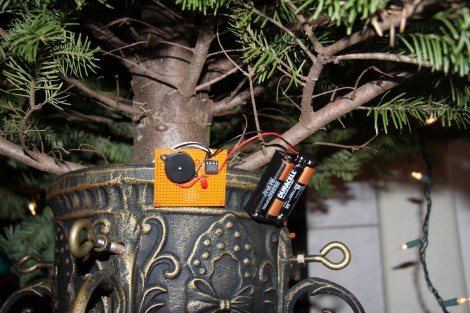
The end of the year is rapidly approaching and there’s a good chance you have a slowly dying tree in your living room. Help it hold on a little longer by using [Eric Ayars’] Christmas Tree water monitor. He’s built a sensor out of a piece of strip board. Three bus strips on the board allow for a variety of alerts. When all three are submerged everything is ok. When the two longer traces are still under water but the third is not an LED will blink to let you know it’s time. If you don’t pay attention and there’s no water left, a piezo buzzer makes noise until you add water (or the coin cell runs out of juice).

This project centers around an ATtiny85 that [Eric] programmed using an Arduino, one of the methods we covered in our AVR Programming Tutorial. But if this simple circuit isn’t high-tech enough for you, we saw a similar method last year that will send an alert to your iPhone.

Tiny USB Business Card

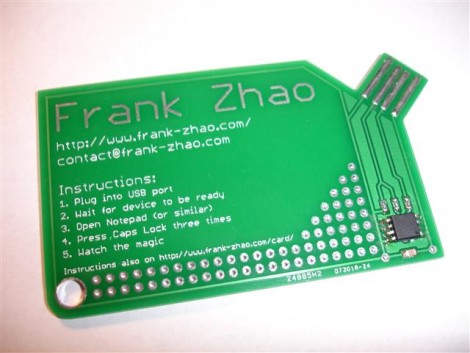
[Frank Zhao] put together a USB business card. It’s even got the instructions printed right on the silk screen of the PCB explaining how it should be used. He based the design around an AVR ATtiny85 microcontroller. It runs the V-USB package that handles USB identification and communication protocols. The rest of the hardware is pretty standard, the uC draws power from the 5V USB rail, with a couple of 3.6V Zener diodes to drop the two data lines down to the proper level.

Once plugged in it waits until it detects three caps lock keypresses in a row, then spews a string of its own keypresses that type out [Frank’s] contact information in a text editor window (video after the break). It’s not as reusable as the mass storage business card because [Frank] didn’t breakout the pins on controller. But we still enjoy seeing business cards that make you stand out.

This is a great project to tackle with your newly acquired AVR programming skills.

Continue reading “Tiny USB Business Card”

World Smallest TV-B-Gone

uTVBG

The TV-B-Gone has proven to be a dangerous and versatile gadget. At Interactive Matter, they created an even smaller version with more sneaking potential. Called the µTVBG, it packs an entire TV-B-Gone in a 1.4 x 2.5 cm footprint and even has room for a programming header. He found some high-powered surface-mount IR LEDs that would match the original TV-B-Gone’s power. To drive the board, they used a CR1220 button battery on the bottom of the board. The whole thing is smaller than your thumb and should be easier to hide next time you wreak havoc.

AVR RFID Tag

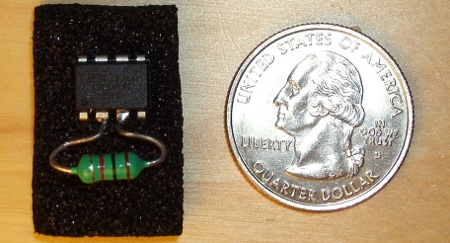
[pc486] sent in his hack that uses an ATtiny85 to act like an EM4102, a chip used for RFID tags. Minimally, all that is needed is the AVR and a coil, but he recommends some filtering capacitors. Depending on the size of the coil, different frequencies and ranges can be achieved. This project actually includes several hacks, such as using the coil for not only power, but a clock signal. The coil is actually able to power the chip without being connected to the power pins due to clamping diodes on the connected pins. The firmware is short but available on subversion.

Related: Scratch-built RFID tags